
High-altitude descents from the Wasatch Mountains induce rapid thermal transfer, pushing brake fluid past its boiling point. At 8,000 feet, atmospheric pressure changes accelerate fluid vaporization. Maximum braking safety requires high-density rotors to act as a heat sink, preventing mountain-induced thermal soak from vaporizing the hydraulic fluid.
Why your pedal softens descending Big Cottonwood Canyon
I am pulling the wheels off a BMW that just came down from Brighton Resort. The driver complained of a sinking pedal near the mouth of the canyon by La Caille. I pull a sample of the brake fluid into my tester to confirm the thermal breakdown. The copper content is high and the moisture level sits at 3%, indicating the fluid is chemically exhausted.
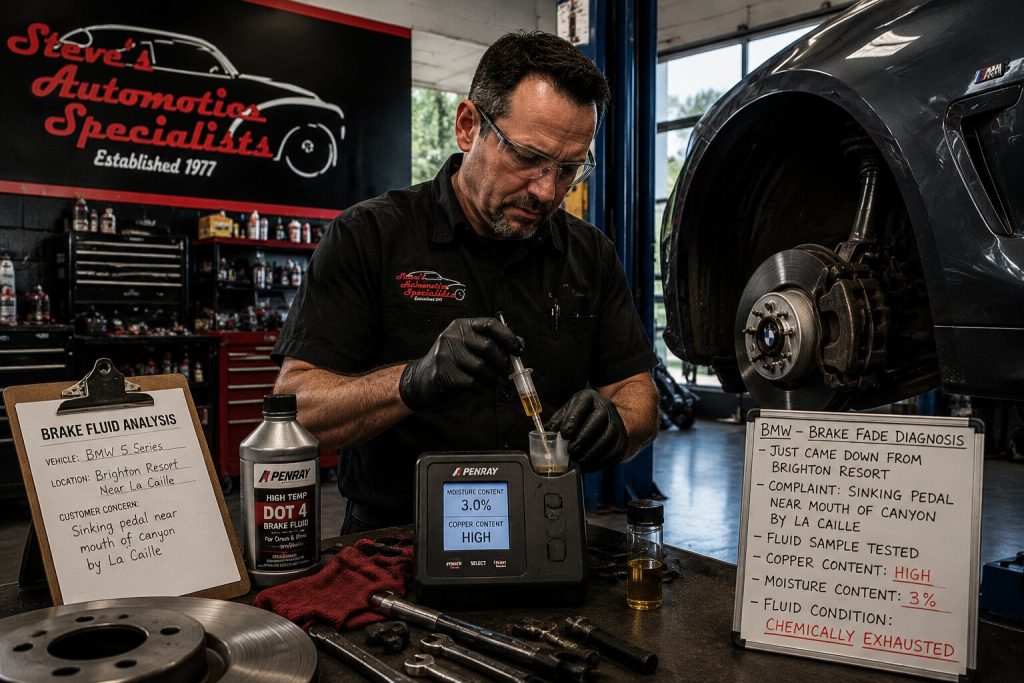
The 155°C vapor lock threshold
Brake fluid is hygroscopic. It drinks moisture from the humid May snowmelt air through the rubber flex-lines. New DOT 4 fluid boils at 230°C. With 3% water, that boiling point collapses to 155°C. As this car descended from Guardsman Pass, the rotors hit 400°C. That heat soaked into the calipers and turned the water in the fluid into steam. I can feel the result in the bleeders. Steam is compressible; brake fluid is not. When you hit the pedal and it feels like stepping on a wet sponge, you are not moving pistons. You are just compressing bubbles of water vapor. At the 8,000ft elevation of the Wasatch peaks, the atmospheric pressure is only 10.9 PSI. This lower pressure allows those steam bubbles to form even faster than they would in Sandy.
Rotor mass versus Wasatch Boulevard heat soak
I put my micrometer on the front rotors. They measure 28.4mm. The discard limit stamped on the hub is 28.0mm. These rotors meet legal standards but lack the thermal density needed for steep Utah canyon descents.
Why thin rotors warp during May snowmelt runs
A rotor is a heat sink. It exists to turn kinetic energy into thermal energy and then shed it. Descending a 6% grade at 45 MPH in a 4,000lb SUV generates 1,200 Kilojoules of heat every minute. This rotor has lost 2mm of steel from years of friction. That missing mass means the rotor reaches its thermal ceiling instantly. During the descent, the rotor cannot dissipate the heat fast enough. I see the blueing of the steel. I see the heat spots. 400°C rotors contracting unevenly from cold snowmelt runoff on Wasatch Boulevard will cause immediate structural warping. Now, there is a lateral runout of .005 inches. I can feel the steering wheel shudder in my hands during the test drive. It is a mechanical vibration born from thermal exhaustion.
Managing hydraulic pressure on the UT-210 “S” curves
I am looking at the diagnostic data on the scanner. There are no fault codes, but the Brake Fade Compensation logs show active intervention. This proves the vehicle has been fighting hydraulic loss long before the driver realized there was a safety issue.
How Brake Fade Compensation masks mechanical failure
Audi and BMW Brake Fade Compensation logic utilizes the ABS pump to artificially maintain line pressure as fluid temperature climbs. The ABS pump provides extra hydraulic assist when the system detects the car is not slowing at the programmed rate. It hides the fade. You think the brakes are fine because the car is stopping, but the fluid behind the scenes is screaming toward a total boil. By the time the software can no longer compensate, the pedal goes to the floor without warning. Neglected brake systems cannot handle the high-cycle thermal loads required to navigate the Storm Mountain “S” curves safely. The car is lying to you until it is too late.
Forensic brake analysis at Steve’s Automotive Specialist
I pull the slide pins from the calipers. They are coated in a gritty, grey paste. This is a mix of lithium grease and magnesium chloride runoff from the canyon floor that has bypassed the rubber seals.
Measuring fluid copper content and rotor runout
The pins are seizing. This caused the inboard pad to do 70% of the work while the outboard pad stayed cold. This uneven loading creates a taper in the pad material. I am cleaning the brackets and applying high-temp synthetic lubricant. I torque the new bleeder screws to 8Nm and perform a full pressurized flush.
My boiling point tester just flashed a final reading of 320°F for the old fluid. That is the smoking gun. In the laboratory environment of a flat Sandy road, this car stops. On a May afternoon descending from the Wasatch peaks, this fluid is a liability. The combination of low atmospheric pressure and high thermal load has compromised the hydraulic integrity. Installing high-carbon rotors provides the necessary mass to absorb the massive energy of a Brighton descent without warping.
If your brake pedal felt unusually long or ‘spongy’ at the mouth of Big Cottonwood Canyon today, your fluid has likely crossed the vapor lock threshold. Contact Steve’s Automotive Specialist in 9245 S 700 E, Sandy, UT 84070 for a digital boiling point test and a high-temp pressurized flush.
Frequently Asked Questions
Does high altitude affect my brakes?
Yes. Lower atmospheric pressure at 8,000 feet causes air-contaminated brake fluid to expand and vaporize at lower temperatures than at sea level. This leads to a spongy pedal and reduced stopping power during the long descents characteristic of the Wasatch Mountain range.
Why do my brakes smell after driving down Little Cottonwood Canyon?
The smell indicates your brake pads have reached their thermal outgassing point. As resins in the pad material overheat, they turn into gas, creating a thin layer between the pad and rotor. This reduces friction and is a precursor to total brake fade.
Can I use standard DOT 3 fluid for canyon driving?
No. Most European vehicles and mountain-driven cars require DOT 4 or high-temp LV fluid. DOT 3 has a lower boiling point and will fail much faster under the intense heat generated by descending steep grades like those found near Brighton or Solitude.
Why is rotor thickness important for mountain safety?
Rotors act as heat sinks. A thin rotor has less mass to absorb the energy generated by braking. When descending Wasatch grades, a thin rotor will overheat rapidly, leading to structural warping, steering wheel vibration, and decreased hydraulic efficiency.