
Monitoring real-time wheel speed data is essential for identifying intermittent electrical faults. By analyzing high-frequency digital signal packets during dynamic driving, technicians can pinpoint resistance-driven dropouts caused by salt-induced corrosion. This precise diagnostic approach differentiates between logical sensor noise and actual circuit failure, ensuring effective repairs in harsh environments.
Why ABS Signals Fail on Utah Roads
Modern anti-lock braking systems rely on active Hall-effect sensors that transmit digital pulses to the Electronic Stability Control unit. In the high-vibration environment of Utah, specifically during freeze-thaw cycles, Magnesium Chloride brine penetrates harness weather seals. This creates microscopic conductive bridges within connectors, leading to signal degradation that manifests as intermittent wheel lockup codes.
The module mistakes these momentary signal interruptions for a loss of traction, leading to unwarranted hydraulic pressure modulation or the complete deactivation of stability control during high-stakes mountain driving. This constant exposure to road salt transforms a vehicle’s electrical system into a battleground where moisture and electricity fight for dominance.
The Diagnostic Reality of Modern Sensors
Static resistance checks are fundamentally ill-equipped to detect the dynamic high-resistance faults that only materialize when vehicle movement and extreme thermal fluctuations stress the electrical harness. In Utah’s harsh environment, road salt corrodes connector pins, creating signal jitter that only appears during active driving conditions.
Consequently, a perfectly functional sensor is often incorrectly replaced for a failure that actually lies within a compromised wiring harness. By moving beyond static testing, we can identify these connection-based signal dropouts that the standard diagnostic path frequently overlooks.
Brine and the Hidden Electrical Fault
Salt spray atomizes into a fine mist that coats the chassis, infiltrating electrical connectors to create microscopic conductive pathways. When moisture from slush-filled roads migrates into these connections, it induces high-resistance corrosion that triggers erratic signal noise. Even though the circuit remains physically complete, the ABS module detects these millisecond-long frequency disruptions as illogical data. Consequently, the module logs a rationality fault and defaults to a safe mode, effectively disabling traction control to protect the system from what it perceives as an impossible speed discrepancy.
Troubleshooting the Signal with Precision
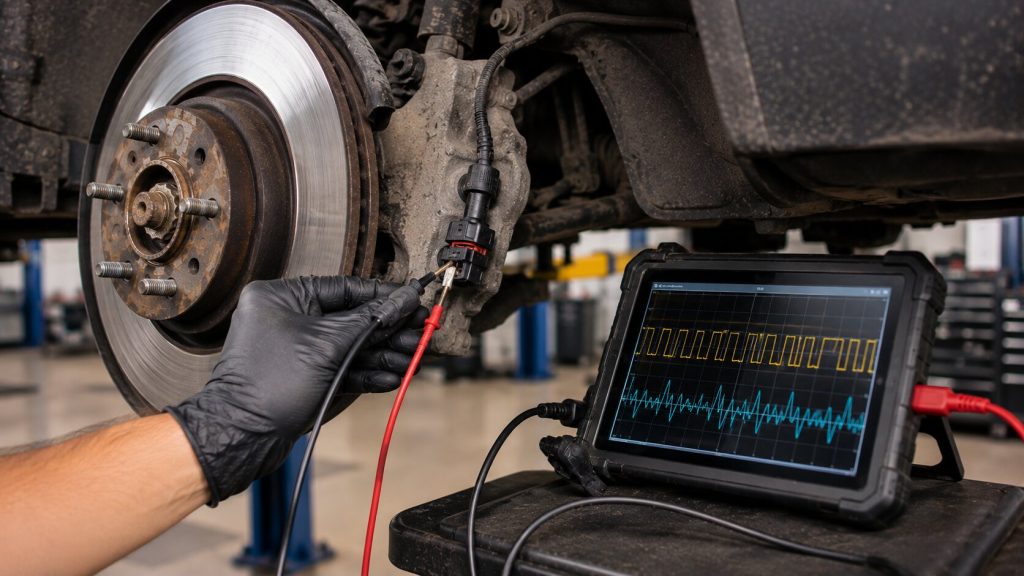
To find the root cause, you must move beyond the basic scan tool. We connect a PicoScope directly to the sensor harness while the vehicle is in motion. We are looking for signal integrity across the entire frequency range. You will see the crisp square wave of a healthy sensor suddenly jitter or collapse as the vehicle hits a road seam. That specific moment of distortion, often lasting less than 500 milliseconds, is the smoking gun. It is not the sensor failing; it is the physical connection fighting against a layer of conductive road salt.
By capturing the waveform, we differentiate between an actual sensor output failure and a harness-side voltage drop. It is this level of detail that separates a guess from a fix, ensuring we address the corrosion, not just the symptom.
Mechanical Struggle in the Salt Lake Commute
Navigating Salt Lake City’s stop-and-go winter traffic demands consistent data, but brine-compromised wiring often fails to deliver a clean square wave during braking. This electrical instability forces the ABS pump to engage unnecessarily, causing the pedal to pulse with rhythmic, grinding feedback. Since the failure is contingent upon a damp and vibrating chassis, the electrical circuit will consistently test as perfectly healthy while the vehicle sits stationary on a dry shop floor. Without an oscilloscope to capture the signal dropout, technicians are left guessing at a mechanical failure when the root cause is purely electrical.
Contrasting Communication Protocols
Modern vehicles utilize complex communication protocols such as CAN bus or LIN bus to relay wheel speed data. Unlike the old-school inductive sensors that sent a simple analog sine wave, today’s active sensors send a digital current signal. This means the ABS module is not just looking for voltage; it is looking for specific packetized data. If the signal is noisy, the module can’t parse the packets. This is why resistance checks fail.
The wire might have continuity, but it does not have signal integrity. The brine creates a noisy path, and the high-frequency digital pulses get lost or corrupted. This is a critical distinction for modern technicians. A technician using a standard multimeter sees good continuity and concludes the circuit is fine, but the oscilloscope shows the signal is actually too noisy to be read by the ABS module.
Managing Ghost Faults from Salted Roads
The factory manual for many modern SUVs suggests checking for open or shorted circuits. This implies a binary, all-or-nothing failure state. However, the shop floor reality is far more nuanced. We frequently encounter intermittent high-resistance states. These are the ghost faults that pop up after a week of driving on salted roads and then disappear after a car wash. The manual never accounts for the way Magnesium Chloride acts as an electrolyte in a connector. Standard manuals fail to address the physics of salt-induced conductivity, which only compromises the circuit when simultaneous vibrations and active sensor polling occur under wet conditions.
Forensic Diagnostics for Reliable Performance
I confirm the root cause by capturing a waveform that shows a signal dropout precisely synchronized with physical vibration or connector movement. Detecting these millisecond-long disturbances gives me the clarity to move beyond superficial code clearing and instead provide the precise harness maintenance necessary to ensure vehicle reliability during high-altitude travel. Every diagnostic I perform is a forensic exercise, mapping the digital behavior of the car against the physical environment it travels through.
If persistent safety system warnings are interrupting your drive, reach out to Steve’s Automotive Specialist in 2809 S 2300 E, Salt Lake City, UT 84109 for a professional diagnostic evaluation to get your vehicle back to reliable performance.
Frequently Asked Questions
Are intermittent ABS faults usually caused by the module itself?
No. Intermittent ABS faults are rarely caused by the internal failure of the ABS control module. Environmental factors, most frequently salt-induced connector corrosion, frayed sensor wiring, or debris buildup on the pulse ring, account for the vast majority of these system warnings.
Does a scan tool show a code for a sensor that was just replaced?
Yes. Most of these faults stem from corroded connectors or wiring, not the sensor itself. Salt-induced corrosion in the connector pins creates high resistance, which causes the new sensor to send an erratic or weak signal that the module interprets as a failure.
Does washing a car prevent ABS sensor failures?
Yes. Regular undercarriage washing during the winter months significantly reduces the risk of electrical failure. Removing Magnesium Chloride brine prevents the chemical from reaching and penetrating the electrical connectors of the ABS system, which is the primary driver of connector corrosion and subsequent signal degradation.
Is there a difference between a rationality fault and a circuit fault?
Yes. The difference lies in the signal validity. A circuit fault means the module detects an electrical open or short, indicating a broken wire. A rationality fault means the sensor is sending data, but the module determines it is illogical compared to the data from the other wheels.
Can an ABS sensor be diagnosed with a basic multimeter?
No. A multimeter is insufficient for diagnosing modern, active ABS sensors. These sensors output a complex digital frequency signal rather than a simple voltage change. An oscilloscope is required to visualize the signal in real-time and identify intermittent dropouts that occur under driving vibrations.