
Proactive maintenance at 25,000-mile intervals prevents long-term engine damage caused by chronic thermal cycling and chemical degradation.
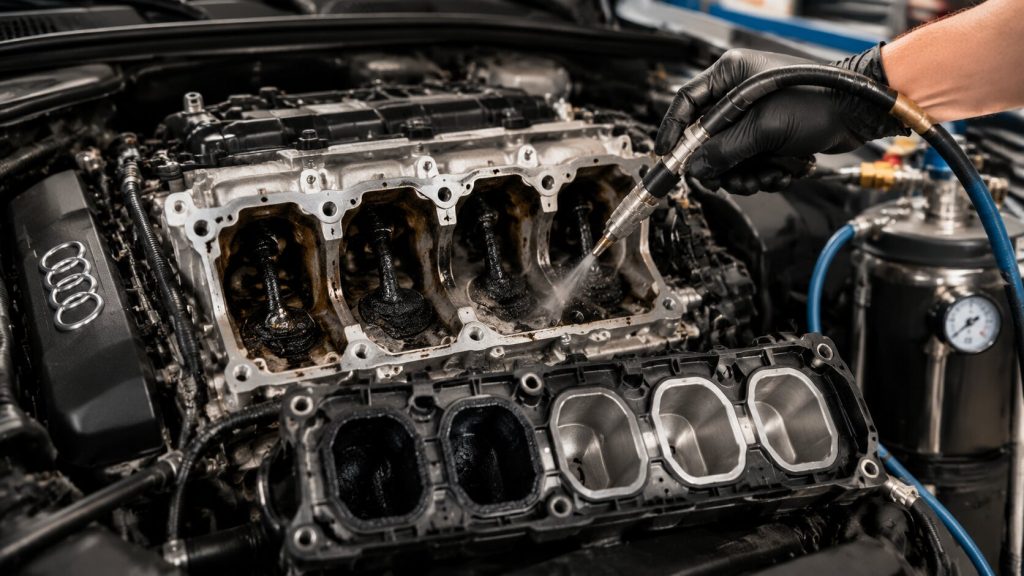
Thin air at 4500 feet and above in the Wasatch Range forces my Audi GDI engines to run richer fuel trims to compensate for lower oxygen density. This chronic over-fueling combined with recirculated oil vapors from the PCV system creates a rapid, baked-on carbon shell on intake valves that standard 40k mile service intervals fail to prevent.
The Physics of GDI Valve Coking
Direct Injection engines bypass the cleaning benefit of fuel washing over the back of the intake valves. Under normal sea level conditions, I find this manageable through standard crankcase ventilation. At high elevation, the reduced ambient air density shifts the combustion balance. The ECU senses reduced oxygen density and widens injector pulse width to preserve the stoichiometric air-fuel target.
Extended periods of this richer mixture lead to higher levels of unburnt hydrocarbons and localized heat-soaking within the cylinder head. These vapors circulate back through the PCV system and adhere to the intake valves. While port-injected systems utilize fuel to dissipate heat, the dry intake valves here reach temperatures sufficient to bake oil residues into a hardened carbon shell. This crust does not just sit there. It disrupts the air charge tumble effect, causing laminar flow separation. The result is a restricted intake port that chokes the engine of the very oxygen it already struggles to gather at altitude.
Diagnostic Protocol for Early Detection
Waiting for a check engine light often means the buildup is already thick enough to cause power loss and permanent injector spray pattern interference. I employ a rigorous diagnostic approach to catch these deposits before they compromise compression.
- Perform a cold-start vacuum leak check to verify trim levels.
- Remove the intake manifold or upper plenum access port.
- Insert a high-resolution borescope to inspect the back of the intake valves.
- Compare mass airflow readings at idle against known clean-engine baselines.
Addressing Mountain Climate Degradation
Driving from the Salt Lake valley floor up into the canyons introduces extreme thermal cycling. The rapid change in ambient temperature causes the aluminum intake manifold and the steel valve components to expand and contract at different rates. This thermal movement cracks brittle carbon deposits. These shards break loose and get ingested into the combustion chamber.
While small, these carbon particles are extremely abrasive. They act as a lapping compound on the cylinder walls and piston rings. Over time, this leads to ring land wear and oil consumption. When I drive an Audi in Utah, I am not just fighting the altitude. I am fighting a constant cycle of chemical and thermal stress.
Proactive Valve Maintenance
Corporate service intervals ignore the 4,500ft reality of our valley. They rarely account for the regional reality of living at 4500 feet or the impact of canyon driving. I utilize a walnut shell blasting process that physically removes the carbon without damaging the valve surface or seat.
I remove the intake manifold to gain direct access. I then seal each cylinder individually to prevent debris from entering the combustion chamber. By pneumatically projecting organic walnut media at the intake tract, I effectively descaled the accumulated carbon while maintaining the integrity of the valve seats. This process restores the factory air-flow characteristics. Neglecting this buildup leads to compromised fuel economy and can eventually trigger catastrophic misfires that require head removal.
Expert Service for Audi Performance
The risk of ignoring valve coking is not just a rough idle. Ignoring this kills compression and fries ignition coils struggling to jump a fouled air gap. Do not wait for a major performance loss or a constant dash warning light. Contact Steve’s Automotive Specialist at 2809 South 2300 East, Salt Lake City, UT 84109 to book your Audi carbon cleaning service and restore your engine to peak factory performance.
Frequently Asked Questions
Why does my Audi perform worse at high altitude?
Oxygen density loss. The engine management system compensates for thinner mountain air by extending fuel injector pulse widths, which inadvertently increases unburnt hydrocarbon deposits on intake valves.
How often should I perform carbon cleaning in Utah?
Every 25,000 miles. I recommend a borescope inspection at this interval to verify if current carbon thickness exceeds the 2mm threshold before it impacts your cylinder compression.
Can fuel additives prevent valve carbon buildup?
No. Because TFSI engines inject fuel directly into the combustion chamber, no additive can reach or clean the back of the intake valves where the carbon crust forms.
Is walnut blasting safe for my cylinder head?
Yes. When performed with precision, the crushed walnut media is soft enough to abrade carbon without marring the base aluminum or steel surfaces of the intake port.