
Rapid elevation changes between Orem and local mountain passes cause extreme barometric pressure fluctuations in Audi air suspension systems. This thermal stress degrades desiccant effectiveness and leads to trapped moisture freezing inside the valve block. Diagnostics must focus on pressure decay rates and electrical voltage drop testing to prevent total compressor failure.
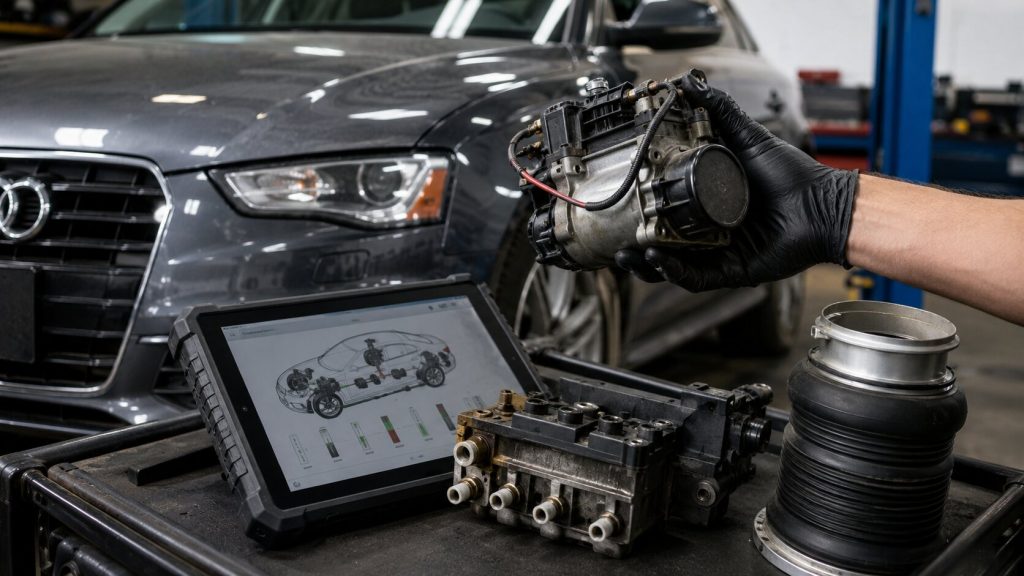
Driving steep Orem mountain passes stresses luxury vehicle suspension and performance. If you drive an Audi equipped with adaptive air suspension like I do, you might have already encountered stubborn dashboard fault codes or a sudden drop in ride height after a trip up Provo Canyon.
In my experience, these suspension issues are rarely random. Rapid barometric pressure drops, combined with local humidity and dramatic temperature swings, create the perfect storm for moisture accumulation, valve freezing, and catastrophic compressor failure. Figuring out why these systems fail under pressure is the only way to keep from buying a second compressor next winter. Here is how these systems choke out in the canyons, how I test the pressure drop on the bench, and what you actually need to fix it.
The Direct Impact of Orem Elevation Shifts on Audi Air Bellows
Driving from the Orem valley floor up the Alpine Loop pushes Audi air systems past their thermal and pressure limits. This triggers persistent suspension fault codes on early C7 and D4 chassis platforms.
Factory diagnostic equipment often misinterprets these transient pressure spikes as simple compressor fatigue when the true root cause is trapped particulate moisture freezing inside the valve block during high-altitude thermal drops.
Barometric Physics During Provo Canyon Ascents
Atmospheric pressure drops steadily as a vehicle climbs toward high-altitude destinations like Sundance Resort. Audi pneumatic systems rely on the G291 pressure sensor to monitor the internal reservoir and the individual strut chambers. The suspension control module vents excess pressure when dropping barometric levels cause internal compressed air to expand.
Locally, rapid canyon carving forces the N111 discharge valve to actuate hundreds of times within a tight driving window. When micro-debris clogs the exhaust port, internal valves fail to keep up with expansion, creating a high-pressure bottleneck against the thin outside atmosphere.
Thermal Expansion and Contraction in Rubber Bellows
Temperature swings heavily compound the mechanical stress of barometric changes. A valley floor baking in 90° heat transitions to 50° mountain air within thirty minutes. Rubber polymers subjected to rapid thermal contraction lose their pliancy, leading to several key failure points:
- Delamination: Accelerated breakdown occurs exactly where the crimp ring seals the synthetic elastomer against the lower aluminum shock body.
- Embrittlement: The rubber becomes brittle and loses flexibility at the fold layer.
- Micro-fissures: Small cracks in the internal cord matrix let high-pressure air leak out and bubble beneath the outer dust sleeve, causing the strut to slowly flatten overnight.
Moisture Accumulation and Component Degradation
Audi adaptive air suspension systems operate via a closed or semi-open loop design utilizing an electromechanical compressor, a desiccant drying canister, an aluminum valve block, and four reinforced elastomer air springs. Utah summer storm cycles and heavy winter moisture introduce severe atmospheric challenges to this architecture.
Desiccant Saturation and Galvanic Corrosion
As humid air is pulled into the pneumatic intake during heavy valley downpours, the silica gel desiccant canister absorbs baseline humidity. Continuous daily operation in high humidity rapidly consumes this finite capacity. Frequent mountain climbing superheats the compressor pump assembly, forcing bound moisture out of the saturated desiccant bed and directly into the valve block manifolds as steam that condenses into liquid water inside the lines.
This moisture causes immediate electrochemical pitting on internal brass solenoid valve seats. Dissimilar metals exposed to an electrolyte like dirty condensation trigger aggressive galvanic corrosion along the aluminum housing threads. Nighttime drops in temperature cause trapped moisture to freeze solid inside tiny exhaust ports, locking the pressure relief valve open. The compressor then attempts to fill a system venting straight to the atmosphere, running without resistance until motor windings overheat and thermal protection circuits kill power.
Compressor Heat-Sinking and Motor Cavitation
A saturated desiccant system forces the electromechanical compressor to work beyond its engineered duty cycle. When liquid water replaces compressible air, fluid dynamics change drastically. The pump attempts to compress unyielding water droplets trapped in the cylinder head, introducing severe mechanical cavitation along the piston cylinder walls. The resulting friction generates extreme heat that destroys the Teflon piston ring and warps the cylinder head mating surface, causing complete pneumatic failure.
Advanced Diagnostic Procedures
Catching Audi air suspension degradation early requires moving beyond basic fault code reading. True diagnostics demand rigorous isolation of the pneumatic circuit using factory-level interface tools and physical load testing.
Real-Time Data Logging and Pressure Decay Testing
First, connect the factory VAG-COM interface to log real-time pressure generation rates during a manual relay activation test. A healthy compressor must ramp from baseline atmospheric pressure to operating specs within twenty seconds. If output lags, the compressor piston ring is likely suffering from thermal scoring.
Second, isolate individual air struts by performing a static hold test. Drop the vehicle into lift mode, clamp off pneumatic supply lines using specialized soft-jaw pinch pliers, and monitor pressure decay over a twelve-hour parking cycle. Weighing the desiccant drying canister provides further insight: any weight gain exceeding ten percent over factory dry specification indicates complete desiccant breakdown.
Electrical Circuit Assessment and Voltage Drop Analysis
Mechanical failures inevitably cause electrical strain. A struggling compressor motor draws excessive amperage, overheating the J403 compressor relay contacts. Performing a rigorous voltage drop test across the relay and main power supply harness is mandatory:
- Access the primary fuse panel and remove the heavy-duty compressor relay.
- Command the compressor on via diagnostic software.
- Measure voltage at the load pin relative to battery ground.
A voltage drop exceeding 0.5 volts indicates carbon tracking on the relay contacts or high resistance in the wiring harness. Replacing a burned-out compressor without testing the circuit guarantees a repeat failure.
Proactive Maintenance Interventions
Running German air suspension through Utah’s brutal temperature swings means you can’t wait for a total blowout before you look at the logs. A sagging suspension corner or an overheating compressor requires immediate isolation testing before the electrical harness melts or the valve block fractures completely.
Bring your vehicle to Steve’s Automotive Specialist at 925 N State St, Orem, UT 84057 for expert diagnostics tailored to local driving conditions to secure a precise repair.
Frequently Asked Questions
Will a simple software reset fix my Audi air suspension pressure warning?
No, clearing soft fault codes via a diagnostic scan only temporarily restores ride height functionality if the trigger was a transient barometric glitch. The warning will return because underlying physical issues like saturated desiccant or micro-leaks remain entirely unresolved.
Can I drive my Audi with a sagging air suspension strut?
No, driving on a completely deflated air spring forces the compressor to run continuously and causes permanent thermal burnout of the internal electric motor. It also overloads the remaining healthy suspension corners and damages adjacent control arms.
Is moisture accumulation inside the air compressor normal in Utah climates?
Yes, severe summer storm humidity combined with rapid altitude shifts continuously creates condensation inside sealed pneumatic lines. Regular inspection and replacement of the drying canister prevent this moisture from freezing or corroding internal brass components.
Should I replace the suspension relay when installing a new compressor?
Yes, a failing compressor draws excessive amperage that scorches internal contacts of the power relay and degrades its reliability. Installing a new pump on a damaged electrical circuit guarantees poor performance and high risk of immediate repeat failure.