
Audi Virtual Cockpit blackouts often stem from thermal stress rather than permanent hardware failure. In high-heat climates like Sandy, Utah, extreme cabin temperatures cause fiber-optic bus expansion and cooling fan degradation. Monitoring the MOST bus and cooling fan performance enables early identification of thermal stress, which protects electronics from the risks of cascading system failure.
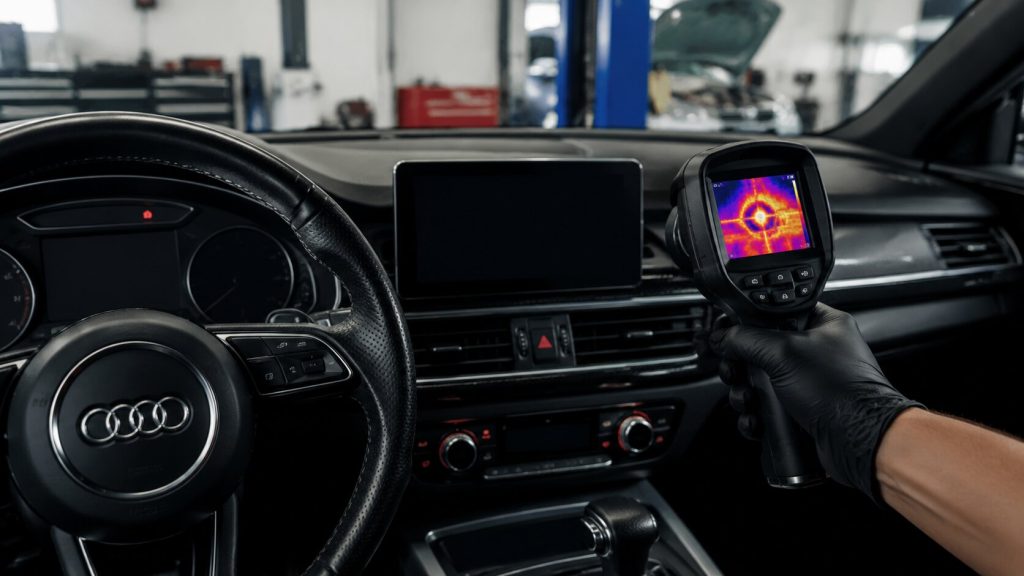
I have found that the Audi Virtual Cockpit is susceptible to persistent MMI blackouts under the stress of 100-degree heat cycles here in the Sandy, Utah valley. My diagnostics reveal that when the cooling fan fails in these older vehicles, the resulting heat soak forces the high-speed fiber-optic bus loops to expand past their strict mechanical tolerances.
Assessment of Thermal MMI Degradation
Under normal conditions, I see the rear-mounted ventilation fans pull air across the heat sinks attached to the MMI processing unit. Sandy motorists frequently encounter heavy traffic on the I-15 corridor, where extended idling prevents airflow through the front grille. This lack of movement triggers a heat-soaking effect.
The internal temperature rises, causing the solder joints and fiber-optic connectors to expand. When the expansion passes specific thresholds, the light signal passing through the MOST bus loops becomes inconsistent. The data stream drops, leading to a complete display failure. The components do not necessarily melt, but they lose the precise physical contact required for high-speed data transfer. The result is a system crash that I find resets only after the cabin reaches a cooler, more stable temperature.
Fiber Optic Sensitivity
Fiber-optic cables rely on precise alignment to maintain signal integrity. In the Audi MMI system, these cables transmit data between the instrument cluster, navigation module, and media controller. When the cabin temperature spikes, I observe the plastic housings surrounding these connections expanding at a different rate than the optical glass. This physical movement induces micro-fractures in the light path, causing the system to lose its heartbeat signal.
Component Heat Soaking
The MMI processor generates significant heat while running high-resolution graphics for the navigation and instrument cluster. At Sandy’s altitude, the air is thin. The MMI fan has to spin 15% faster than at sea level to move the same mass of air. When these fans get choked with local dust, they don’t just slow down; they draw excess current, triggering the thermal brownout. If the fan performance lags, I see the processor hit a thermal throttle point, cutting power to non-essential components, starting with the display, to protect the main board from permanent damage.
Diagnostic Workflow for Virtual Cockpit Errors
Identifying this issue requires more than scanning for generic OBD-II codes. A standard scanner often misses the nuance of thermal-related bus communication errors. I follow this strict protocol to isolate the fault.
- Connect a VCDS diagnostic tool to the OBD-II port while the engine is running and the cabin is heat-soaked.
- Monitor block 07 Control Head for intermittent data bus interruptions.
- Use a thermal imaging gun to measure the external housing temperature of the MMI unit behind the glove box.
- Command the ventilation fan via software to verify if the pulse width modulation signal is reaching the cooling unit.
If the fan fails to reach full RPM during the command test, the MMI controller logs a communication timeout.
Advanced VCDS Interpretation
I look specifically for sporadic communication errors in the optical ring. Monitoring the VCDS error logs enables me to verify whether the problem is limited to the display or if it is actively impacting the communication stability of the whole MOST bus. When performing this scan, I consistently look for fault codes like 00463 – Control Module for Digital Sound System (J525) or 01305 – Databus for Infotainment. When these codes appear alongside thermal symptoms, it confirms the bus is dropping due to heat soak. This distinction saves owners from replacing a perfectly functional dashboard when the actual problem is a downstream connector or a blocked fan duct.
Environmental Stressors in the Sandy Valley
Sandy presents a unique challenge for German engineering. The combination of intense summer heat and dry, dusty conditions accelerates the failure of the cooling fan bearings. I often find fine particulate matter enters the ventilation ducting and coats the fan blades, creating an unbalanced load. As the fan struggles to overcome this added resistance, it draws higher current and eventually seizes.
Drivers notice the dashboard screen going dark right when the cabin air temperature is at its highest. Frequently, the hardware remains functional, but the localized thermal management system prevents the data from reaching the screen. Replacing the entire Virtual Cockpit display does nothing to resolve the underlying cooling fan restriction, which is why I focus on the environmental root cause first.
Shop Secret: Never replace an expensive MMI head unit before verifying the cooling fan voltage draw. A fan that pulls more than 0.8 amps is nearing total failure and will inevitably cause thermal brownouts on the fiber-optic bus.
The Risks of Delayed MMI Repair
Ignoring these blackouts leads to secondary damage. I know that persistent signal drops on the MOST bus inevitably corrupt the long-term memory buffers used by the navigation module, satellite radio, and vehicle settings menu. These cascading software faults complicate the repair process and turn a simple cooling issue into a complex digital headache.
Avoid the lengthy queues and impersonal service at the dealership. I specialize in the specific environmental stresses placed on luxury European vehicles operating in the Sandy region. I repair the existing MMI controller at the component level, skipping the ‘replace-all’ dealership approach.
Reach out to Steve’s Automotive Specialist at 9245 South 700 East, Sandy, UT 84070, to schedule an MMI thermal diagnostic and keep your vehicle running reliably through the summer heat.
Frequently Asked Questions
Will a software update fix my black screen issue?
No. A software update will not fix a hardware-based thermal blackout. The core problem is physical—specifically cooling fan degradation and fiber-optic expansion—which requires a manual diagnostic of the bus loops.
Does this issue affect other Audi electrical systems?
Yes. This issue is a precursor to systemic MOST bus failure. Because the Virtual Cockpit shares the same data bus as your navigation and media systems, failure often spreads, leading to corrupted data modules that require advanced software reflashing.
How long does a typical cooling fan diagnostic take?
I can usually identify a failed cooling fan and determine if it is the root cause of your screen blackouts within one hour. This process involves testing the fan under simulated load to see how it responds to high-temperature demands.
Can I prevent Audi MMI thermal failures?
Yes. Regularly checking your cabin air filters and ensuring the MMI cooling ducts remain free of dust is a start. However, given the extreme heat in Sandy, I recommend a thermal performance check during your standard oil service to catch fan degradation before the dashboard crashes.
