
Operating an Audi e-tron along Utah’s Wasatch Front pushes drive units into severe thermal zones. High-altitude climbs accelerate dielectric coolant oxidation, while gear shear accelerates bearing wear. Testing coolant conductivity (under 20 micro-Siemens per centimeter) and gearbox fluid every 30,000 to 40,000 miles prevents isolation faults and major failures.
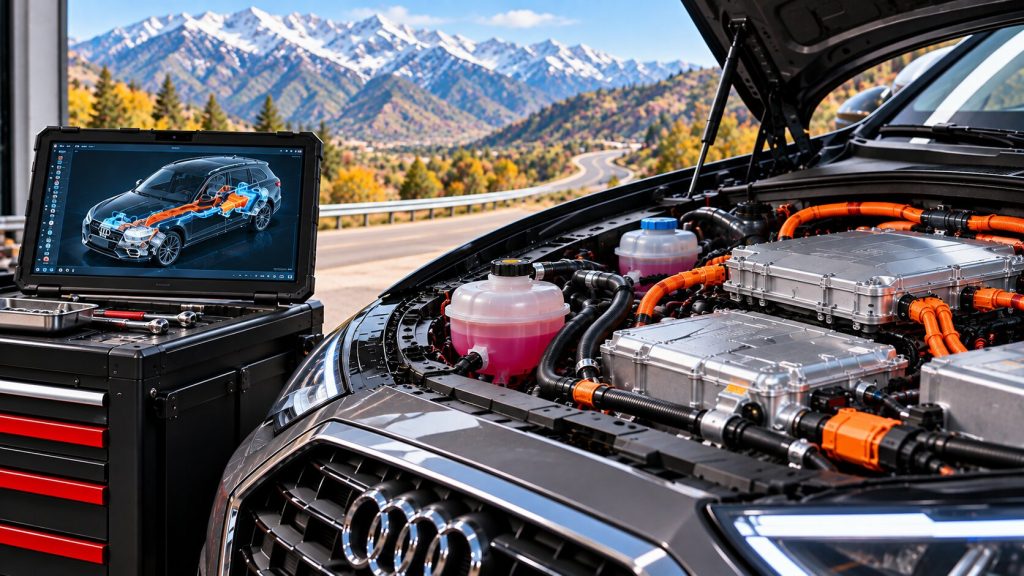
Driving your Audi e-tron up Parleys Canyon on a 100 degrees Fahrenheit summer afternoon forces the front (0MA) and rear (0MB) electric motors to pull heavy power for miles. Parking that same car overnight in freezing Salt Lake Valley winters creates extreme temperature swings. This thermal roller coaster breaks down protective motor coolant and thins out reduction gear oil much faster than standard maintenance schedules suggest.
What Happens to Motor Coolant at High Temperatures
Electric motors rely on specialized low-conductivity coolant to carry heat away from high-voltage parts safely. Over time, high temperatures weaken the protective additives in the fluid, causing it to become conductive. When electrical conductivity spikes past 20 micro-Siemens per centimeter, the coolant loses its electrical insulating ability. This can damage internal seals and trigger high-voltage isolation warning codes (like code P1B00) on your dashboard.
The reduction gearboxes attached to your motors face a different kind of stress. Instant electric torque creates intense friction where gear teeth meet. This breaks down synthetic 75W gear oil, thinning its protective layer (dropping viscosity under 9.5 centistokes at 100 degrees Celsius). Without that fluid cushion, metal gears rub together, leading to internal wear and high-pitched whine noises.
A Real Salt Lake City Service Case
An e-tron was recently towed to my shop off I-80 after shutting down with a dashboard isolation fault right after climbing Parleys Grade. The initial estimate called for replacing the entire rear motor assembly.
I pulled a sample of the motor coolant and tested its electrical resistance. Conductivity had jumped to 24.2 micro-Siemens per centimeter—well past safe safety limits. The degraded fluid had lost its insulating power under heat. I used shop equipment to draw a sustained vacuum (negative 0.9 bar), flushed the loop with fresh factory-spec dielectric fluid, and cleared the system warning. The car was back on 2300 East that afternoon without needing a new motor.
How Local Utah Driving Accelerates Wear
- Mountain Grade Power Pulls: Climbing from 4,200 feet up to over 7,000 feet up Parleys Canyon forces continuous electrical current through the motors, pushing internal temperatures up to 140 degrees Celsius.
- Thermal Shock: Shifting rapidly between scorching canyon runs and sub-zero overnight parking weakens protective fluid additives.
- Moisture Condensation: Freezing winter air causes moisture to condense inside sealed gear cases, turning worn oil into an acidic sludge.
Professional Service Steps in the Shop
Replacing fluid in an Audi electric drive unit requires specific diagnostic tools and precise service steps:
- Vacuum Coolant Flush: Refilling the cooling loop requires a negative 0.9 bar vacuum pull to remove trapped air pockets that cause localized hot spots on motor windings.
- Dielectric Testing: Fresh fluid is tested before filling to guarantee electrical conductivity sits safely below 10 micro-Siemens per centimeter.
- Temperature-Checked Gearbox Fill: Draining and refilling the front (0.95 liter) and rear (0.40 liter) gearboxes must be completed while fluid temperatures stay between 30 and 40 degrees Celsius.
- Torque-Spec Drain Plugs: Drain and fill plugs are torqued precisely to 22 foot-pounds (30 Newton-meters) with new crush washers to prevent leaks.
Schedule Your Audi E-Tron Drivetrain Inspection
Ignoring fluid breakdown leads to silent internal damage until major drive components fail. Testing fluid conductivity and performing preventative flushes every 30,000 miles preserves performance, prevents unexpected breakdowns, and protects your resale value.
I handle complex Audi high-voltage systems right here in Salt Lake City without long dealer service backlogs. To test your e-tron’s drivetrain fluids or schedule a diagnostic service, reach out to Steve’s Automotive Specialists, located at 2809 S 2300 E, Salt Lake City, UT 84109.
Frequently Asked Questions
How often should Audi e-tron drive unit fluids be changed?
Every 30,000 to 40,000 miles. Driving steep mountain grades like Parleys Canyon accelerates thermal fluid breakdown, making 30k-mile conductivity and viscosity testing essential to prevent drive-unit isolation faults.
Can bad gear oil cause noise in an electric car?
Yes. When high-torque shearing drops gear lubricant viscosity below 9.5 centistokes, metal-to-metal contact occurs, creating a distinct 8 kilohertz high-pitched whine during acceleration or regenerative braking.
Is EV motor coolant the same as standard engine coolant?
No. Electric vehicles require specialized low-conductivity dielectric coolants designed to maintain high electrical resistance. Standard automotive antifreeze contains conductive ions that can cause high-voltage short circuits and isolation fault codes.
What happens if air gets trapped in the electric motor cooling loop?
Trapped air pockets block heat transfer away from the stator windings, causing localized hot spots exceeding 150 degrees Celsius that melt internal seal materials and trigger thermal safety shutdowns.