
Oil leaks around Land Rover engine covers and seals often mimic major failures when road grime spreads fluid across the undercarriage. Systematic surface cleaning combined with UV dye testing isolates active leaks from historical seeps. Proper diagnostic testing prevents misdiagnosis, ensuring targeted repairs with OEM materials before fluid damages surrounding components.
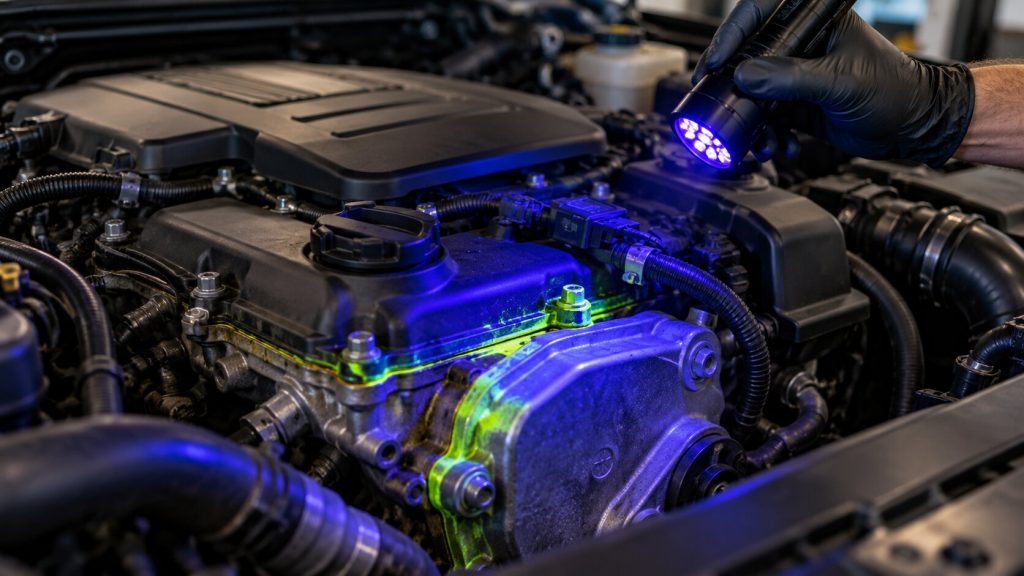
Oil leaks around Land Rover engine covers, timing covers, and valve seal mating surfaces can easily lead to costly misdiagnoses if environmental road grime and residual fluid are not systematically isolated. On vehicles driving through Utah’s severe freeze-thaw cycles and heavy winter road salt, ambient temperature shifts expand and contract aluminum engine blocks, creating subtle weep paths that spray fluid backward across the undercarriage. We perform systematic cleaning and UV dye testing to verify the exact leak source before recommending major repairs.
Tracking Down Hidden Engine Cover Seeps Before They Cause Major Damage
Land Rover engines rely on a complex network of valve cover gaskets, timing covers, oil pan rails, and solenoid O-rings to keep oil contained. Over time, high engine heat causes these flexible rubber seals to harden and break down. Once a seal loses its flexibility, oil starts creeping out along the metal joints where engine parts meet.
Because air rushes through the engine bay while driving, leaking oil gets blown backward and sprayed across lower parts. By the time the oil drips onto your driveway, a minor leak near the top of the engine often looks like a major failure of the oil pan or steering system below.
Utah’s extreme weather makes these seal failures happen much faster. Sub-zero winter nights cause rubber gaskets to freeze and shrink, while daytime drives up the canyons push oil temperatures past 200°F. This constant swing between freezing cold and extreme heat cracks aging rubber, opening tiny gaps for pressurized oil to escape.
Why Surface Cleaning Is the First Step in Real Leak Detection
You cannot find a new oil leak on a dirty engine. Old road grime, dirt, and dried oil build up over thousands of miles, completely masking where fresh oil is coming from. Skipping the cleaning step often leads shops to replace perfectly good parts based on old stains.
Before testing, we thoroughly wash and degrease the engine bay to clear away all old residue. Once every cover and metal joint is completely dry, any new oil that appears gives us an accurate reading of the active leak path.
- Eliminating False Leads: Degreasing removes old oil trails that trick technicians into replacing the wrong parts.
- Clear Visibility: A clean, dry surface makes even the smallest drop of fresh oil instantly visible during a test run.
- Pinpointing the Height: Spotting clean oil reveals whether the leak starts high up on a valve cover or lower down near the timing case.
Advanced UV Dye Testing Pinpoints the Exact Fluid Source
When an oil leak is too small or hidden to see with the naked eye, we add a special glow-in-the-dark UV tracer dye directly into your engine oil. As the engine runs and gets up to operating temperature, oil pressure circulates this safe dye through the entire engine and pushes it out through any leaking seal.
We then inspect the engine bay in a dimmed shop area using a high-intensity ultraviolet blacklight and specialized yellow viewing glasses. Under the UV light, the dye glows brightly right at the exact spot where the fluid is escaping.
Shop Secret: Running the vehicle on a lift for 10 to 15 minutes at varying engine speeds creates real-world oil pressure. This forces the glowing dye through microscopic seal gaps that stay completely dry while the car is just idling.
Differentiating Active Pressure Leaks from Minor Cosmetic Weeping
Not every damp spot under your Land Rover’s hood calls for an expensive, immediate repair. Over 10,000 miles, engine seals naturally “sweat” or weep a microscopic amount of oil without ever lowering the level on your dipstick. We evaluate leak severity by watching how quickly fluid builds up during our test run.
Active pressure leaks form wet, hanging droplets, drip onto hot exhaust parts, or cause measurable oil loss between oil changes. Cosmetic seeps just create a dark, dry stain that attracts light dust. Telling the difference between the two keeps you from spending money on unnecessary tear-downs.
- Active Leaks: Form liquid droplets within minutes, putting you at risk of low oil pressure or smoke under the hood.
- Seeps and Sweating: Show slight discoloration along gasket edges without any measurable drop in oil.
- Airflow Spray: Happens when the cooling fan or highway wind pushes escaping oil across nearby parts, making a small leak look much worse.
Preventing Repeat Failures with Proper Torque Specs and OEM Materials
Fixing a Land Rover cover leak permanently takes more than just slapping in a new rubber gasket. Land Rover engines use a mix of aluminum blocks and plastic composite covers that warp easily if bolts are tightened unevenly. Using exact factory torque settings ensures the cover presses down with equal force along its entire edge.
We also use high-grade original equipment manufacturer (OEM) seals and high-temperature sealants that resist chemical breakdown from modern synthetic engine oils. Cleaning the metal surfaces carefully without scratching the aluminum ensures your new seal stays tight for years to come.
Technician’s Note: On popular 3.0L V6 Land Rover engines, a leaking valve cover gasket can easily be confused with a failed PCV valve system. Checking internal crankcase pressure before replacing gaskets prevents new seals from failing under excess pressure just a few hundred miles later.
Protect Your Engine from Unnecessary Labor and Hidden Damage
When we inspect Land Rovers in our shop, we often find that ignoring active oil leaks allows harsh fluid to soak into nearby rubber engine mounts, suspension bushings, and coolant hoses. Over time, oil rots these rubber parts, leading to costly secondary repairs.
Bringing your Land Rover to us at Steve’s Automotive Specialist takes the guesswork out of repairs. We perform step-by-step cleaning and UV dye testing to isolate the true source of the leak, saving you both time and money. Schedule your comprehensive engine leak inspection with our team at 2809 S 2300 E, Salt Lake City, UT 84109.
Frequently Asked Questions
How long does a UV dye leak test take on a Land Rover?
A standard UV dye test takes between one and two hours. This gives us enough time to thoroughly wash the engine bay, add the glowing tracer dye, run the engine under load to build pressure, and inspect all seals with ultraviolet light.
Can I drive my vehicle with a minor engine cover seep?
Yes, you can safely drive with a minor seep as long as your oil level stays full and fluid is not dripping onto hot exhaust pipes. However, you should have weeping seals checked during regular oil changes to make sure they haven’t turned into active pressure leaks.
Why do Land Rovers seem more prone to valve cover and seal leaks?
Land Rover engines combine aluminum metal parts with plastic covers, and these two materials expand and shrink at different rates as temperatures change. In Utah’s climate, freezing winters and hot summer drives cause the rubber gaskets between these parts to harden and lose their seal over time.
Will fixing an oil leak require replacing the entire cover or just the gasket?
In most cases, replacing just the rubber gasket or O-ring completely fixes the leak. However, if heat has warped or cracked a plastic valve cover, the whole cover assembly must be replaced so the new gasket can seal evenly.