
Land Rover underboost faults usually happen when air leaks out of a cracked hose or when an engine valve gets stuck. High mountain drives across Utah force your turbocharger to work twice as hard, making small leaks instantly cut your engine power. Simple smoke testing finds these leaks quickly, saving you from buying a costly new turbocharger.
If you are driving your Land Rover up high-altitude Utah mountain passes and suddenly lose power while your check engine light turns on, your vehicle likely has a turbocharger underboost fault (often stored in the computer as code P0299).
Climbing steep mountain passes in thin Utah air forces your engine to pump maximum air into the cylinders. Cold Utah winters and salty roads make rubber hoses brittle over time. When you press the gas pedal on a steep hill, that extra pressure pops open tiny cracks in rubber pipes or sticks moving engine parts, causing the computer to cut your engine power to protect itself.
Thin Altitude Air Forces Land Rover Turbos to Work Overtime
Your turbocharger acts like a high-powered fan that pushes extra air into your engine so your Land Rover has plenty of passing power. In Utah’s high elevation, the air is thinner, meaning the fan has to spin much faster to push the same amount of air as it would at sea level.
An underboost fault simply means your engine’s computer asked for a specific amount of air pressure, but the sensors measured less air than expected.
- Cracked Rubber Hoses: Cold Utah winters and high engine heat cause plastic and rubber air tubes to split along their seams.
- Sticking Valves: Carbon build-up can cause the small internal door (the wastegate) that controls turbo pressure to stick open, letting air escape.
- Failed Air Sensors: Dirt or electrical glitches can cause the sensor measuring your air pressure to send incorrect information to your car’s computer.
Over 60% of Land Rover underboost codes are caused by simple, split rubber hoses or loose clamps rather than a broken turbocharger. Replacing the entire turbo without checking for air leaks first is an expensive mistake.
Accurate Diagnostic Steps to Isolate Leaks from Turbo Failures
Finding an air leak or a bad sensor requires a clear step-by-step test rather than guessing and replacing expensive parts.
- Checking Computer Data: We plug in a diagnostic scanner while test-driving the vehicle to compare how much air pressure the engine wants versus how much pressure it is actually getting.
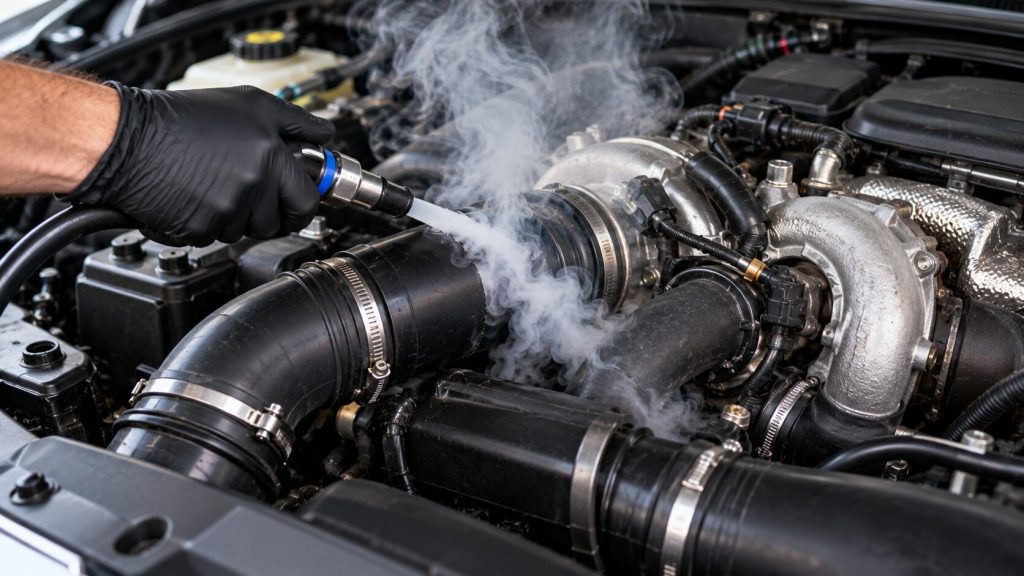
- Smoke Testing the Air Pipes: We pump harmless, high-density smoke into the air tubes under low pressure. If a hose has a hairline crack, smoke pours out of the hole, showing us the exact spot that needs fixing.
- Testing Moving Valves: We use a hand vacuum pump to check that internal turbo doors and valves move smoothly without sticking or catching.
- Checking Internal Turbo Parts: We inspect the rotating blades inside the turbo to make sure nothing is physically bent, scraping, or loose.
Recognizable Drivability Symptoms of Lost Charge Air Pressure
You will usually notice these clear warning signs before any major engine damage happens:
- Loss of Power (Limp Mode): The gas pedal suddenly feels heavy or unresponsive when accelerating uphill or merging onto high-speed Utah highways.
- Hissing or Whistling Noise: A loud rushing air sound when you step on the gas pedal usually means compressed air is escaping through a split hose.
- Delayed Acceleration: The engine takes several extra seconds to respond after you press the gas pedal from a complete stop.
Preventing Overheating and Secondary Catalyst Engine Damage
When air escapes through a leak, your engine computer forces the turbocharger to spin much faster to make up for the lost pressure. Running a turbocharger past its safety limit creates extreme heat that can warp metal parts, ruin bearings, and clog your exhaust system.
Addressing a check engine light early prevents minor air leaks from turning into major repairs. Independent shops use the same official diagnostic computer software as dealerships to pinpoint small leaks quickly without long wait times.
Don’t Let Lost Boost Stall Your Next Alpine Adventure
Don’t let a sudden loss of power ruin your mountain drives or lead to expensive engine repairs downstream. Our team of experienced technicians uses factory-level diagnostics and pressure testing to find the exact source of your underboost issue quickly and accurately.
If your vehicle is losing power on Utah mountain climbs or showing a check engine light, visit our team at Steve’s Automotive Specialist, located at 2809 S 2300 E, Salt Lake City, UT 84109, for a complete, accurate turbocharger diagnostic.
Frequently Asked Questions
Can I drive my Land Rover with a P0299 underboost code?
Yes, you can drive short distances to a repair shop, but you should avoid driving long distances or towing heavy loads. The engine computer may cut power to protect itself, and driving with a severe leak can overheat and damage internal turbocharger parts.
Does an underboost code mean I need a brand-new turbocharger?
No, a new turbocharger is rarely needed for this code. Most underboost problems are caused by split rubber hoses, loose pipe clamps, or a stuck valve, which are much less expensive to replace than the whole turbocharger.
Why does the power loss only happen when driving up steep canyons?
Thin air at high mountain elevations across Utah forces your turbocharger to work twice as hard to push air into the engine. Small hose cracks that stay sealed on flat roads pop open under the high pressure needed to climb steep mountain grades.
How much does it cost to fix a turbocharger underboost issue?
Repair costs vary depending on the exact source of the leak or component failure. Simple fixes like replacing a cracked hose or tightening loose clamps cost significantly less than replacing major turbocharger hardware, which is why a proper smoke test and diagnostic check are essential first steps.