
Brake pedal pulsation during the Sandy to Orem commute typically stems from Disc Thickness Variation or Lateral Runout exceeding .002 inches. High-speed stops on I-15 cause pad material transfer, creating vibrations. This use of digital dial indicators and micrometers distinguishes hub-alignment errors from metallurgy failures, ensuring smooth, precise braking.
Why Your Steering Wheel Shakes Near the Point of the Mountain
Descending I-15 between Draper and Lehi causes significant brake friction and heat buildup at the Point of the Mountain. Restricted airflow in heavy traffic near 123rd South stops rotors from cooling, forcing brake pad resins to liquefy and coat the metal unevenly. This microscopic layer of pad material creates the sticky surface responsible for rhythmic pedal vibration.
Beyond the Warp Myth
Modern cast-iron rotors rarely warp; instead, digital micrometers typically reveal Disc Thickness Variation. Measuring eight points around the rotor circumference often uncovers differences as small as .0005 inches that cause the pads to bounce. This variation pushes the caliper piston back, sending a hydraulic pulse through the pedal that feels like a rhythmic thumping on the descent into Lehi.
Thermal Transfer and Localized Heat
Higher freeway speeds and sudden deceleration near University Parkway subject brakes to intense thermal shock. At 4,500 feet, the thin Salt Lake Valley air reduces cooling efficiency and accelerates metallurgical changes like cementite hard spots. Once these heat-induced hard spots form, the rotor fails to wear evenly regardless of pad replacements.
The Only Way to Diagnose Runout
Human eyes cannot detect the half-thousandth of an inch that differentiates a smooth stop from a vibrating steering wheel. This is why I rely on digital metrology rather than visual inspections. Traditional brake jobs often fail because they ignore lateral runout. If the rotor is not perfectly parallel to the hub, it will wobble. This wobble causes the rotor to strike the pads intermittently even when you are not touching the brake pedal. Over time, this “ghost braking” creates the DTV that eventually ruins the part.
The Dial Indicator Test
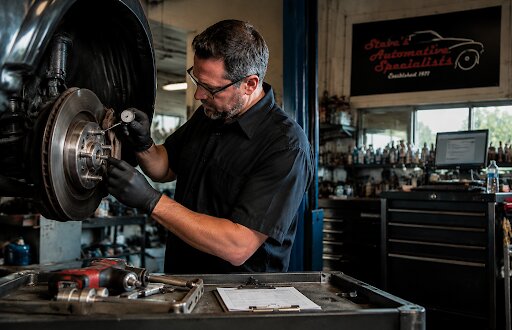
I begin each diagnosis by mounting a magnetic-base digital dial indicator to the steering knuckle and rotating the hub by hand. If the readout exceeds .002 inches, I have identified a runout issue rather than a simple rotor failure. This data allows me to distinguish between a bent hub flange and a rotor wobble, preventing unnecessary part replacements. Identifying the high spot often lets me index the rotor to a different hub position, effectively canceling out the runout felt during high-speed Sandy and Orem commutes.
Hub Surface Prep
Utah road brine and magnesium chloride cause galvanic corrosion to build up between the alloy wheel and iron hub. Even a rust layer as thin as a human hair prevents the rotor from sitting flush, creating significant runout. I use specialized abrasive discs to clean the hub assembly back to bare metal to ensure the rotor seats perfectly. Skipping this step leads to renewed pulsation within a few thousand miles of driving in Orem.
Precise Braking Solutions
I prioritize identifying the specific failure, whether it’s cementite formation or hub-to-rotor runout, to avoid the 3,000-mile failure loop common with ‘pad-slap’ brake jobs. While standard resurfacing restores the surface finish, it reduces the rotor’s thermal mass, making it incapable of handling the heat-cycling seen at the Point of the Mountain. Machining a rotor already at its minimum thickness or showing deep heat-checking will worsen the vibration and compromise safety. A thinner rotor has less mass, which means it will overheat even faster on your next trip over the Point of the Mountain.
Measuring vs. Guessing
I use live digital data to decide the best course of action. If the lateral runout is within spec but the DTV is high, a precision on-car brake lathe might be the answer. This machine trims the rotor while it is attached to the hub, ensuring the two surfaces are perfectly synchronized. However, if my micrometers show that the rotor metallurgy has been compromised by extreme heat, I will always recommend replacement. Daily I-15 commuters rely on metallurgical integrity more than the minor savings of a resurfacing job.
The 2-Year Mountain Strategy
Living along the Wasatch Front requires a specialized maintenance approach to handle constant elevation changes and corrosive environments. I apply high-temperature synthetic lubricants to caliper slide pins to prevent seizing from salt exposure. Seized pins prevent the caliper from floating, which causes localized overheating and rotor pulsation. This strategy ensures vehicles remain reliable against the steep grades and high speeds unique to the Utah landscape.
To stop the vibration on your descent into Lehi, contact us at Steve’s Automotive Specialist , 9245 S 700 E, Sandy, UT 84070 for a digital runout sweep. I’ll document your hub-to-rotor PIDs so you can see exactly why your brakes are pulsing before we turn a single wrench.
Frequently Asked Questions
Does my brake pedal vibrate only at highway speeds?
Yes. High speeds increase the frequency of brake pads striking rotor high spots. This frequency amplifies microscopic imperfections from lateral runout or disc thickness variation, transforming a subtle vibration into a significant shake in the steering wheel or pedal that is less noticeable during slower, city driving.
Can I just turn my rotors to stop the pulsation?
Yes. Machining rotors can eliminate pulsation if the metal has sufficient thickness to dissipate heat. If rotors are below minimum thickness or have internal heat damage, turning them makes the remaining metal more susceptible to rapid overheating, structural weakening, and the inevitable return of pedal vibration.
Does road salt cause brake pulsation?
Yes. Road salt and de-icers create galvanic corrosion between the wheel hub and the rotor. This microscopic rust layer prevents the rotor from sitting flush against the hub, inducing lateral runout. This misalignment leads to uneven wear patterns and persistent pedal pulsation during the braking process.
Why is my steering wheel shaking when I brake downhill?
Shaking during descents is caused by thermal soak from extended braking. Intense heat causes pad resins to transfer unevenly onto the rotor surface. Sticky material buildup highlights existing rotor thickness variations that usually go unnoticed during low-temperature operation.
Are my brakes safe if the pedal is pulsating?
No. While the vehicle may still stop, pulsation indicates your braking system is not operating at peak efficiency. Pulsation extends stopping distances and damages suspension components through persistent vibration and irregular hydraulic pressure during deceleration.
How do you measure rotor runout accurately?
I mount a digital dial indicator to the vehicle suspension to measure the rotor face as it rotates on the hub. This precision tool detects metallurgical imperfections as small as .0005 inches, allowing me to verify that the rotor and hub are perfectly aligned for a smooth stop.