
Braking at South Towne keeps discs north of 200°C, creating a “heat trap” that causes pad imprinting and pedal pulse. Stops near the mall elevate temperatures beyond 370°C, inducing gas outgassing. Sandy’s high altitude necessitates ceramic pads with integrated copper fibers to stabilize braking telemetry during professional rideshare duty cycles.
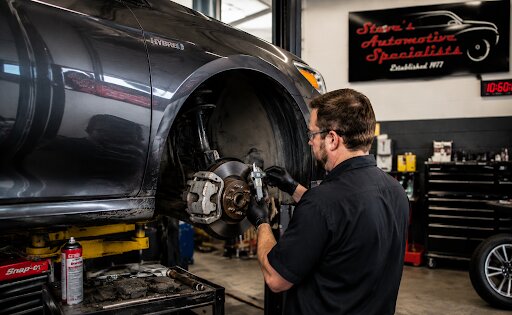
I am pulling the front wheels off a 2024 Camry Hybrid that spends twelve hours a day circling the South Towne Center loop. The owner complains of a rhythmic pulsing in the pedal every time they slow down for the light at 10600 S. On paper, the manufacturer suggests a brake inspection every 12,000 miles. In the reality of the Utah gig economy, that interval is a fantasy. This car was in the shop three months ago. Today, the pads are already at 3mm.
Why do your Toyota or Honda pulses near State Street?
The pulsing sensation felt through the steering wheel and brake pedal is a physical manifestation of uneven rotor geometry. In Sandy, the convergence of high-density traffic and aggressive descent cycles induces localized overheating that physically compromises the metallurgy of the disc surface. I see this most often in late-model hybrids where the driver relies on heavy friction braking after the regenerative system reaches its thermal limit.
The mechanics of heat soak and gas fading
I am holding a micrometer to the front rotor, and the 0.08mm readout confirms that lateral runout has exceeded the 0.05mm limit for these Japanese hybrids. This excessive heat causes phenolic resins in cheap pads to outgas at 370°C, creating a cushion of gas that leads to the dangerous “sailing” sensation of gas fading. When the driver compensates with high pedal pressure during a long idle at a State Street light, hot friction material transfers unevenly onto the scorching rotor. This pad imprinting creates permanent high spots that cause the vehicle to shudder every time the caliper squeezes the disc.
Ceramic vs. Semi-Metallic for Utah gig workers
Standard semi-metallic pads are designed for a standard commute, not the 300-stop shift of a South Towne rideshare driver. Mechanical failure is inevitable when the friction material’s thermal dissipation rate is eclipsed by the load, causing the structural resins to liquefy and bond. Switching to a specific ceramic compound is the only way to ensure the brake bite remains consistent from the first morning pickup to the final drop-off.
Maintaining a stable coefficient of friction during a 10-hour shift
I am installing high-tier ceramic pads featuring a kiln-fired clay base and copper fibers, a significant upgrade over the budget options that fail under the “Rideshare Burn.” While standard pads suffer a dangerous drop in friction when hot, these units maintain a stable μ ≈ 0.45 coefficient across the entire thermal range common to South Towne Center traffic. High-tier ceramic compounds prevent the erratic grab-and-slip stutter in parking structures and stop the vitrification of the friction surface when hardware fails to reach a cooling equilibrium.
The impact of Wasatch descents on rotor geometry
Descending from the foothills into Sandy creates a continuous thermal load that most passenger vehicles are not equipped to handle for hours on end. Repetitive braking cycles lead to surface vitrification, where the friction material crystallizes into a smooth glaze that significantly compromises the system’s mechanical bite. The 5,800ft altitude thin-air cooling capacity is physically eclipsed by the abrasive intake of I-15 construction grit, creating a grinding paste that vitrifies pads faster than standard sea-level driving.
How DTV and lateral runout develop in Sandy stop-and-go
The geography of Sandy adds a layer of mechanical stress as drivers descending from higher elevations vitrify their pads into a glass-like surface, reducing stopping power by 30 percent. This sustained thermal load, coupled with May mountain runoff striking glowing rotors at 10000 S, induces thermal shock that manifests as microscopic surface cracks and compromised structural integrity.
Furthermore, abrasive grit from I-15 construction infiltrates the caliper housings, causing the inboard pads to wear prematurely and the guide pins to stick. Without the application of high-temp silicone paste to combat this contamination, the resulting brake drag significantly diminishes both safety and fuel economy.
Precision brake service at Steve’s Automotive Specialist
I refuse to just ‘slap pads’ because even a micron of hub-face oxidation induces ‘stacked runout’; using an on-car lathe is the only way to index the rotor’s plane to the bearing’s specific axis. I treat every brake job as a precision engineering task to account for the thermal expansion these cars face daily. Without addressing the underlying runout and torque specs, new pads would simply fail within weeks.
Measuring runout and applying 110Nm lug torque for thermal expansion
I am mounting the Pro-Cut on-car lathe to the hub to ensure the rotor is perfectly true to the bearing axis, listening as the cutting head scrapes through the physical geometry changes caused by relentless South Towne stop-and-go cycles. The final diagnostic verdict confirms that Sandy’s 5,800ft elevation and high-frequency braking have physically altered the metal, requiring a full resurface and a precise star-pattern torque of 110Nm to allow for even thermal expansion. Because your brakes are both a vital safety system and a recurring overhead cost in the Utah gig economy, any presence of scorched smells or low-frequency groans demands an immediate technical evaluation.
Reach out to Steve’s Automotive Specialist in Utah for a forensic evaluation of your vehicle’s stopping power.
Frequently Asked Questions
Do my brakes pulse only after driving near South Towne Center?
Yes, this is typically due to heat soak. The heavy stop-and-go traffic near the mall prevents rotors from cooling. If you hold the brake pedal down while the rotors are extremely hot, pad material transfers unevenly to the disc, creating the high spots that cause pulsation.
Are ceramic brake pads better for rideshare drivers in Sandy?
Yes, high-quality ceramic pads are essential for gig workers. They utilize copper fibers and specialized clays to maintain consistent stopping power at high temperatures. Unlike semi-metallic pads, they do not outgas or fade as easily during 10-hour shifts in urban Sandy traffic.
How often should a Utah rideshare driver inspect their brakes?
Every 5,000 to 6,000 miles is the realistic interval. While standard manuals suggest longer, the elevation changes and high-frequency braking cycles in Sandy accelerate wear. Many local drivers reach the 3mm wear limit in half the time of a standard commuter.
What causes the burning smell after a long shift in Sandy?
Overheated binding resins. When the temperature exceeds the pad’s operating range, the glue holding the friction material together begins to burn. This often leads to glazing, which permanently reduces your vehicle’s stopping effectiveness.
Can road grit from I-15 affect my braking performance?
Yes, construction debris and gravel dust from the Sandy area act as abrasives. This grit gets trapped in the caliper slides and guide pins. In the absence of clean, silicone-lubricated slides, the calipers will seize or stick, forcing uneven friction material wear and a measurable drop in miles per gallon.
Does Utah elevation affect how my brakes perform?
Yes, the 5,800ft elevation and local terrain mean longer descents and different air cooling properties. The reduced atmospheric pressure at 5,800ft negatively impacts the convective cooling of the braking system, necessitating high thermal mass rotors and professional-grade pads for these heavy duty cycles.