
High-density stop-and-go traffic near Hill AFB gates induces thermal stacking, where brake rotors reach 700°F without adequate cooling. This heat causes hygroscopic fluid degradation and pad outgassing, leading to brake fade. In Clearfield’s 2026 congestion, frequent high-torque stops result in lateral runout and premature rotor warping before 25,000 miles.
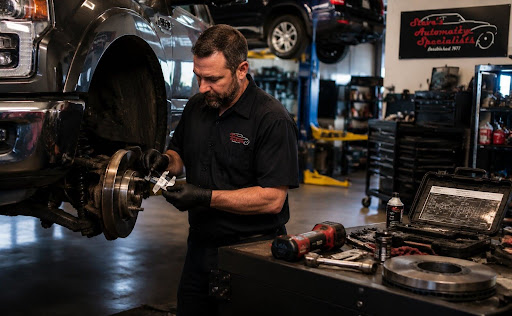
I am pulling the wheels off a late-model commuter truck that just spent forty minutes idling and creeping through the Hill AFB West Gate. The heat radiating from the wheel wells is immediate. I do not need a laser thermometer to know these rotors are north of 500°F, though the infrared gun confirms it. This is the reality of May 2026 in Clearfield. The ongoing I-15 interchange upgrades at 700 S have funneled a massive volume of base traffic onto local roads, and the braking systems are paying for it in metallurgical shifts.
Why does your brake pedal feel soft near the West Gate?
The frequent, low-speed braking cycles required to navigate the West Gate entrance prevent the calipers and rotors from shedding thermal energy. Without the cooling air of highway speeds, the heat transfers directly into the hydraulic lines, taxing the chemical stability of the fluid. I often see commuters struggle with a pedal that gradually sinks toward the floorboards while they are trapped in the morning queue.
The 3% moisture threshold in DOT 4 fluid
I am currently bleeding the lines on this vehicle, and the fluid coming out is dark, signifying heavy oxidation. Most drivers think brake fluid is a sealed system, but it is hygroscopic. It pulls moisture from the Utah air. In the stagnant, high-heat environment of a South Gate crawl, that moisture content hits the 3% threshold quickly. Once that happens, the boiling point of the DOT 4 fluid drops significantly. Rapid deceleration near Antelope Drive flash-boils the moisture in the lines, transforming liquid into incompressible steam. That is the physics behind the soft pedal that feels like stepping on a sponge.
Is it a warped rotor or Hill AFB road grit?
The Antelope Drive funnel forces drivers into a high-frequency braking rhythm that creates localized hot spots on the rotor surface. I am finding that the particulate matter from the South Gate construction area acts as a grinding compound between the pad and the disc. This grit scores the metal, while the heat-soak from stop-and-go idling causes the rotor to lose its true flat profile.
Identifying rotor runout from the Antelope Drive funnel
I have my micrometer on the front left rotor and am measuring a lateral runout of 0.003-inch, which exceeds the factory 0.002-inch tolerance. This 0.003-inch runout translates into a rhythmic pedal pulsation at the Roy Gate, the physical evidence of a heat sink effect that has permanently altered the rotor’s grain structure. I also discovered that construction grit from South Gate Avenue has turned the slide pin lubricant into an abrasive paste, forcing the pads to drag and inject even more heat into the system.
How stop-and-go fatigue kills brake pads before 25,000 miles
The short-trip nature of a Clearfield commute means the braking system stays in a constant state of high friction without the benefit of wind-driven cooling. Mechanical thickness is a deceptive metric in Clearfield; I see pads every day that look nearly new but have been chemically neutralized by chronic overheating and glazing. The constant pressure of gate traffic vitrifies the pad surface, turning a safety component into a liability.
The reality of glazing in Short-Trip Clearfield commutes
While manufacturer guides suggest a 50,000-mile lifespan, the vitrified, glass-like surface of these glazed pads proves that Hill AFB stop-and-creep cycles dictate a much shorter reality. I prefer ceramic pads for these Clearfield routes because they resist the catastrophic outgassing seen in cheaper organic pads, which fail when resins hit 600°F and turn into a gas. When resins vitrify at high temperatures, they release a gas that forms an invisible barrier, effectively allowing the brake pad to surf on a layer of its own outgassed vapor.
How we verify braking integrity at Steve’s Automotive Specialist
Every brake job I perform starts with a forensic evaluation of how the vehicle handles local stress points like the I-15 Southbound merge. I use precision measuring tools to find the tiny deviations in rotor thickness that standard inspections miss. Verification means ensuring the system can handle a sudden May 2026 rainstorm on a hot, congested arterial road.
Measuring micrometer runout after an I-15 commute
I have the 32mm socket on the axle nuts now, but the real forensic breakthrough happened when the PicoScope detected voltage jitter in the harnesses compromised by the 2026 gate traffic heat-soak. The diagnostic verdict confirms that the May 2026 roadwork diversions and high-frequency stop cycles induced a total thermal collapse of both the rotor geometry and the hydraulic fluid stability. I have installed high-carbon rotors and fresh high-boiling-point fluid to ensure this truck can handle the specific thermal demands of the Hill AFB commute. The proof of this environmental stress is visible in the micrometer readings and the acrid scent of burnt resin still lingering in the shop air.
Don’t let the 2026 interchange construction grit grind down your calipers. Reach out to Steve’s Automotive Specialist in 975 E 700 S, Clearfield, UT 84015 for a localized brake flush and hardware lubrication designed for Hill AFB’s specific stop-and-go thermal cycles.
Frequently Asked Questions
Do my brakes squeak even if the pads are new?
Yes, this is common near Hill AFB due to construction dust. Fine particulates from local roadwork embed in the brake pad chamfers, creating a grinding or squeaking sound. Even new pads will squeal if the hardware is not properly lubricated to resist Clearfield environmental grit.
Does my brake pedal vibrate when exiting I-15?
Yes. Rhythmic vibration indicates lateral runout exceeding 0.002 inches. When rotors are heated to extreme temperatures in gate traffic and then clamped during a full stop, they cool unevenly. This creates hot spots that cause the pedal to pulsate during high-speed deceleration on off-ramps.
How often should Hill AFB commuters change brake fluid?
Every 12 months. Constant heat-soak from idling near base gates accelerates moisture absorption. Crossing the 3% moisture barrier fundamentally destabilizes the fluid, resulting in a dangerous loss of line pressure as the liquid flash-boils during a sudden Hill AFB gate merge.
Are ceramic brake pads better for stop-and-go traffic?
Yes, ceramic pads generally manage higher temperatures better than organic or semi-metallic alternatives. Ceramic compounds resist outgassing during the extreme thermal cycling of the Roy and West Gate morning rushes, ensuring the hydraulic system maintains a firm and predictable pedal feel.
Why do my brakes smell like they are burning after my commute?
This acrid smell is the resin binders in your brake pads overheating and outgassing. In heavy Clearfield congestion, your brakes can exceed 600°F. If the smell is persistent, your pads may be glazed or a caliper may be sticking due to road salt and debris.