
Audi vehicles rely on Advanced Driver Assistance Systems that require absolute sensor alignment to function safely. Extreme temperature cycling in the Cache Valley causes microscopic expansion in radar housings, leading to persistent signal deviation. Factory-grade recalibration restores the precise beam path required for the Pre-Sense suite to accurately process objects during frequent mountain travel.
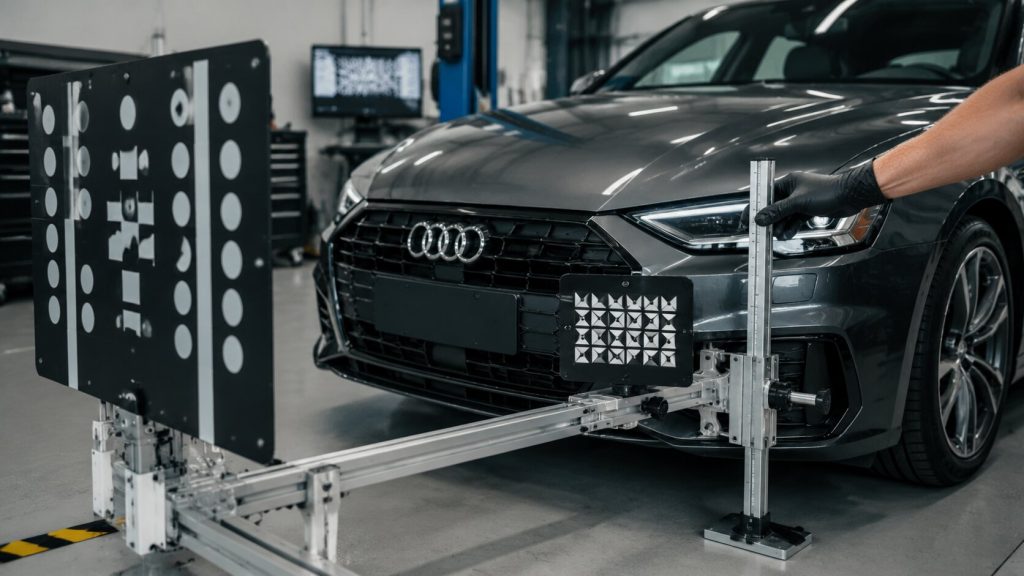
Precision radar and camera systems on late model Audi vehicles often lose calibration when navigating the severe washboard gradients and extreme temperature swings common to the Cache Valley foothills. Frequent travel along the steep grades of the local canyons causes subtle suspension shifts that throw the front radar sensors out of alignment, directly compromising the Pre-Sense safety suite during high speed I-15 commutes.
Understanding the Physics of Radar Misalignment
The Audi ADAS framework demands high-precision angular calibration, as the system is programmed to operate within a very narrow window of physical orientation. When a vehicle undergoes constant, heavy suspension cycling on rugged Utah backroads, the mounting geometry of the radar housing inevitably shifts. These internal components are sensitive to the physical state of the vehicle frame.
Angular Variance and Signal Distortion
The front radar sensor relies on a precise aim relative to the vehicle thrust line. Even a variance of less than one degree causes a significant deviation in the detected path. When the radar beam hits a target at the wrong angle, the signal returns distorted. The computer interprets this as an obstacle, often triggering phantom braking during high speed travel. This is not a software glitch, but a physical orientation failure.
Thermal Fatigue and Mechanical Stress
Heat soaking further complicates this failure. Exposure to intense mountain sun cycles causes microscopic expansion in the plastic bumper fascia and mounting brackets. When thermal fatigue meets the persistent mechanical shock of rugged terrain, the sensor mounting points yield, allowing the module to drift out of its calibrated position. Once the sensor loses its factory-set orientation, it begins to read the road incorrectly, leading to degraded performance of the entire safety architecture.
Salt Residue and Housing Corrosion
Additionally, we see localized issues where road salt and debris from Cache Valley winters infiltrate the sensor housing. This residue causes galvanic corrosion on the mounting clips, which prevents the sensor from maintaining a firm, vibration-free seat. As the clips lose tension, the sensor essentially floats within the bumper, making it impossible for the software to compensate for the constant, erratic movement.
Proactive Diagnostic Process
I rely on a rigorous verification process to identify these shifts before they become safety hazards. First, I connect the factory diagnostic interface to pull the alignment offset data. If the deviation exceeds the manufacturer threshold, I begin the physical re-alignment. Every step requires absolute control over the environment to ensure the laser sensors can establish a true baseline.
- Initial Scan: Connect the diagnostic tool to identify the specific error code associated with horizontal or vertical alignment drift.
- Static Reference: Place the vehicle on a perfectly level surface to establish a baseline that eliminates floor pitch or roll.
- Laser Triangulation: Use the laser measuring tool to ensure the radar rig is exactly perpendicular to the vehicle centerline.
- Software Reset: Once the physical hardware is positioned, write the new calibration values to the Control Module.
- Road Test: Perform a high speed run on the highway to confirm that the Pre-Sense system tracks leading vehicles without jitter.
My shop floor features a dedicated calibration bay where I maintain precise lighting levels and zero floor variance. This prevents the artificial interference that often causes calibration failures at dealerships with busier, less controlled environments. I calibrate in a dark, climate-controlled bay to prevent light-bleed from shifting the laser baseline.
Mitigating Long Term System Degradation
Continued driving with a misaligned sensor forces the vehicle to rely on degraded data, which increases the likelihood of emergency braking events on I-15. These mechanical stresses eventually lead to internal component failure within the radar module itself, turning a simple alignment into a costly hardware replacement.
The Dangers of Restricted Mode
The sensors lack the internal mechanisms to compensate for physical mounting shifts caused by harsh terrain. When the vehicle detects that the data stream is inconsistent, it defaults to a restricted mode. This reduces your driving safety and forces the computer to make conservative decisions based on outdated geometry. Staying proactive with alignment checks preserves the longevity of the radar array and prevents the need for a full module swap.
What I Do on the Rack
I see many vehicles come into the shop with sensors that have been vibrating against mounting hardware for thousands of miles. This often leads to cracked housing brackets or corroded electrical contacts. Addressing the alignment early prevents this secondary damage. Bring your Audi to my shop located at 52 West 3900 North, Suite A, Hyde Park, UT 84318 for a professional calibration check that ensures your safety systems perform exactly as designed.
Schedule your Calibration at Steve’s Automotive Specialist.
Frequently Asked Questions
Does a wheel alignment fix sensor issues?
No, a wheel alignment addresses suspension geometry but does not calibrate the ADAS radar or camera sensors. The radar module demands a specialized, independent alignment protocol to verify that its beam vector is precisely indexed to the vehicle’s chassis centerline.
Why does my car brake for no reason on the highway?
When a radar module drifts out of alignment, the system misinterprets signal returns from the road surface, leading to unprompted braking events often initiated by vibration-induced mechanical settling.
How often should I calibrate my Audi sensors?
I recommend checking the sensor alignment once a year or immediately after any suspension repairs or off-road driving. Regular calibration is necessary to account for the gradual wear and physical shifts that occur with daily use in our local climate.
Can I calibrate these systems myself at home?
Calibrating ADAS equipment requires specialized laser rigs and factory software that are not available to the average consumer. Performing these adjustments without the correct tools will likely result in a permanent system error that requires a professional shop to rectify.