
Road salt and slush on I-15 and Bangerter Highway frequently lead to ABS sensor failures in Sandy. Corrosive brine can degrade sensor wiring or coat magnetic tone rings with debris, triggering warning lights. Professional diagnostic scan tools are necessary to pinpoint whether the fault is a simple sensor obstruction or a larger hub assembly issue.
How Winter Road Salt Impacts Your Braking System
In Sandy and throughout the Salt Lake Valley, winter driving involves more than just navigating snow; it involves constant exposure to aggressive de-icing chemicals. While road salt keeps the I-15 moving, it is notoriously hard on a vehicle’s undercarriage electronics.
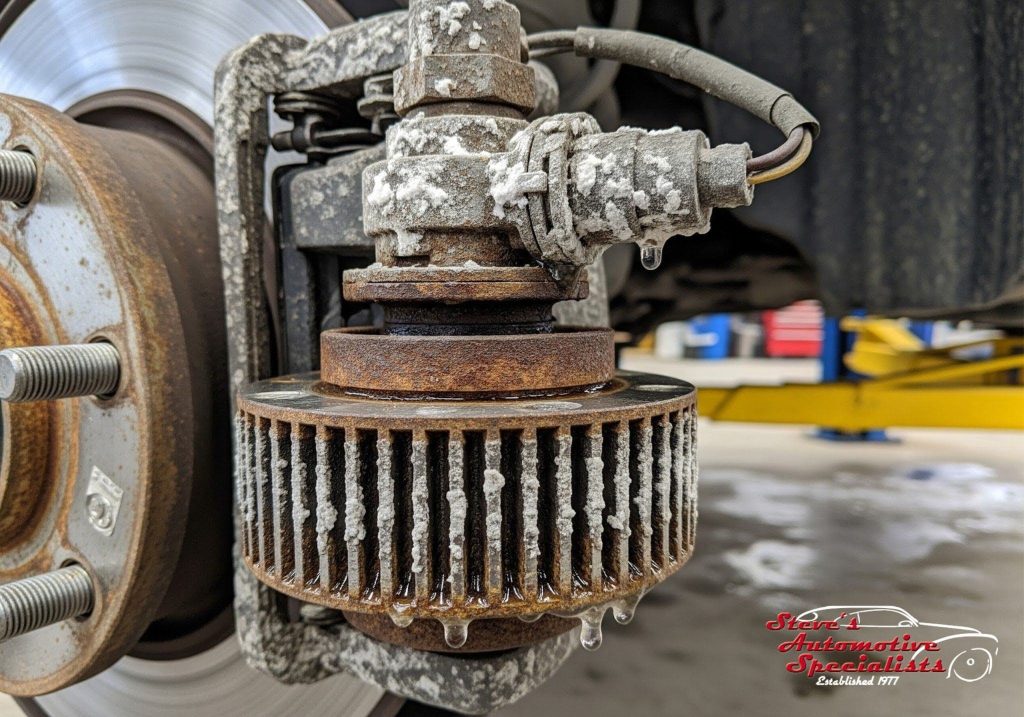
The Anti-lock Braking System (ABS) relies on constant data from wheel speed sensors located at each corner of your vehicle. These sensors are essentially small magnets that read a notched ring on your wheel hub to determine how fast each tire is spinning. When salt, magnesium chloride, and road grime build up around these components, the signal is often interrupted.
The Mechanics of Sensor Failure
The failure usually happens in one of two ways:
- Debris Interference: A thick crust of salt and frozen slush physically blocks the sensor’s ability to see the tone ring. This leads to erratic data and an immediate dashboard light.
- Corrosion: Over time, the chemical brine used on Utah roads eats through the protective shielding on the sensor wires. Once moisture hits the copper inside, the sensor shorts out.
Symptoms of a Failing ABS Sensor
The most obvious sign is the amber ABS light on your instrument cluster. However, because the ABS is integrated with other safety systems, you might also see:
- Traction Control Light: Often labeled as TCS or a car icon with squiggly lines.
- Brake Pedal Pulsation: You may feel the ABS kick in during normal, dry-weather braking if a sensor is sending false data.
- Loss of Stability Control: The vehicle may struggle to manage power distribution during turns.
Ignoring these symptoms doesn’t just mean living with a light on the dash; it means your vehicle may default to “traditional” braking. In an emergency stop on a slick Sandy road, your wheels could lock up, leading to a skid rather than a controlled halt.
What We Commonly See in Our Work
During the spring thaw, we see a significant influx of vehicles with intermittent ABS lights. A common scenario involves a driver who frequently commutes from Sandy to Salt Lake City along the Bangerter Highway. The high-speed spray from other vehicles pushes brine deep into the wheel wells.
In many cases, it isn’t just the sensor that has failed. We often find that the magnetic “tone ring” on the wheel bearing has become so pitted by salt that it can no longer provide a clean reading. Precision prevents waste. Replacing a sensor is useless if the underlying salt damage is actually inside the wheel hub assembly. Be sure to check our current repair specials.
How Technicians Diagnose the Issue
A common misconception is that the ABS light tells us exactly what part to replace. Scan tools don’t “fix” cars. They point to an electrical circuit fault, but a technician must find the physical break.
- Digital Scanning: We use professional-grade diagnostic tools to pull codes from the ABS module. This tells us which wheel is affected (e.g., Left Rear Wheel Speed Sensor Circuit).
- Live Data Monitoring: We often perform a “graphing” test. Watching the speed data live allows us to see exactly which sensor is glitching while the vehicle is in motion.
- Physical Inspection: We check for frayed wires or cracked sensor housings. Sometimes, a thorough cleaning of the tone ring can restore function, though replacement is more common if corrosion has set in.
Preventing Sensor Damage
While you can’t avoid the salt on Utah roads, you can mitigate its effects. A high-pressure undercarriage wash after a snowstorm is the most effective DIY prevention. Focus the spray behind the wheels to clear out the accumulation of salt and grit near the hub assemblies.
Professional Evaluation and Diagnostics
When a warning light hits your dash post-winter, a digital readout is the only way to find the specific circuit failure. At Steve’s Automotive Specialist, our ASE Certified mechanics use advanced diagnostics to ensure your safety systems are functioning correctly before the next rain or snowstorm hits the valley. As a shop with an A+ BBB rating, we prioritize transparent communication and reliable repairs. Reach out to our team in Sandy for a comprehensive brake and sensor evaluation to keep your vehicle performing safely.
Frequently Asked Questions
Is it safe to drive with the ABS light on?
Your car will still stop, but the anti-lock feature will not engage during a hard or slippery stop. This increases the risk of skidding. Get it checked now; Utah’s erratic spring storms aren’t the time to find out your ABS is failing.
Can I just clean the sensor myself?
Sensors sit tucked behind the rotor; cleaning them properly usually requires a partial teardown of the brake assembly. Furthermore, if the internal wiring is corroded, cleaning the exterior will not fix the issue.
Will a failing ABS sensor affect my regular brakes?
Most modern vehicles disable Traction and Stability Control automatically when they detect an ABS sensor failure to prevent erratic braking.
How does the Utah climate specifically affect these sensors?
The combination of extreme temperature swings and heavy use of road brine creates a “perfect storm” for electrical corrosion. Salt residue is hygroscopic, meaning it pulls moisture from the air to continue corroding your sensor’s electrical plugs year-round.
Maintaining Your ABS After Harsh Winter Driving
ABS sensor failures are a common byproduct of Utah’s harsh winter driving conditions. By understanding how salt impacts these sensitive electronics and recognizing the early warning signs of failure, you can maintain your vehicle’s most critical safety systems. Prioritizing a professional diagnosis over guesswork ensures that your car remains prepared for whatever the I-15 throws your way.