
Downhill braking on Utah’s mountain routes, like Provo Canyon, generates extreme heat leading to rotor warping, vibrations, and uneven wear. This thermal stress requires utilizing lower gears to allow rotors to cool, preventing brake system failure. Proper engine braking techniques are essential for maintaining safety when descending steep canyon grades.
The Reality of Mountain Braking in Utah
Driving in the Orem and Provo area offers some of the most beautiful scenery in the country, but the geography of the Wasatch Range puts unique demands on a vehicle’s braking system. Whether you are coming down from Sundance or navigating the steep grades of Squaw Peak, your brakes are working significantly harder than they would on level ground.
We often see cars with shaking steering wheels or a pulsing sensation in the brake pedal. Usually, the issue isn’t just worn-out parts; it’s the extreme heat soak caused by driving on these steep local grades.
How Downhill Driving Warps Rotors
To understand warping, you have to understand how kinetic energy works. Your brakes function by converting the forward motion of your car into heat through friction. On a flat road, this heat dissipates quickly. However, on a long descent, the friction is constant.
The Science of Thermal Runaway
Applying steady pressure during a mountain descent quickly overheats the rotors; these metal discs often soar between 400°F and 600°F, reaching a point where the metal can actually begin to distort. If the heat cannot dissipate fast enough, the cast iron of the rotor can physically distort.
Strictly speaking, warped rotors are often actually suffering from disc thickness variation (DTV). This happens when extreme heat causes brake pad material to transfer unevenly onto the rotor surface. This creates high spots of cementite—an ultra-hard iron carbide—which leads to the vibration you feel in the pedal.
Common Symptoms of Heat-Damaged Brakes
If your commute involves significant elevation changes, keep an eye out for these specific red flags:
- Steering Wheel Shakes: If the wheel vibrates specifically when you apply the brakes at higher speeds, the front rotors are likely distorted.
- Pulsing Brake Pedal: A rhythmic pushback from the pedal suggests the rear rotors or drums are uneven.
- Acrid Smells: A sharp, chemical burning scent during a descent indicates your brake pads are outgassing due to extreme heat.
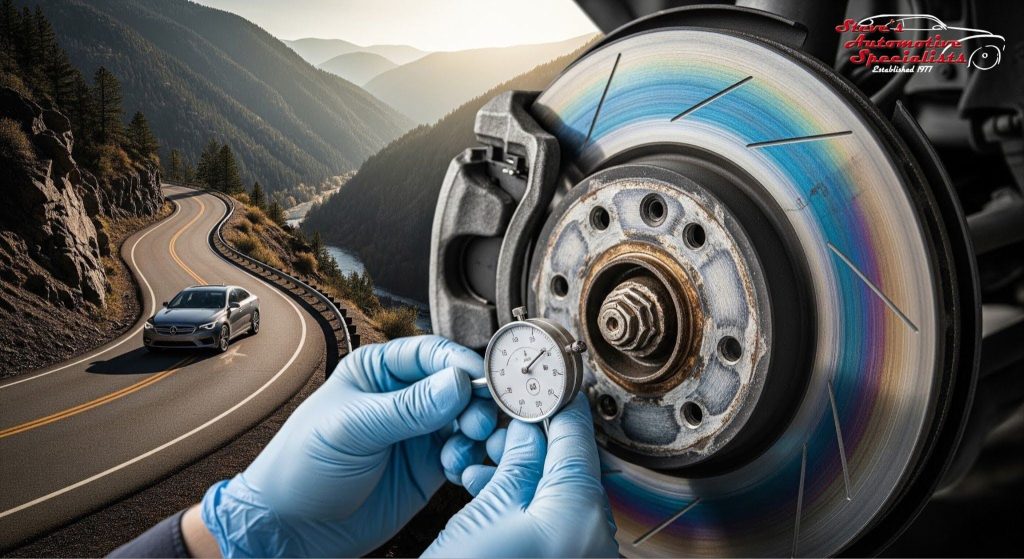
- Blue Tint on Rotors: If you look through your wheel spokes and see a blue or rainbow-like discoloration on the metal disc, it has been subjected to excessive heat.
The Orem Downhill Factor: A Local Case Study
We recently worked with a client who lives in the foothills near Orem and commutes daily via Highway 189. Despite having relatively new brake pads, the driver complained of a violent shudder whenever they slowed down for city traffic after the canyon descent.
Upon inspection, we found the rotors had developed significant heat checking—small cracks on the surface—and uneven material transfer. The driver had been riding the brakes (applying light, constant pressure) for the entire five-mile descent. This localized experience is common in Utah County; the constant friction simply never allows the metal to cool, leading to premature component failure regardless of the vehicle’s age.
How to Prevent Rotor Warping on Steep Grades
Preventing damage is largely about driving technique and cooling. You do not necessarily need to replace your brakes every time you go for a mountain trip if you manage the heat correctly.
1. Use Engine Braking (Downshifting)
This is the most effective way to save your rotors. By shifting your vehicle into a lower gear (even in an automatic), you allow the engine’s compression to slow the vehicle. This reduces the burden on your friction brakes.
2. Practice “Snub” Braking
Instead of holding the brake pedal lightly for miles, apply the brakes firmly to drop your speed by 5–10 mph, then let go completely. This on-off cycle gives the rotors a few seconds of airflow to shed heat between applications.
3. Avoid Standing Water After a Descent
If your rotors are glowing hot after a long drive and you immediately drive through a deep puddle or into a car wash, the rapid cooling (thermal shock) can instantly warp the metal.
Professional Evaluation vs. DIY
While some enthusiasts attempt to resurface their own rotors, modern rotors are often designed with thinner discard specifications to save weight. If a rotor has been overheated to the point of structural change (creating cementite spots), resurfacing is usually a temporary fix. The hard spots remain, and the vibration typically returns within a few thousand miles. A professional inspection ensures the hub surface is clean and the “runout” is measured with a dial indicator to ensure a perfect fit.
Professional Brake System Inspection
If you’ve noticed a change in how your vehicle handles the canyons, it may be time for a professional look. At Steve’s Automotive Specialist, we have been operating since 1977 and understand the specific toll that Utah’s terrain takes on your vehicle. We can evaluate your braking system to ensure your rotors, pads, and fluid are capable of handling the heat of mountain driving. Reach out to us at our Orem location if you’re in the area and need a reliable safety check.
Frequently Asked Questions
Is it safe to drive with warped rotors?
The car will still stop, but warped rotors increase your stopping distance and cause vibrations that can prematurely wear out suspension components like ball joints and tie rods. In extreme cases, the reduced surface contact can lead to brake fade.
Why do my brakes only shake when I’m coming down the mountain?
Heat causes metal to expand. A rotor might be slightly uneven when cold, but the vibration becomes much more pronounced as the metal expands under the extreme heat of a mountain descent.
Does Utah’s road salt affect rotor warping?
While salt doesn’t directly cause warping, it causes corrosion and rust jacketing around the edges of the rotor. This blocks cooling and can cause pads to drag, creating constant, damaging friction.
How often should I check my brakes if I drive Provo Canyon daily?
For drivers frequently navigating steep grades, a brake inspection every 6,000 miles is recommended. This allows a technician to check for heat discoloration and pad glazing before it becomes a safety issue.
Prioritizing Your Vehicle’s Braking Health
Brake rotor warping is often a result of the extreme thermal environment created by Utah’s mountains. By utilizing engine braking and ensuring your braking system is maintained with high-quality, heat-resistant components, you can navigate the Orem area safely. Taking care of your brakes early saves you money and keeps your car ready for those steep mountain descents.
Related Topics
For information on advanced systems, see our guide on Electronic Parking Brake Diagnostics in Modern Vehicles.