
Utah spring weather reactivates dormant road salts, accelerating corrosion on brake calipers and hydraulic lines. This chemical reaction, combined with high moisture levels, leads to seized hardware and degraded fluid. Proactive spring inspections isolate these localized oxidation points before Salt Lake City’s high-altitude thermal cycles force a total hydraulic failure.
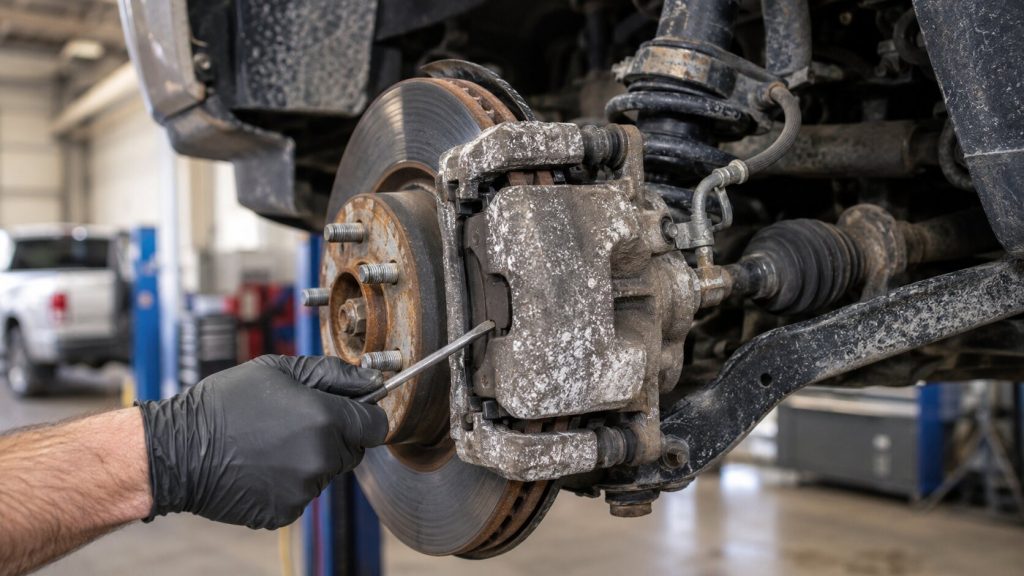
I am prying a brake pad away from its bracket on a Ford F-150 that spends its life commuting between Summit County and the Salt Lake Valley. The movement is stiff. I feel a gritty, high-friction resistance that should not be there. This is the reality of May in Utah. During the dry winter freezes, the magnesium chloride applied to I-80 stays relatively dormant. Once our spring rains and snowmelt hit, that salt liquefies and migrates into the tightest tolerances of the braking system. It sets up a corrosion battery between the steel piston and the aluminum caliper housing. If I do not clear this white-bloom oxidation now, the owner will face a seized caliper before the July heat arrives.
The Hidden Cost of Winter Salt Dormancy
I find that road salt hidden in caliper crevices stays harmlessly dry in winter but liquefies into a corrosive brine the moment spring snowmelt hits the hardware. I’m seeing how this liquefied salt acts as a bridge for electrical current, accelerating the oxidation that welds steel hardware to aluminum caliper bores. Without a thorough cleaning, this reactivated salt hardens into a ceramic glaze that pits metal surfaces and causes significant mechanical drag.
How May moisture re-activates Salt Lake City road brine
I pull the slide pins out. They should be slick with synthetic grease. Instead, I hear a grinding-sandpaper sound. The salt has breached the rubber dust boots. For Utah EV drivers in Teslas or Rivians, the situation is actually worse.
EV regenerative braking prevents the mechanical friction necessary to clear salt-induced oxidation, leading to premature hardware seizure despite low pad wear. Their hardware stays cold and wet, allowing salt to rot the calipers in silence. By the time they actually need to slam on the brakes to avoid a deer on Wasatch Boulevard, the pins are locked solid.
Parleys Canyon vs. Your Brake Fluid
Utah’s significant elevation changes and rapid May humidity shifts force brake fluid to reach its critical moisture saturation threshold much faster than the national average. I’ve pulled fluid samples that are so water-heavy they would likely turn to gas and cause total pedal loss before you even reached the bottom of Parleys Canyon. Testing for this 3.7% moisture limit during a spring inspection prevents the terrifying experience of a sinking brake pedal on steep mountain grades.
The moisture absorption (hygroscopy) trap
When you are dropping 3,000 feet from Park City, your brake fluid is the only thing keeping that pedal firm. As the fluid absorbs May’s humidity, its boiling point drops from a safe 450°F to a dangerous 300°F. If that fluid reaches its limit on a steep grade, it turns to gas. The pedal goes to the floor. The manual does not account for a Utah spring thaw or the constant pressure of mountain driving. I have seen fluid go from clean to contaminated in a single season of heavy canyon use.
Avoiding the $1,200 Caliper Seizure
Investing in a professional spring cleaning allows a technician to strip away salt buildup and apply high-temperature synthetic lubricant to the critical sliding surfaces of the brake hardware. This targeted maintenance prevents caliper piston seizure, a mechanical failure that would otherwise force a complete replacement of the hydraulic assembly and rotors. Proactive care in May effectively eliminates the need for the thousand-dollar repairs that typically plague Utah drivers once summer heat expands the salt-corroded components.
Why a $50 lubrication service beats a full system replacement
I am looking at the junction where the rubber brake hose meets the hard steel line. This is a primary failure point for Utah vehicles. The brine spray from I-15 near the Point of the Mountain construction collects here. I see the orange flakes of iron oxide. If this line pinches or leaks, the vehicle loses hydraulic integrity. This is the forensic part of the job. I look for the “notching” on the brake carrier where the pad has been hammered against the metal by stop-and-go traffic in Lehi. These tiny divots prevent the pad from retracting, leading to constant friction and ruined fuel economy.
Identifying Salt-Locked Hardware
Uneven or tapered wear on a single brake pad serves as the primary forensic evidence that Utah road salt has compromised the sliding integrity of the caliper. I use a PicoScope to verify hydraulic pressure balance and visually inspect for the white powdery bloom that indicates aluminum oxidation on the piston bores. Pinpointing these subtle failure signals now guarantees your brakes won’t fail under the extreme torque loads created by heavy spring runoff and steep Wasatch grades.
Reading the wear patterns at Steve’s Automotive Specialist
A spring inspection is not about looking for worn pads. It is about identifying the chemical rot that Utah’s environment imposes on the hardware. I can smell the acrid, metallic scent of a system that has been running hot due to salt-drag. I am stripping away this salt crust today to ensure your rotors can actually dissipate heat during a 100°F July afternoon or a heavy-load weekend trip up Big Cottonwood Canyon. If you want to avoid the mid-summer breakdown, you have to address the winter’s leftovers before they become permanent.
If your brake pedal exhibits a gritty resistance or you detect the acrid scent of overheating pads after a mountain descent, reach out to Steve’s Automotive Specialist in 2809 S 2300 E, Salt Lake City, UT 84109.
Frequently Asked Questions
Does road salt really affect my brakes even after the snow melts?
Yes. Magnesium chloride remains on your vehicle’s undercarriage long after the snow is gone. Spring rain and humidity reactivate these dormant salt crystals, causing them to migrate into brake calipers and line fittings where they trigger rapid oxidation and hardware seizure.
Why is brake fluid moisture a bigger deal in Utah than other places?
Utah’s high altitude and mountainous terrain subject brake systems to extreme heat during canyon descents. Because brake fluid is hygroscopic, it absorbs Utah’s spring moisture, lowering its boiling point and significantly increasing the risk of pedal failure during steep mountain drives.
How does stop-and-go traffic on I-15 affect my brake wear?
Heavy stop-and-go traffic, particularly near Point of the Mountain construction, causes localized heat-soaking without the cooling airflow of highway speeds. This constant idling prevents the mechanical agitation required to shed brake dust and salt effectively, leading to ‘notched’ carrier brackets and uneven pad wear that drastically reduces component lifespan.
Can I just wash my car to remove the salt from my brakes?
No. Standard car washes cannot reach the tight tolerances between the brake caliper pistons, slide pins, and internal seals. Professional disassembly is required to mechanically remove salt-crust and re-lubricate the sliding surfaces with high-temperature synthetic grease to prevent the calipers from locking up.
Is there a specific sign that my brakes are suffering from salt corrosion?
Yes. Common indicators include a “crunchy” or stiff pedal feel, a rhythmic squeal that changes with wheel speed, or the vehicle pulling to one side. Visually, a technician will look for white-bloom powder on aluminum parts or unevenly tapered wear on the brake pads.