
Balancing Audi repairs requires weighing factory precision against aftermarket savings. Utah’s extreme winter temperature swings punish cheap components, making material quality critical for cooling systems. Knowing when to invest in OEM standards protects engines from costly failures while keeping maintenance practical.
The Reality of Audi Ownership and Parts Costs
Every driver knows the sinking feeling of staring down a dashboard lit up like a pinball machine while a mechanic mutters something expensive. Suddenly, looking at a steep part estimate makes my eyes water. Keeping an Audi on the road around Salt Lake City means choosing between genuine factory parts and aftermarket options feels like playing high-stakes poker. I want reliability without paying dealership ransom prices, but saving a few bucks upfront can sometimes backfire.
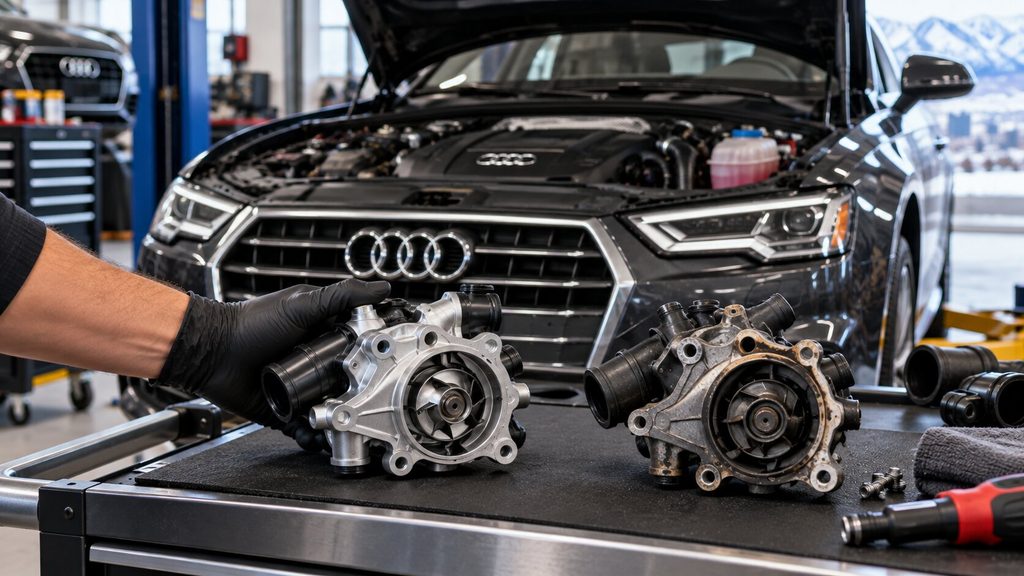
Understanding the financial and mechanical tradeoff helps in making smarter choices. Throwing money away at the dealership is unnecessary, but slapping cheap discount-bin parts onto a precision-engineered German machine is an unnecessary gamble.
Why Utah Weather Tortures German Engineering
Driving an Audi through local mountain passes and winter valley inversions is fantastic until I realize what those extreme temperature swings do to my car. One minute I am idling in freezing morning traffic, and the next I am pushing hard up a canyon grade. That rapid thermal cycling puts immense stress on plastics, gaskets, and metal components.
Salt Lake City winters bring freezing temperatures, snow, and aggressive road treatments like magnesium chloride. Cheap aftermarket parts often use inferior polymers and lower-grade metals that simply cannot handle the expansion and contraction. When the mercury drops and I fire up the engine, sub-zero conditions cause brittle aftermarket thermostat housings and water pump seams to micro-crack, leading to sudden coolant leaks and expensive tow trucks.
Shop Note: Pulling apart an EA888 Gen 3 water pump housing after a sub-zero Salt Lake inversion usually reveals structural shear right at the thermostat map-valve pivot pin due to brittle recycling plastic. If the casting doesn’t carry a Pierburg or Elring stamp, expect micro-fractures along the coolant gallery O-ring channel by 60,000 miles.
The Real Truth About Aftermarket Quality
Not all aftermarket parts are created equal, and knowing where savings are safe makes all the difference.
- Where saving is safe: Cabin air filters, wiper blades, high-performance brake pads, and certain suspension bushings from reputable aftermarket brands often match factory performance without draining a savings account.
- Where quality is non-negotiable: Critical engine sensors, timing components, water pumps, and turbo assemblies demand strict manufacturing tolerances.
I can grab a budget-friendly filter online without losing any sleep, but when I get into complex engine systems, bargain-hunting usually ends in tears. Factory parts match exact metallurgical tolerances and material specs, ensuring a proper fit and high-pressure resilience. Premium aftermarket brands that specialize exclusively in German vehicles can also bridge this gap, offering upgraded materials that outlast original factory designs.
The Hidden Costs of Cheap Substitutions
Choosing the absolute cheapest part from a digital auto parts catalog looks great on an initial invoice, but it rarely stays cheap for long. When a sub-standard water pump impeller cavitates or a cheap plastic flange cracks under boost, the resulting overheating event can warp cylinder heads or compromise head gaskets.
Labor costs also factor heavily into the equation. If a cheap part fails, I end up paying for the exact same labor hours a second time just to rip it back out and replace it properly. Paying a little more for a robust component the first time around protects against paying double in labor later.
Spending Smart Without Cutting Corners
Protecting an automotive investment means knowing when to splurge and when to save based on expert guidance rather than guesswork. Independent shops give drivers the freedom to choose high-grade performance alternatives that often outperform factory components without the obnoxious markup. Bypassing massive corporate dealership waitlists helps secure honest, straightforward advice on what a machine actually needs.
Ready to talk about strategy for your car? Reach out to the team at Steve’s Automotive Specialist located at 2809 S 2300 E, Salt Lake City, UT 84109 and let us keep your Audi running right.
Frequently Asked Questions
Are Audi Genuine parts always superior to aftermarket alternatives?
No. While factory parts guarantee exact metallurgical tolerances, specialized German aftermarket brands like Pierburg or Elring often manufacture upgraded components that outperform OEM weaknesses. The key is avoiding bargain-bin generics for high-pressure systems.
Do Audi cooling components fail so frequently in Salt Lake City?
Yes, local winter thermal shock is a primary catalyst. Salt Lake City’s valley inversions paired with rapid engine heat-up climbing Parleys Canyon cause inferior aftermarket plastics to lose elasticity, triggering micro-fractures along the thermostat housing O-ring channels.
Can aftermarket cooling components void an existing warranty?
Legally, a generic part alone won’t void your entire vehicle warranty under the Magnuson-Moss Act. However, if a sub-standard aftermarket component fails and causes collateral damage to the engine block, the manufacturer or warranty provider can deny coverage for that specific repair.
How often should an Audi cooling system be pressure tested?
I recommend checking cooling system pressure every 30,000 miles or right before winter hits. It is a quick preventative step that catches micro-fractures in the thermostat housing before a sudden coolant loss leaves a driver stranded.