
Recurring Land Rover warning lights indicate deeper underlying issues that simple scanner resets cannot resolve. Effective diagnostics rely on matching active symptoms with historical fault logs, freeze-frame sensor data, and targeted electrical testing. Addressing the root cause prevents cascading component failures and ensures long-term vehicle reliability.
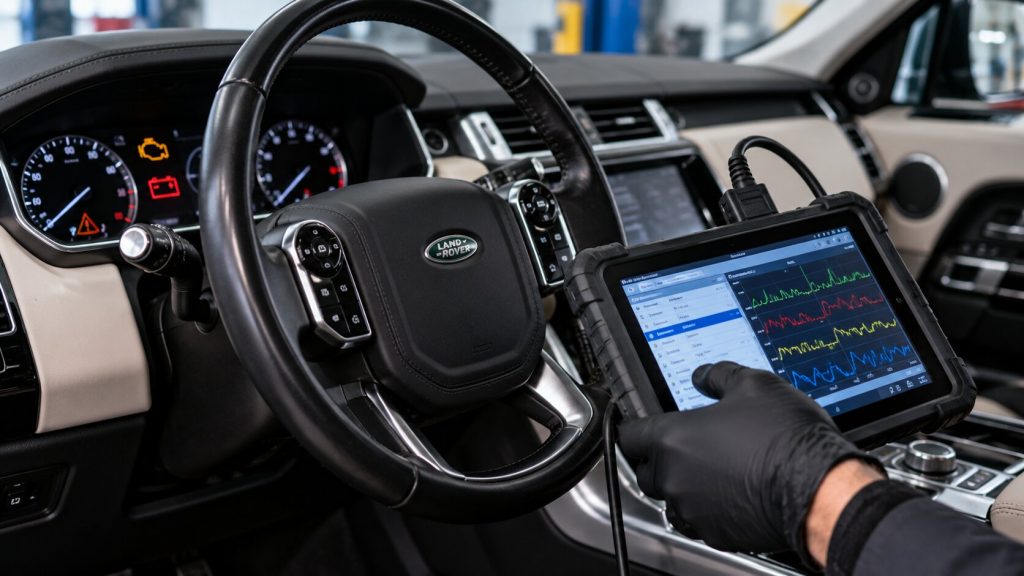
When a dashboard warning light illuminates on a Land Rover climbing steep mountain grades across Utah, clearing the fault code with a handheld scanner only hides an active system failure. Erasing diagnostic trouble codes turns off the light temporarily, but it wipes critical freeze-frame data right as heat, elevation changes, and engine load force sensor readings out of their normal range. We find that fixing the issue permanently requires comparing persistent dashboard alerts with historical computer logs, live sensor readings, and physical circuit testing to isolate why the fault keeps returning.
How Intermittent Electronic Network Failures Develop
Modern Land Rovers operate like complex computer networks. Dozens of dedicated control computers continuously share high-speed data across a system called a Controller Area Network (CAN bus). Under normal highway driving, sensors monitor vehicle metrics such as wheel speeds, exhaust temperatures, and air pressure within tight electrical tolerances. When a sensor measures a reading outside its factory limits, the main control computer logs a pending error code. If that abnormal reading repeats over several drives, the computer turns on a solid dashboard warning light to alert you.
Local driving conditions across Utah can worsen minor electrical issues. Temperature changes cause metal terminals to expand and contract, while mountain elevation shifts alter air-density calculations. A slight voltage drop from a lightly corroded wiring connector might pass automatic system checks during a cold morning start, but fail once the engine bay heats up on a long uphill drive. When that electrical signal drops for even a fraction of a second, the computer logs a fault code to protect mechanical parts. Erasing that code without fixing the underlying loose or corroded wire forces the computer to run on corrupted data, leading to accelerated engine wear or unexpected power reduction (limp mode).
Shop Bench Note: On L322 and L405 Land Rover models driven in Utah, we consistently trace intermittent network communication errors (such as U0100 codes) to surface corrosion on the main chassis ground wire behind the front wheel liner, where winter road salt penetrates the wiring sheath over time.
The Operational Risks of Relying Solely on Scanner Code Resets
Basic code readers only show the final outcome of a problem, not the initial event that started it. We frequently find that a single dashboard light is caused by a secondary computer reacting to a primary failure elsewhere in the vehicle. Simply replacing the part listed on a basic code reader screen often leads to unnecessary parts replacement while leaving the true root cause unfixed.
- Loss of Freeze-Frame Snapshots: Clearing codes erases vital operational data recorded at the exact millisecond the failure occurred, including engine load, vehicle speed, and exact battery voltage.
- Cascading Computer Miscommunication: Unresolved electrical issues force connected control modules to run on backup default settings, which often triggers unrelated secondary warning lights.
- Unresolved Intermittent Wiring Faults: Loose wiring connections, ground drops, or drifting sensors remain active in the system, exposing expensive mechanical assemblies to unmonitored stress until total component failure occurs.
Advanced Diagnostic Strategies Used to Isolate Complex Codes
Resolving recurring warning lights requires a systematic approach that goes far beyond plugging in a basic OBD-II code scanner. We use dealer-grade expert diagnostic services (such as Land Rover Pathfinder and TOPIx Cloud) to pull complete diagnostic logs across every computer in the vehicle rather than looking at a single isolated code. Comparing active vehicle performance against stored freeze-frame snapshots helps us pinpoint whether a fault is electro-mechanical, thermal, or software-related.
Our testing involves monitoring live data streams during active test drives to check sensor voltage and signal timing in real time. We perform targeted multimeter voltage-drop tests, back-probe wiring harnesses, and test main ground connections under electrical load. This detailed diagnostic process pinpoints the exact failure, ensures an accurate repair plan, and protects connected mechanical components from secondary damage.
Stop Resetting Codes and Fix the Real Problem
Driving up mountain passes across Utah with an active network communication error forces the transmission control module to operate on default backup settings, which can overheat transfer case fluid and accelerate clutch wear. Simply clearing the dashboard code masks this hidden stress until a major mechanical breakdown occurs.
Our team uses specialized diagnostic tools, lab oscilloscopes, and hands-on electrical testing to identify pin-level terminal wear, failing sensors, and hidden wiring faults before they cause widespread damage. Fixing the root wiring resistance or software issue solves the warning light permanently without wasting money on unnecessary replacement parts.
Schedule your diagnostic evaluation with Steve’s Automotive Specialist at our Salt Lake City location at 2809 S 2300 E, Salt Lake City, UT 84109 to keep your vehicle running reliably.
Frequently Asked Questions
Why does my warning light come back after being cleared?
Clearing a code only erases the recorded error log, not the underlying physical or electrical failure. As soon as the control computer detects the same out-of-spec voltage or sensor reading while driving, it turns the warning light back on.
Can a weak battery trigger recurring warning lights?
Yes. Modern vehicles are extremely sensitive to voltage drops. A weak battery or poor ground connection causes momentary voltage dips during starting or high electrical load, which disrupts computer communications and triggers false warning lights across multiple systems.
What is freeze-frame data and why is it important?
Freeze-frame data is a digital snapshot of engine load, vehicle speed, coolant temperature, and battery voltage captured at the exact millisecond a fault code triggers. We use this data snapshot to recreate and test the precise failure conditions in the shop.
Is it safe to drive if the warning light keeps turning on and off?
No. An intermittent warning light indicates an active electrical or mechanical fault that occurs under specific driving conditions, exposing components like your engine or transmission to secondary damage over time.