
Land Rover cabin heating issues during Utah winters stem from restricted coolant flow through the heater core, trapped air pockets, stuck thermostats, or failed blend door actuators. Diagnostics require scanning module fault codes, thermal imaging, and testing actuator signals. Prompt repairs restore cabin comfort and prevent costly cooling system damage.
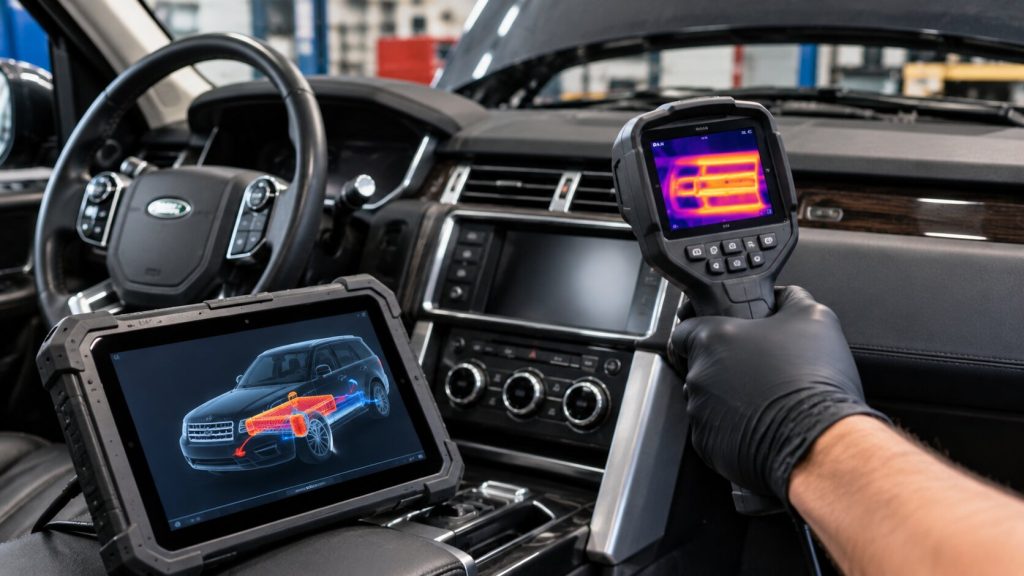
When Utah temperatures dip below freezing, a malfunctioning Land Rover climate control system leaves your cabin blowing tepid or icy air. Low coolant volume, clogged heater core channels, sticky blend doors, or failed climate module signals typically cause this issue.
Why Cold Cabin Air Happens in Land Rovers
Your Land Rover relies on a precise balance of fluid dynamics and electronic sensors to deliver hot air into the cabin. Hot engine coolant travels through tiny passages inside the heater core while air passes over the core fins to absorb heat. Electric actuators then rotate blend doors to mix that warm air to your selected temperature setting.
If any part of this closed system loses flow or calibration, heat output drops quickly. A slight drop in coolant fluid pressure can stall circulation through the heater core entirely. Furthermore, modern luxury SUVs use complex dual-zone or quad-zone flap actuators that can lose alignment after voltage fluctuations.
Understanding whether your issue stems from liquid flow or mechanical airflow helps us pinpoint the exact repair. We can trace temperature changes across specific hoses to isolate the failure point cleanly.
Common Reasons Your Heater Blown Air Stays Cold
- Clogged Heater Core Passages: Mineral deposits or degraded coolant sludge build up inside the microscopic internal passages of the heater core, restricting hot fluid circulation.
- Trapped Air Pockets: Air bubbles entering the cooling system create air locks, which prevent warm coolant from reaching the upper heat exchanger.
- Faulty Blend Door Actuators: Small plastic gears inside the HVAC housing strip or bind, locking the temperature door in the full-cold position.
- Stuck-Open Engine Thermostat: A thermostat that fails to close prevents engine coolant from reaching optimum operating temperature during cold drives.
- Failed Auxiliary Water Pump: Auxiliary electric pumps designed to boost low-speed coolant flow can stop working, causing heat to fade at idle.
How Coolant Restrictions Block Cabin Heat
Coolant must flow continuously through your heater core to keep up with sub-freezing outside air entering the HVAC housing. Over years of driving throughout Utah, aging coolant loses its corrosion inhibitors and forms internal scales. This debris settles directly in the narrow tubes of the core, restricting hot liquid from warming the aluminum fins.
Even when overall coolant levels look acceptable in the reservoir, internal restrictions stop the thermal transfer process. You might notice warm air while cruising down the highway, only to feel cold air as soon as you stop at a light. That symptom points directly to insufficient flow rate through the heater core circuit.
Proper flushing with our dedicated shop equipment can sometimes dislodge light accumulation. However, severe restrictions often require replacing the heater core assembly to restore full heating performance.
Mechanical Blend Door and Sensor Failures
Modern Land Rover HVAC assemblies rely on tiny stepper motors to position internal blend flaps precisely. These flaps partition warm air from the heater core and cool air from the evaporator core to reach your set temperature. When these motorized actuators fail, the system gets stuck blowing air from only one temperature source.
In addition to physical door jams, ambient air sensors and cabin temperature thermistors can feed incorrect data to the control module. If an interior sensor reads the cabin temperature as hot when it is actually freezing, the system limits hot air delivery. Physical door failures often produce subtle clicking sounds behind the dashboard when changing climate settings.
Diagnosing these electronic failures requires specialized diagnostic tools capable of reading live HVAC module parameters. By checking real-time data, we can verify command signals against actual flap positions without tearing down your dashboard unnecessarily.
Diagnosing Inconsistent Vent Temperatures
When we diagnose a heating issue, we start by scanning the automatic climate control module for stored fault codes and sensor discrepancies. We use thermal imaging cameras to measure the exact temperature differential between the inlet and outlet hoses of the heater core. A sharp temperature drop between these two lines confirms an internal fluid restriction.
Next, we inspect the cooling system for subtle leaks, air pockets, or failed bleeder valves that bleed off system pressure. Bidirectional scan tools allow us to command each blend door actuator through its full range of motion to test for bound gears or lost calibration. Vent temperature probes monitor individual dashboard outlets so we can isolate driver-side versus passenger-side variations.
This systematic approach prevents unnecessary parts replacement and targets the exact failure mechanism. Catching minor coolant leaks or failing actuators early saves you from more costly dashboard teardowns later on.
Restoring Warmth to Your Winter Drives
Driving through a harsh Utah winter without reliable heat creates uncomfortable and unsafe driving conditions. Delayed repairs can also allow small coolant leaks to escalate into severe engine overheating issues when spring arrives.
At Steve’s Automotive Specialist, located at 2809 S 2300 E, Salt Lake City, UT 84109, our experienced team provides precise diagnostics and repairs tailored to your vehicle’s specific HVAC configuration. We use advanced diagnostic equipment to resolve heater core clogs, actuator failures, and coolant circulation faults accurately.
If your heater is blowing cold air, reach out to us today to schedule an inspection. You can visit us in person at our Salt Lake City location or book your appointment online through Steve’s Automotive Specialist.
Frequently Asked Questions
Why does my Land Rover heater blow warm air only when driving?
This symptom usually indicates low coolant levels or a weak auxiliary water pump that cannot push fluid at low engine RPMs. Increasing engine speed speeds up the main water pump, forcing warm coolant through the restricted heater core temporarily.
Can a thermostat cause cabin heating issues without engine overheating?
Yes, a thermostat that is stuck partially open allows coolant to circulate through the radiator constantly, preventing the engine from reaching full operating temperature. The engine stays cool enough to avoid overheating, but never gets warm enough to provide hot cabin air.
How do I know if my blend door actuator is broken?
A failing blend door actuator often causes clicking or tapping noises behind the dashboard when you adjust the temperature settings. You may also experience hot air blowing from the driver vents while the passenger side stays freezing cold.
Is it safe to drive with a clogged heater core?
While a clogged heater core won’t immediately stop your engine, it restricts overall coolant flow and can lead to air locks or localized engine hot spots. Additionally, a loss of cabin heat prevents your defroster from clearing windshield ice, creating a driving hazard.