
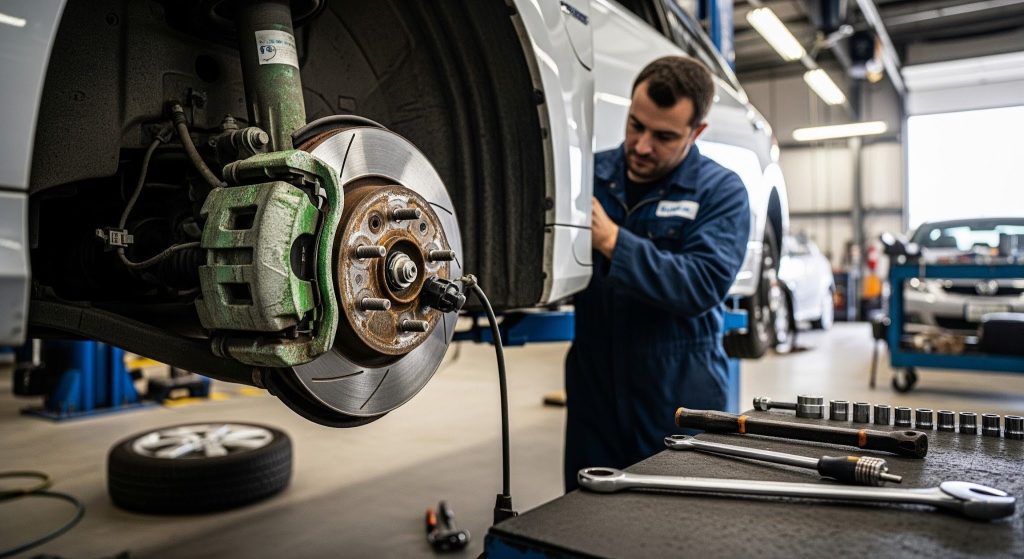
Utah’s stop-and-go traffic relies on regenerative braking, leaving friction pads idle. This creates a mechanical paradox: magnesium chloride and spring slush seize stagnant calipers while fuel is saved. Skipping manual teardowns allows calipers to seize, causing them to fail when maximum stopping force is required for sudden road hazards.
Why your hybrid lurches at the bottom of Parleys Canyon
As you descend from Park City into the Salt Lake Valley, your vehicle uses the motor-generator to create resistance, slowing the car while shoving energy back into the high-voltage battery.
The 7mph Hand-off
There is a hard physical limit to how much a magnetic field can slow a rolling chassis. Once your speed drops below roughly 7 mph, the motor-generator loses its counter-electromotive grip. This is the transition point where I see the computer tell the hydraulic system to take over and pinch the rotors. Winter grit causes pin seizure, which kills hydraulic engagement during the hand-off. That’s the sound of a stagnant mechanical system struggling to wake up.
Regenerative Fading
On those crisp April mornings when your battery is already at 100% charge, the car disables or reduces regenerative braking. Suddenly, your friction brakes are drafted into full-time service without a warm-up. If your rotors have developed a layer of flash rust from the high humidity near the Great Salt Lake, your first few stops will feel wooden and unresponsive. I see drivers panicking because their brakes feel different from one day to the next, unaware that the thermal management system is shifting the workload back to parts that haven’t moved in weeks.
Is Utah’s road salt killing your brakes?
In the Salt Lake Valley, lifetime is a dangerous word. We use magnesium chloride on our roads because it’s effective at low temperatures, but it is also highly hygroscopic. I see it attract and hold moisture against the metal long after the roads have dried.
Caliper Stagnation
Because you rarely use your friction brakes hard enough to generate real heat, that moisture never evaporates. It sits in the caliper bracket, reacting with the steel backing plate of your brake pads. I’ve pulled pads out of Teslas and Konas where the rust has swollen so thick it’s actually fused the pad to the bracket. I call this rotational stagnation. When the pad can’t slide, it can’t retract. It stays in light contact with the rotor, dragging and overheating the hub, or it stays stuck open, leaving you with significantly less stopping power.
ABS Sensor Corrosion
The green crust is a hallmark of Utah spring maintenance. Magnesium chloride reacts with the brass and copper components of your wheel speed sensors, creating a thick, conductive oxidation. These sensors provide the data the regenerative system needs to balance braking torque. When I see this crust interfere with the signal, the car experiences signal dropouts. The computer thinks a wheel has locked up and triggers the ABS unnecessarily. If you feel a buzzing in the pedal while braking on a dry day on State Street, your sensors are likely drowning in salt residue.
Diagnosing Brake Assist Failure
When a Brake Assist Failure light illuminates your dash, the culprit is often much smaller and buried under the hood.
The 12V Winter Hangover
Modern hybrids use an Electronic Brake Booster (EBB) instead of the old vacuum-driven canisters. These EBB modules are extremely sensitive to voltage. After a brutal Wasatch winter, I often find the 12V auxiliary battery is at the end of its rope. When you hit the brakes, the EBB draws a significant spike of current. If the battery is weak, the voltage drops, the computer panics, and it throws a failure code. I’ve fixed dozens of braking systems just by replacing a three-year-old battery that couldn’t handle the spring chill.
Physical Forensics
I don’t just trust the scan tool. A computer can tell me the electronics are happy, but it can’t see the flash-rust seizing your rear calipers. I perform a manual teardown to grease the slide pins and clean the pad contact points. In Utah, I consider this a safety requirement, not an upsell. I also look for glazing caused by the fine alkaline dust blown in from the lakebed. This dust acts as an abrasive, polishing your rotors until they are as smooth as glass, which destroys the friction coefficient you need to stop.
If you notice a lurch, a squeak, or a dashboard warning, reach out to us at Steve’s Automotive Specialist to ensure your regenerative system and friction brakes are working in total harmony. You can also visit our branch location at: 2809 S 2300 E, Salt Lake City, UT 84109
Frequently Asked Questions
Why does my hybrid car lurch just before it comes to a complete stop?
This lurch usually occurs during the transition hand-off when the electric motor stops braking and the mechanical pads take over. If your caliper slide pins are seized or dirty from Utah road salt, the pads cannot engage smoothly, causing a noticeable mechanical jerk.
Can a weak 12V battery cause brake failure warnings in an EV?
Yes. A weak 12V auxiliary battery triggers brake assist warnings because the Electronic Brake Booster (EBB) demands stable voltage to function. Even if your high-voltage battery is fully charged, a degraded 12V battery causes the brake computer to register a fault and disable assistance.
Do I still need to change my brake fluid if I rarely use my friction brakes?
Yes, brake fluid is hygroscopic and absorbs moisture from the air regardless of how often you use the pedal. In Utah’s humid spring climate, moisture in the fluid causes internal corrosion in expensive ABS and regenerative braking actuators, leading to very costly hydraulic repairs.
Why are my hybrid brake rotors rusty even though I drive every day?
Your rotors are rusty because regenerative braking handles most of the slowing, meaning the pads rarely scrub the metal surface. Without the heat of friction to evaporate morning dew or spring slush, flash rust forms quickly on the unused iron surfaces of the rotors.
Is magnesium chloride worse for hybrid brakes than regular road salt?
Yes, magnesium chloride is more corrosive and moisture-attracting than standard rock salt. I constantly see this green crust on wheel speed sensors and caliper hardware. Since hybrid brakes rarely heat up, that salt residue just sits there and cements the components in place.
What is brake glazing and why does it happen in Utah?
Brake glazing occurs when fine alkaline dust from the Great Salt Lake gets trapped between the pad and rotor. This alkaline dust polishes rotors into a mirror-like finish, effectively killing the friction coefficient needed for panic stops.