
I-15 winter road salt triggers galvanic corrosion in brake calipers, often seizing pistons and slide pins by April. This causes uneven wear, steering pull, and fluid boiling. Professional Clearfield inspections focus on green crust removal, silicone lubrication, and hydraulic testing to prevent braking failure near Hill Air Force Base during spring.
Why Your Brakes Are Pulling Toward Hill AFB
Driving the I-15 corridor during a Utah winter is essentially an endurance test for your braking system’s metallurgy. By the time April arrives, the high concentration of road brine has had months to settle into the tightest tolerances of your vehicle’s wheel ends. When I see a truck or SUV pulling hard to one side during a stop on the way to the base, I’m rarely looking for a simple pad replacement—I’m looking for a hydraulic stalemate.
The Galvanic Piston Lock
The primary culprit in Northern Utah is galvanic corrosion. When sodium chloride and magnesium chloride from the highway get trapped between a steel caliper piston and an aluminum housing, they act as an electrolyte. This creates a chemical bridge that triggers oxidation. I call this piston jacking. As the oxidation builds up, it physically narrows the bore, pinning the piston in place. The piston might move out under the immense pressure of your foot, but the square-cut seal can no longer pull it back. The result is a brake that stays partially applied, generating heat even when your foot is off the pedal.
The I-15 Commute Heat Cycle
The morning S-curve congestion near the 650 North exit is a torture chamber for compromised calipers. High-speed stops generate massive thermal energy. If you’ve spent the winter soaking your brakes in brine, that heat essentially bakes the salt and road grime into a permanent, abrasive shell. The grime-crust often fossilizes the dust boots, turning the rubber into a brittle material that shatters during disassembly. Once that boot fails, the piston is defenseless against the next rainstorm.
Forensic Evidence: The Slide Pin Cement
When I pull a wheel and find the inner pad worn to the metal while the outer pad looks nearly new, I know exactly what I’m going to find inside the caliper bracket.
Boot Failure and Salt Ingress
The slide pins are designed to let the caliper float so it can center itself over the rotor. However, the rubber boots protecting these pins are susceptible to the sharp temperature swings we see in April—going from a 30°F morning to 65°F by the afternoon. These swings cause the rubber to expand and contract, eventually allowing salt-laden moisture to seep into the pin bore. Inside, it mixes with the factory grease to create a slurry that thickens into a cement-like paste. This creates a vacuum lock. The caliper can’t slide, the pads can’t retract, which is why a service repair is often required, and your fuel economy drops as you fight the constant drag.
Inner vs Outer Pad Taper
If a slide pin is seized, the hydraulic piston can only push the inner pad against the rotor. Since the caliper can’t slide to pull the outer pad into play, that single inner pad is forced to do 90% of the work. During a commute from Clearfield to Salt Lake City, this localized friction can push temperatures past the 300°F drag threshold.
When I hit a seized Hill AFB commuter’s rotor with an IR thermometer, I’m often seeing 450°F+ while the opposite side is a cool 180°F. When the heat gets that high, the moisture absorbed by old DOT 3 fluid begins to boil, creating gas bubbles in your lines and giving you that terrifying soft brake pedal.
Neutralizing Utah Salt Corrosion at the Hub
A pad slap won’t fix a Utah salt problem. If I don’t address the underlying chemistry, the new pads will be ruined in weeks. My approach focuses on neutralizing the corrosion at the source to ensure the mechanical components can actually move.
The Green Crust Clean-Out
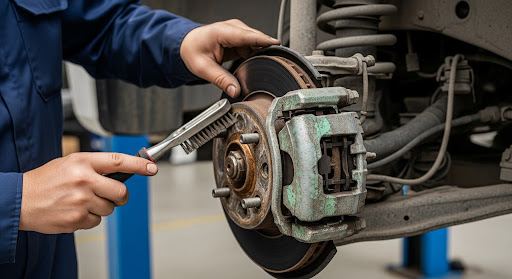
When I perform a brake teardown, I focus heavily on the caliper brackets. I look for the characteristic green crust oxidation that builds up under the stainless steel abutment clips. If that corrosion isn’t removed—either through meticulous wire brushing or bead-blasting—it pinches the pads, preventing them from sliding. I ensure the bracket mating surfaces are down to bare metal before applying a thin layer of specialized moly-grease to prevent the salt from taking hold again.
Flushing the Salt-Laden Fluid
A mechanical fix is only half the battle. Because brake fluid is hygroscopic—meaning it attracts water—the humidity of a Northern Utah spring can lower your fluid’s boiling point significantly. If your calipers have been dragging and overheating, that fluid is likely thermally degraded. I perform a full system flush to swap out that dark, moisture-heavy liquid for fresh fluid with a high dry-boiling point. A full flush ensures that when you hit the brakes on Antelope Drive, the hydraulic pressure moves the pistons rather than simply compressing gas bubbles.
If your vehicle is pulling to one side or you smell burning brakes after a freeway run, contact Steve’s Automotive Specialist. I’ll perform a full teardown to neutralize winter salt damage and restore your stopping power. View our shop’s location on Google Maps for directions.
Frequently Asked Questions
Can road salt cause my brakes to stick?
Yes. Road salt acts as a catalyst for corrosion between the caliper piston and the bore. When oxidation builds up in the bore, it creates a physical barrier to piston movement, forcing the pads to stay engaged and generating the heat responsible for fluid degradation.
Why does my car pull to one side when braking?
A pull usually indicates a seized caliper on one side of the vehicle. If the left front caliper piston is stuck, it won’t apply the same pressure as the right, causing the vehicle to pivot toward the side with the functioning brake.
How do technicians fix seized slide pins?
I remove the pins, clean the bore of all oxidized grease and salt, and inspect the rubber boots for tears. When I find pins without pitting, I use high-temperature silicone grease for lubrication, but pitted hardware requires immediate replacement to ensure the caliper centers correctly.
Is it safe to drive with a dragging brake caliper?
No. A dragging caliper generates extreme heat that can boil your brake fluid, leading to a spongy pedal or total brake failure. Additionally, the heat can damage wheel bearings and warp your rotors, significantly increasing repair costs.
What is the green crust found on brakes?
The green crust is a byproduct of road salt reacting with the metal of your caliper brackets and clips. The accumulation functions as a physical obstruction that prevents the pads from moving freely, leading to the binding effect that ruins brake performance.