
Sandy I-15 commuters experience accelerated brake wear due to high-speed kinetic energy dissipation. Deceleration from highway speeds to stop-and-go traffic near the Point of the Mountain generates rotor temperatures exceeding 450°C. This thermal load causes pad glazing, cementite formation, and caliper hardware corrosion, necessitating frequent friction material replacement.
I am currently inspecting a vehicle that performs a daily round trip between the Sandy Expo Center and Silicon Slopes. As I remove the front wheels, the acrid scent of scorched binding resins confirms significant thermal distress. The high-speed bursts followed by abrupt stops at the 14600 South bottleneck have clearly pushed these components beyond their standard operating parameters.
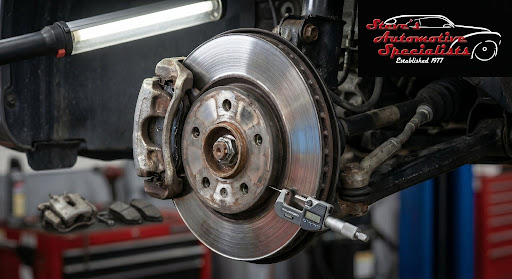
Is the Point of the Mountain killing your brake pads?
Descending the 4 percent grade into Utah County forces friction materials beyond their 450°C thermal recovery limit. Sustained pedal application creates a continuous heat-soak that compromises pad binding agent integrity. I observe a measurable decline in deceleration efficiency before the vehicle clears the Point of the Mountain.
The 450°C thermal threshold
Descending toward Utah County requires the braking system to manage a 4 percent grade shift while maintaining highway speeds. I have observed rotor temperatures on this route exceeding 450°C (842°F). At this intensity, the resins in OEM semi-metallic pads liquefy and migrate to the surface. This creates a hardened, glass-like layer known as glazing. Once a pad is glazed, it loses the ability to bite into the rotor effectively. I am seeing this manifest as a wooden pedal feel during the morning rush at the 9000 South interchange. Ceramic compounds maintain friction stability during heat-soak, while semi-metallic pads undergo resin liquefaction. I am recording less surface glazing on ceramic installations following high-speed I-15 cycles.
Why does Sandy’s winter brine cause uneven rotor thinning?
Magnesium chloride runoff from local interchanges penetrates caliper seals and leads to mechanical seizing of the slide hardware. This localized corrosion prevents the caliper from floating freely, forcing the inboard pad to drag against the rotor surface even when the pedal is released. The result is a parasitic heat gain that thins the rotor casting unevenly across its diameter.
Mechanical seizing at 10600 South
Environmental catalysts along the Wasatch Front are particularly aggressive toward hydraulic hardware. UDOT’s application of liquid magnesium chloride and salt brine on I-15 atomizes into a corrosive mist. I frequently find that this brine penetrates the caliper slide pin boots, causing the pins to seize. When the caliper cannot slide freely, the inboard pad remains in constant contact with the rotor. This results in inboard wear that is often 30 percent faster than the outboard side. This hydraulic imbalance serves as the primary catalyst for premature pad depletion on the I-15 corridor. I prioritize the inspection of caliper slide pin articulation to identify this specific friction variance during every forensic teardown.
How stop-and-go traffic near the Sandy Expo Center creates pedal pulsation?
Stationary clamping after a high-speed stop creates localized heat spots that transform rotor iron into ultra-hard cementite. When the vehicle sits at a standstill during I-15 congestion, the hot pads act as an insulator, preventing the covered portion of the rotor from cooling at the same rate as the exposed casting. This thermal variance permanently alters the metallurgical structure of the disc.
Cementite formation and DTV
Many drivers reporting a steering wheel shimmy assume they have warped rotors. In my experience, the issue is usually Disc Thickness Variation or DTV. Bridge maintenance near 7200 South in May 2026 creates high-speed deceleration followed by stationary clamping. Holding pads against a hot rotor prevents cooling and initiates localized metallurgical changes. This traps heat between the pad and a single spot on the rotor.
Thermal cycles trigger a carbon phase shift, creating localized cementite. This brittle carbide is harder than the iron casting and causes immediate pedal pulsation. Because the pad cannot wear down the cementite, a high spot develops. I utilize a digital micrometer to track these deviations to the thousandth of an inch. Even a minor lateral runout causes the rhythmic pulsation felt through the chassis during deceleration.
How do we measure brake integrity at Steve’s Automotive Specialist?
Forensic evaluation of the braking system requires quantitative measurements of lateral runout and fluid moisture content to verify roadworthiness. I use digital micrometers because a variance of just .001 inches—thickness you can’t see—is enough to trigger a rhythmic pedal pulse at highway speeds. Matching your vehicle’s deceleration data against the 450°C thermal threshold allows me to select a friction compound that won’t glaze during the Silicon Slopes commute.
Digital micrometer logging and thermal imaging
I do not rely on visual estimates for Sandy commuter vehicles. I am currently using a digital micrometer to log rotor thinning and a copper-test strip to check for brake fluid hygroscopy. In the Salt Lake Valley, brake fluid absorbs enough moisture in one season to significantly degrade its boiling point, leading to a spongy pedal when descending the Point of the Mountain. While factory manuals might suggest a 30,000 mile interval, I am documenting wear indicators being triggered at 18,000 miles due to local driving cycles. My diagnostic verdict for this vehicle is a full friction reset: new rotors to eliminate DTV and premium pads to handle the thermal load. I will ensure the caliper bracket bolts are torqued to the 80Nm specification to maintain hardware integrity.
If you’re feeling a wooden pedal or steering shimmy at the bottleneck, reach out to us at Steve’s Automotive Specialist at 9245 South 700 East, Sandy, UT 84070. I’ll pull your wheels to map cementite hard spots and verify if your pads have surpassed the 450°C recovery limit.
Frequently Asked Questions
Why do my brakes squeal in Sandy traffic?
Brake squeal in Sandy is caused by abrasive particulate matter and glazed resins becoming trapped between the pad and rotor. During May 2026 roadwork, light-pressure braking prevented pads from reaching self-cleaning temperatures. This allows environmental debris from the Salt Lake Valley inversion to contaminate the friction surface, creating high-frequency harmonic vibrations.
How often should Sandy commuters check their brakes?
I recommend a professional inspection every 6,000 miles for I-15 commuters. The intense thermal cycles at the Point of the Mountain and the corrosive effect of winter brine can cause friction material to degrade twice as fast as the national averages found in standard service manuals.
Can road salt affect my braking performance?
Yes, liquid magnesium chloride used on I-15 causes caliper slide pins to seize. Seized hardware prevents the caliper from centering, causing uneven pad wear and hydraulic loss. This failure significantly extends stopping distances during heavy I-15 traffic cycles.
Why does my steering wheel shake when braking on I-15?
This shaking is typically caused by Disc Thickness Variation. Stationary clamping after high-speed stops causes uneven material transfer and cementite formation. This localized heat-soak creates hard spots that permanently alter the rotor’s surface density. These hard spots create a pulsation that is felt through the steering column during deceleration.
Are ceramic or semi-metallic pads better for Utah driving?
Ceramic pads are superior for I-15 commuters because they handle higher heat-soak cycles without glazing. Ceramics provide consistent kinetic energy dissipation during the rapid speed transitions near Silicon Slopes. Their superior thermal recovery prevents the performance fade common in standard semi-metallic options.
Does the Point of the Mountain increase brake wear?
Yes, the 4 percent grade at the Point of the Mountain increases kinetic energy loads by 15 percent. This elevated friction requirement generates excessive heat, significantly accelerating pad and rotor wear rates. I observe that this sustained thermal stress causes friction materials to reach their failure point faster than national averages.