
Advanced brake diagnostics in Utah eliminate squeals and pulsations from Parley’s Canyon thermal cycles and Magnesium Chloride corrosion. Effective repairs require measuring lateral runout with dial indicators and identifying pad glazing. This diagnostic data allows technicians to fix torque-induced hat-topping, ensuring noise-free operation and reliable stopping power.
Why Your Brakes Scream Descending the Wasatch Front
Descending the I-80 corridor from Park City converts massive kinetic energy into thermal loads that standard city driving cannot replicate. A 6% grade for six miles puts extreme strain on the braking system, often triggering the first signs of harmonic noise or hardware failure.
The Glazing Point
When vehicles frequent Parley’s Canyon, brake pads often reach their Glass Transition Temperature, causing the internal resins to melt and smear across the friction material. Once cooled, this creates a mirror-smooth, vitrified finish known as glazing that lacks the necessary coefficient of friction for quiet operation. This hardened surface slides across the rotor rather than grabbing it, generating a high-pitched, harmonic squeal audible from blocks away.
Harmonic Dampening
Many brake squeaks stem from high-frequency vibrations rather than the friction surface itself. Dry brake hardware vibrates against the bracket during mountain descents, turning the caliper into a source of harmonic noise. I apply high-temp ceramic paste to all metal-to-metal contact points to dampen these vibrations before they become audible noise.
Beyond the Warped Rotor Myth
One of the most common complaints I hear from drivers on State Street or I-15 is a steering wheel shake during braking. Most people assume they have warped rotors. However, in my experience, physical warping of a heavy iron rotor is extremely rare. The reality is usually far more technical and involves microscopic cementite formations.
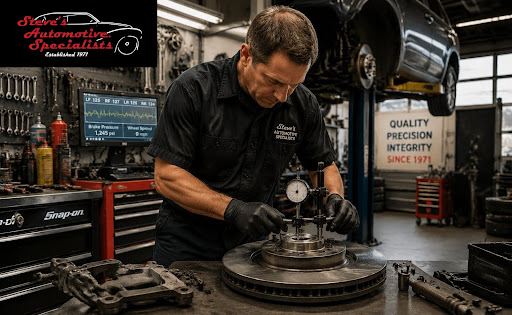
Measuring Lateral Runout
When I diagnose a pulsating pedal, I do not just look at the rotor; I measure it with a dial indicator. We are looking for lateral runout, which is the side-to-side wobble of the rotor as it spins. Even a variance of 0.002 inches is enough to cause a noticeable vibration. This wobble causes the pads to hit the rotor at different intervals, leading to Disc Thickness Variation (DTV). If the rotor is not perfectly true to the hub, you will feel every thousandth of an inch through your foot and steering wheel.
The Impact of Lug Nut Torque
I often trace DTV back to a simple mistake made during a tire rotation or a roadside flat change: improper lug nut torque. Skipping the star pattern or omitting torque sticks creates uneven pressure that distorts the rotor hat. This uneven clamping force causes the rotor to hat-top or slightly distort. Over several thousand miles of driving through the Silicon Slopes in Lehi, this slight distortion causes the pad to wear away high spots on the rotor, leading to a permanent pulse that only a precision resurface or replacement can fix.
The Corrosive Reality of Utah Road Salts
The high-desert climate and the heavy use of liquid de-icers by UDOT create a unique chemical environment for your undercarriage. While these chemicals keep the roads open during mountain storms, they are incredibly aggressive toward your brake hardware.
Seized Slide Pins
Magnesium Chloride is significantly more corrosive than traditional rock salt. I frequently see this liquid chemical creep into the rubber boots of caliper slide pins. Once inside, it dries and turns into a sticky, abrasive paste that prevents the caliper from sliding freely. When a pin seizes, the caliper cannot center itself over the rotor. This results in inboard-only wear, where the inner brake pad grinds down to the metal backing plate while the outer pad looks nearly new. This metal-on-metal contact creates a deep grinding sound that usually means the rotor is beyond saving.
The Spring Cleanse
As the weather transitions from winter snow to spring rain, I prioritize de-scaling the hub surfaces. The interface between the wheel hub and the rotor must be perfectly clean. Any rust or debris trapped between these two surfaces will act as a shim, tilting the rotor and inducing the lateral runout I mentioned earlier. I spend a significant amount of time with a wire brush and hub cleaning tools to ensure a flat, mating surface. This preventative step is the difference between a brake job that lasts 50,000 miles and one that starts shaking after 5,000 miles.
Precision Diagnostics
Visual inspections aren’t enough for modern ABS/EBD systems; you need a dial indicator and live PID data. Pinpointing intermittent harmonics requires measuring thermal deltas and hydraulic pressure across the ABS block.
Thermal Imaging & PID Data
When a driver reports a mysterious grinding or a pull to one side, I often use a thermal imaging camera after a test drive. If one rotor shows a 50°F to 100°F delta compared to the others after a coast-down, it points toward a restricted brake hose or a sticking caliper piston. Furthermore, I can plug into the vehicle’s diagnostic port to monitor Parameter ID (PID) data from the ABS module. Monitoring real-time pressure and wheel speed data ensures the electronic distribution synchronizes with mechanical components.
The 15,000-Mile Canyon Check
Utah’s 4,500-foot elevation and steep canyon grades create a severe driving environment that wears brakes twice as fast as flatter regions. Inspecting brakes every 15,000 miles identifies hardware failures like seizing pins before they become hazardous. My diagnostic process uses empirical data to address specific local issues, from Southern Utah’s abrasive red dust to the extreme heat-soak of Bangerter Highway traffic.
Reach out to Steve’s Automotive Specialist, 2809 S 2300 E, Salt Lake City, UT 84109
to pull your PIDs and verify your rotor runout before your next canyon trip.
Frequently Asked Questions
Do my brakes squeak more in the morning?
Yes. Flash rust forms overnight due to Utah’s humidity shifts. Initial braking cycles strip away this surface oxidation, causing a brief grinding sound that resolves as the pads clean the rotor face. This abrasive noise is temporary and typically disappears after the first few stops once the friction surface is polished.
Can uneven lug nuts cause brake vibration?
Yes. Tightening lug nuts unevenly or with too much force can distort the rotor hat, leading to lateral runout. Over time, this causes the pad to hit the rotor unevenly, creating Disc Thickness Variation which manifests as a pulsing sensation in the brake pedal.
Is brake glazing permanent?
Yes. Light surface glazing may wear off through normal use, severe crystallization typically requires pad replacement. Once heat transforms resins into a hardened mirror finish, the pad loses its friction coefficient. This permanent change results in persistent squealing and reduced stopping power only solvable with new hardware.
How does road salt affect brake noise?
Magnesium Chloride and road salts cause the metal components of the caliper to oxidize and seize. Stuck slide pins prevent pad retraction, causing parasitic drag that generates high heat and rhythmic mechanical noise.
Why do my brakes smell like they are burning after a canyon drive?
This odor indicates that your brake pads have exceeded their optimal operating temperature, causing the bonding resins to outgas. In Utah’s steep canyons, brake fade warns that your system is overheating and requires a professional inspection of the fluid and pads.