
Advanced AI diagnostics track real-time anti-lock braking telemetry and process wheel speed signals at microsecond intervals. Monitoring millivolt variances and controller area network bus data enables machine learning software to flag hydraulic micro-leaks, internal valve bypassing, and mechanical degradation before dashboard warning lights or symptoms manifest.
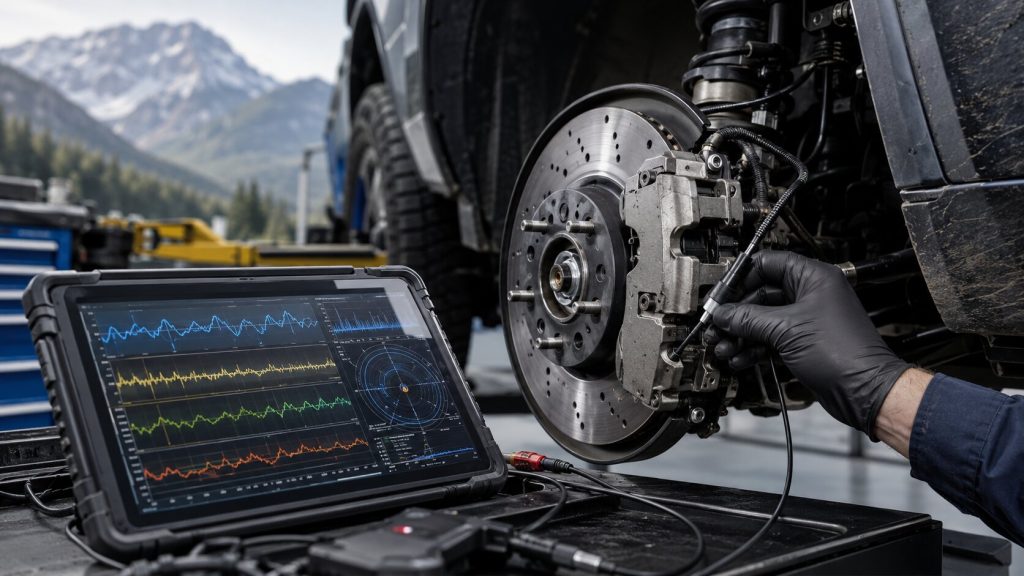
I track live wheel speed data streams down to the microsecond, intercepting tiny signal drops long before a malfunction code can trigger. This real-time analysis of millivolt fluctuations and controller area network bus communication exposes hidden hydraulic micro-leaks and internal valve bypassing instantly. Catching these transient signals allows me to address complex braking degradation long before total system failure.
Why Your Brake Pedal Feel Spongy Descending Parley’s Canyon
I am looking at a late-model sports sedan that just came off the I-80 canyon descent from Park City. The customer stated the brake pedal went soft and spongy halfway down Parley’s Canyon, but by the time they reached the valley floor, the mechanical stiffness returned. The factory service manual says to perform a standard static hydraulic pressure test and check for external leaks, which fails to account for high-altitude thermal stress.
Calculating Hydraulic Micro-leaks via CAN Bus Telemetry Thresholds
I hook up the diagnostic module to extract the historical Controller Area Network bus stream to review the operating timeline. While descending steep grades, the intense kinetic heat causes old brake fluid boiling points to drop, causing localized outgassing and pressure drops. The software maps the exact milliseconds of latency between the Electronic Stability Control command and corresponding wheel deceleration to isolate an internal valve-bypassing signature.
Is it an ABS Module Failure or Winter Road Salt Corrosion
The vehicle currently on my service rack presents an intermittent anti-lock braking system (ABS) light that traditional diagnostic tools have consistently failed to pinpoint. After performing a visual inspection, I removed the right rear wheel assembly to discover the tone ring and wheel speed sensor completely caked in a thick, white, chalky crust. Utah winters are notoriously harsh, requiring the heavy, persistent application of liquid magnesium chloride along the entire I-15 corridor.
This extreme thermal cycling effectively acts as a pump, drawing moisture and atomized salt directly into the most sensitive electrical connections. The resulting corrosion creates high-resistance paths that trick the ABS module into reporting a failure where none exists. Understanding the chemical interaction between road salts and sensor housing is critical, as simply clearing the error code will not prevent the inevitable return of the warning light once the salt-laden moisture migrates back into the harness.
Isolating High-resistance Harness Faults From Mechanical Sensor Wear
Standard digital multimeters are inherently too slow to catch transient dropouts because they average out voltage signals into artificially clean reference lines. They are designed for steady-state measurements, not the high-frequency environment of a modern vehicle’s sensor network. To combat this, I load the raw telemetry feed into my specialized AI diagnostic interface and sample the wheel speed data at microsecond intervals as I manually rotate the hub. The screen displays a jagged, noisy waveform that provides a direct look at the electrical health of the system.
This allows the software to clearly isolate high-resistance wire corrosion from true mechanical sensor wear. It comes down to knowing whether the issue is just crusty, salt-damaged wiring or a real sensor fault, which allows me to get the car fixed efficiently without running up a huge repair bill for the owner.
How Brake-by-wire Encapsulation Responds to Mountain Thermal Shock
In a modern, fully encapsulated brake-by-wire system, the driver’s foot is completely divorced from the physical caliper pistons. The problem with encapsulated systems is that they mask real-world mechanical binds with digital feedback. Drivers don’t realize their slide pins are seizing until the electronic module reaches its limit. This is especially true for the daily grind near Lehi, where the constant cycling of the brake simulation module hides the mounting physical resistance of dirty, stuck pins.
High-desert dust and fine, abrasive particulates inevitably wedge themselves behind the caliper slide pins. This buildup causes enough drag to prevent the hydraulic pistons from retracting the way they were designed to. Because the system is “by-wire,” it tries to compensate for this sluggish return electronically, but this masking only hides the physical degradation until the point of total system failure.
Why Modern Brake Simulation Modules Require Microsecond Software Analysis
Spinning a rotor with a dial indicator or simply eyeballing pad thickness won’t show you why the ESC module is silently panicking under heavy mountain load. In an encapsulated brake-by-wire system, the vehicle electronic stability control module actively hides early mechanical degradation by electronically adjusting individual solenoid pressures. This correction is invisible to the driver but creates a massive discrepancy in the brake system’s performance profile.
Getting to the truth requires bypassing that electronic masking; I focus on comparing the mechanical effort of the pedal against the electrical draw of the actuator and the actual deceleration at the wheels. By analyzing the interaction of these three variables, I can determine if the system is compensating for a physical fault, such as a sticking piston or a warped mounting bracket, long before the driver ever feels a shudder or hears a grind.
Advanced Brake Data Verification
I am monitoring the live diagnostic stream during a simulated road test on the dynamometer to find a subtle brake judder. During a standard test drive, a technician can easily mistake this rhythmic vibration for a typical case of warped brake rotors. However, the physical measurement specifications state the rotors are within the allowed thickness variation of 0.02 millimeters.
Running the multi-channel data stream through the diagnostic platform reveals a distinct waveform jitter that repeats every 360 degrees of hub rotation. The software isolates a microsecond signal dropout from the front left tone ring caused by a microscopic chipped tooth on the magnetic ring.
When these microsecond signal dropouts compromise your safety on the I-15, contact Steve’s Automotive Specialist at 2809 S 2300 E, Salt Lake City, UT 84109 to isolate the exact fault and avoid unnecessary repairs.
Frequently Asked Questions
Can AI diagnostics detect brake fluid breakdown?
Yes. AI diagnostic software identifies brake fluid breakdown by measuring the exact milliseconds of latency between electronic braking commands and wheel deceleration. As brake fluid absorbs moisture, its boiling point drops, causing minute pressure drops that diagnostic software detects under high thermal stress.
Will a standard scan tool find high-resistance sensor faults?
No. Standard scan tools average out voltage signals and only trigger generic trouble codes after a component completely fails. AI diagnostic platforms sample raw sensor telemetry at microsecond intervals, allowing them to isolate high-resistance wire corrosion from true mechanical failures.
Do brake-by-wire systems hide mechanical brake wear?
Yes. Modern brake-by-wire modules electronically compensate for uneven pad wear and sticking pistons by automatically adjusting internal hydraulic solenoid pressures. This electronic masking prevents the driver from feeling physical symptoms through the pedal until the mechanical damage becomes severe.
Can road deicers cause false ABS warning lights?
Yes. Salt and liquid magnesium chloride create a highly conductive crust inside wheel speed sensor harness connectors. This corrosion degrades electrical signals and creates high-resistance anomalies that older diagnostic equipment often misinterprets as a failed anti-lock braking system control module.
How does high altitude affect brake cooling efficiency?
High altitude reduces atmospheric pressure, which alters the convective heat dissipation rates of brake rotors during sustained descents. This thermal retention accelerates brake fluid degradation and friction material glazing, requiring advanced digital diagnostics to track subtle hydraulic pressure drops.