
This article explains why Salt Lake City’s high elevation forces Audi 2.0T turbochargers to work harder along I-215, causing wastegate rattle and P0299 underboost codes. It details how altitude-induced heat ovalizes bushings, outlines a three-step diagnostic process, highlights secondary damage risks like catalytic converter failure, and recommends timely repair.
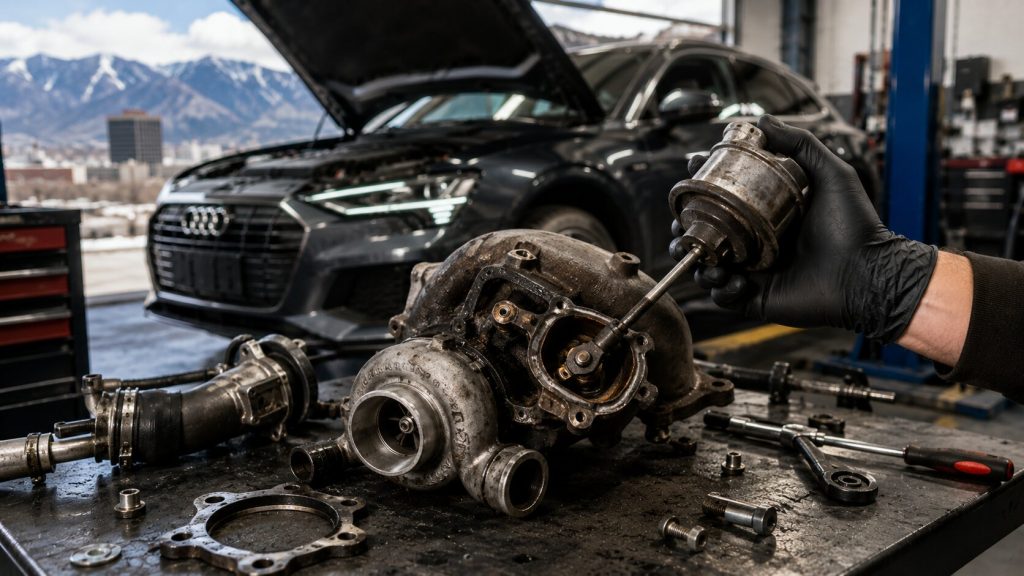
Exhaust gas leaks around the wastegate linkage on Audi 2.0T TFSI engines running along the I-215 beltway in Salt Lake City, causing turbocharger boost loss and a sharp rattling noise under deceleration. At 4,500 feet above sea level, the engine control module forces the wastegate actuator to hold higher duty cycles to maintain target manifold pressure, rapidly accelerating mechanical play in the stainless steel flapper bushing.
Understanding Altitude Stress on Audi Turbochargers
Salt Lake City sits at an elevation of roughly 4,200 to 5,200 feet above sea level, dropping atmospheric pressure down to roughly 12.3 psi (compared to 14.7 psi at sea level). At 5,200 feet, the Audi’s computer forces the turbo to work overtime, cramming extra thin air into the engine just to match sea-level power. When the air outside is thin, I see turbochargers working significantly harder to deliver that same air volume.
The wastegate is a small valve that controls how much exhaust gas spins the turbine wheel. To compensate for thin air on I-215 or up Parleys Canyon, the engine computer holds the wastegate shut much longer:
- Higher Duty Cycles: The system forces almost all exhaust gas past the turbine wheel to build necessary pressure.
- Extreme Heat: Holding the valve shut under heavy load spikes temperatures inside the turbine housing past 1,600°F.
- Accelerated Wear: Combined heat and mechanical tension cause rapid wear on the linkage arms, leading to early component failure compared to sea-level vehicles.
Mechanics of Wastegate Rattle and Boost Loss
Inside the turbocharger, the wastegate valve sits on a metal rod passing through a solid metal bushing in the exhaust housing. Extreme thermal cycles and constant mechanical tension degrade this assembly over time:
- Bushing Ovalization: Intense heat wears down the inside of the bushing, stretching the round hole into an oval.
- Side-to-Side Play: Once ovalized, the wastegate arm loses stability and vibrates violently against its housing when you release the accelerator.
- Deceleration Rattle: This vibration creates a loud metallic rattling sound between 2,000 and 3,000 RPM.
- Boost Leaks: Exhaust escapes past the unsealed valve face, which starves the engine of boost, cuts acceleration, and triggers fault code P0299.
Common Signs Your Audi Turbocharger is Struggling
A failing wastegate actuator gives off several clear warning signs:
- Metallic Rattle: A distinct sound resembling a metal marble spinning in a tin can when letting off the gas pedal.
- Loss of Acceleration: Sluggish throttle response and hesitation when trying to pass or merge onto the freeway.
- Check Engine Light: Active fault code P0299 stored in the engine control unit.
Step-by-Step Diagnostic Procedure
Before condemning the entire turbocharger, I run this three-step test to check if it’s just a bad sensor or actual worn-out metal.
1. Electronic Diagnostics and Live Data Testing
- Connect a dedicated scan tool to check for active and stored fault codes.
- Monitor real-time boost pressure requested by the computer versus actual pressure built by the turbocharger.
- Check wastegate duty cycle; readings staying above 85% during steady acceleration confirm the system is overworking to compensate for a physical leak.
2. Physical Inspection of the Wastegate Linkage
- Allow the engine to cool completely before reaching behind the heat shields.
- Grab the actuator arm connecting the vacuum diaphragm to the turbine housing and test for side-to-side play.
- Use precision measuring gauges on the housing; any shaft movement over a fraction of a millimeter confirms the valve can no longer seal properly.
3. Testing the Pneumatic Actuator Capsule
- Disconnect the vacuum control line and attach a hand pump directly to the actuator fitting.
- Apply controlled pressure to check if the rod moves smoothly across its full range of travel.
- Monitor the gauge for pressure drops, which reveal a torn internal rubber diaphragm.
Prevent Costly Secondary Engine Damage
Leaving a loose wastegate unfixed can destroy your catalytic converter. When the computer detects boost loss, it dumps extra fuel into the engine to protect it from overheating, which burns up and melts the expensive filter in your exhaust.
If your Audi 2.0T makes a metallic rattling sound while coasting down Parleys Canyon or throws a check engine light when merging onto I-215, bring it to Steve’s Automotive Specialist at 2809 S 2300 E, Salt Lake City, UT 84109. We’ll measure the play in the linkage arm to see if a simple anti-rattle clip will fix it, or if the metal housing is worn out and needs a full replacement.
Frequently Asked Questions
Can a loose wastegate cause permanent turbocharger damage?
Yes, when a loose wastegate leaks pressure, the engine computer forces the turbine wheel to spin beyond safe speed limits to reach target boost. This overspeeding creates extreme thermal stress on the center shaft bearings, which eventually causes bearing collapse or wheel disintegration.
Is wastegate rattle repairable without replacing the full turbocharger?
Yes, early linkage play can sometimes be fixed by installing an aftermarket anti-rattle clip or shortening the actuator rod to pull the valve tight. However, if the cast-steel bushing inside the turbine housing is severely ovalized, full turbocharger replacement is the only lasting repair.
Does driving at high altitude make boost leak codes appear faster?
Yes, the thinner air at higher elevations forces the turbocharger to spin much faster and hold the wastegate closed longer to build standard boost pressure. This added workload reveals minor exhaust or intake leaks that might go unnoticed at sea level.
Will driving with a failing wastegate reduce fuel economy?
Yes, when the wastegate leaks exhaust gas, the engine loses boost efficiency and the control module enriches the fuel mixture to protect internal components. This continuous rich condition drops overall miles per gallon and causes sluggish acceleration.