
Post-warranty Audis in Utah fail faster than national maintenance schedules predict. SLC altitude and magnesium chloride road treatments accelerate specific damage, like B9-chassis hydro-bushing crystallization and electrical ground corrosion. Independent specialists target these specific failures, avoiding the unnecessary bulk replacement parts pushed by corporate dealership manuals.
Once your 36-month warranty wraps up, corporate dealerships rely on national rulebooks that ignore local conditions. Salt Lake City’s winter inversions, canyon drives, and magnesium chloride road salt subject your Audi to micro-climate stressors standard service schedules miss. That mismatch hits your wallet. Sticking with the dealership past that window means paying inflated rates for one-size-fits-all service packages. I see this exact story play out in the bay every week when local drivers realize repair bills are climbing faster than their odometer—which is why switching to an independent shop is the smarter financial move.
The Reality Of Dealership Overhead and Flat-Rate Pricing
When you buy a new European luxury car, the first three years are mechanically stress-free on paper. You drop the keys off, sit in a waiting room, and pick up a zero-dollar invoice because everything falls under factory coverage. But the second that coverage expires, the financial mechanics shift entirely.
Corporate dealerships operate under massive facility overhead, multi-layered management structures, and rigid franchise debt. Those expenses don’t just disappear; they are quietly baked into every hourly labor rate and replacement part quote handed out at the service counter. For Audi owners navigating Utah’s harsh driving environment, this corporate overhead model creates a massive disconnect. Dealership service writers work under strict corporate quotas and national flat-rate manuals. These manuals assume every vehicle experiences identical wear patterns, ignoring the reality of local micro-climates.
Evaluating Component Health Versus Preemptive Up-Sells
Working on these cars every day means looking past the polished dealership brochures. Independent shops don’t carry the massive real estate debt or franchise fees of a corporate dealer, which means our labor isn’t tied to quotas. We evaluate what your machine actually needs to survive the next five years, not what a national “all-inclusive” package dictates.
One of the most frustrating things I see in dealership service histories is the “bulk replacement” mentality. If you bring in an Audi for a rough idle at 50,000 miles, a dealership will often push an intake cleaning and a full coil-pack set. In the shop, I usually find it’s just a single cylinder misfire caused by oil weeping into the spark plug well due to a brittle valve cover gasket—a common failure point in our dry, high-altitude climate. We replace the gasket and the single faulty coil, fixing the root cause for a fraction of the cost.
Why Regional Climate Dictates Your Maintenance Strategy
Utah winter road crews rely heavily on liquid magnesium chloride brine to keep canyon routes and highway loops clear during storms. While this chemical treatment keeps roads moving, it wreaks absolute havoc on your car.
An independent specialists looks closer at how regional environmental stressors actually interact with your Audi by focusing on key trouble spots:
- Undercarriage Fasteners: Road brine accelerates galvanic corrosion on steel and aluminum hardware, turning standard bolt removal into a sheared-thread hazard if not handled carefully.
- Electrical Grounds: Salt accumulation and moisture intrusion create microscopic resistance spikes in sensor wiring, triggering phantom fault codes that dealerships often try to fix by replacing entire wiring harnesses.
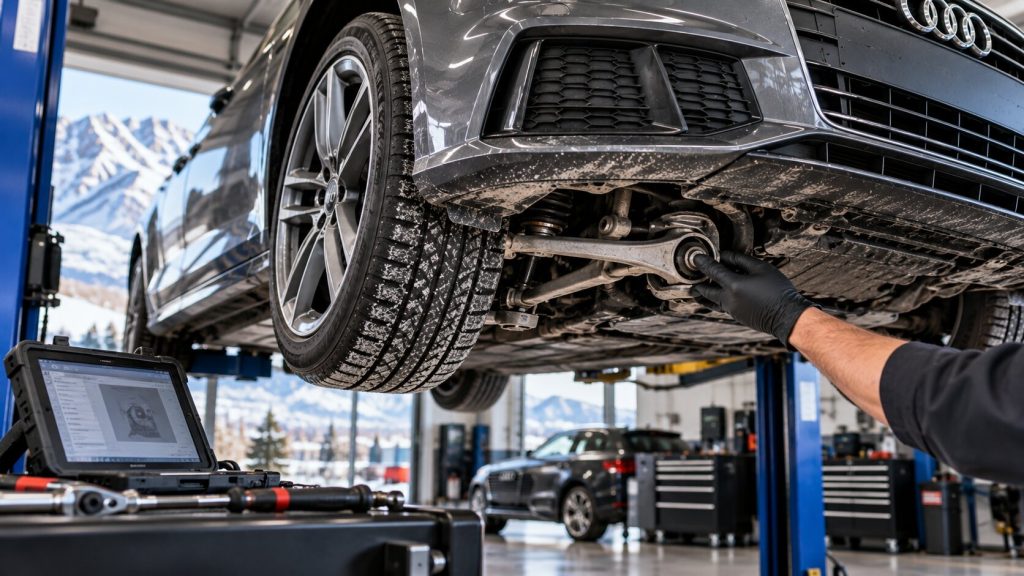
- Rubber Suspension Bushings: Sub-freezing inversion cycles harden elastomeric compounds prematurely, causing micro-cracking long before standard mileage intervals suggest wear. For example, I’m seeing B9-chassis control arm bushings in SLC failing at 45k miles, well ahead of the national 60k average. A dealership will quote the entire wishbone assembly; I’ll often isolate it to the hydro-bushing, saving the client the cost of the structural arm.
Instead of automatically recommending an expensive assembly replacement, an experienced specialist targets the precise point of failure. We focus our labor on mechanical preservation rather than corporate up-sell quotas.
Why Localized Care Outlasts National Manuals
National maintenance manuals ignore SLC’s 4,200ft altitude and heavy brine exposure. Transitioning away from dealership networks allows you to build a direct, transparent relationship with the mechanic turning the wrenches on your car.
Independent shops utilize identical factory-level diagnostic software (such as ODIS) and wiring schematics without the corporate markup. This means your Audi receives the exact same high-level electronic calibrations and mechanical adjustments, but with personalized attention to your actual driving habits.
Stop paying for national bundle maintenance that ignores Utah’s climate. Bring your Audi to Steve’s Automotive Specialist at 2809 S 2300 E, Salt Lake City, UT, for a diagnostic that actually matches your driving habits.
Frequently Asked Questions
Does Audi Signature Care cover all maintenance costs for the first three years?
No. While it covers scheduled maintenance intervals, it excludes common wear-and-tear items like brake pads, rotors, and tires. You will still be responsible for these costs once the package expires or the mileage limit is reached.
Can independent specialists service my Audi without voiding the warranty?
Yes. Federal law (the Magnuson-Moss Warranty Act) protects your right to choose any qualified repair shop. As long as the service is performed to manufacturer specifications using quality parts, your factory warranty remains fully intact.
Do independent shops have the same diagnostic tools as dealerships?
Yes. Professional independent specialists invest in the same factory-level diagnostic software and scan tools used by dealerships. This allows us to read proprietary fault codes, perform module coding, and complete system resets with the same accuracy.
Are independent shop labor rates cheaper than dealership rates?
Yes. Independent shops typically have lower overhead costs than large corporate dealerships. These savings are passed directly to you, resulting in significantly lower hourly labor rates for the same high-quality technical service.