
Brake maintenance at 5,800ft requires proactive pad replacement at 4mm to prevent thermal damage. High altitude reduces air-cooling efficiency, causing thin pads to transfer excessive heat to rotors and calipers. This domino effect triggers rotor warping, seized pistons, and catastrophic ABS module failure during Salt Lake Valley’s high-altitude, stop-and-go commutes.
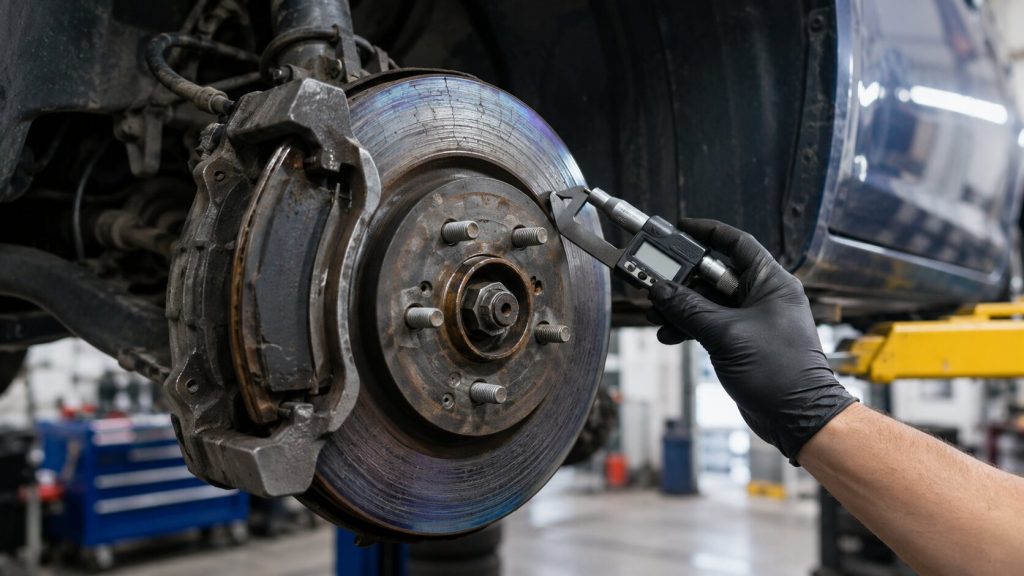
I am standing over a BMW G20 chassis with the wheels pulled, and the smell of scorched friction material is unmistakable. The driver reported hydraulic fade while descending from the Bench toward Orem. I am holding a digital micrometer to the front rotor, and the reading confirms the disaster. The rotor is at 28.4mm, which is technically above the minimum thickness stamped on the hat, but the purplish heat checking tells a different story. In Utah, the service manual is a baseline, not a rule.
Why does a short commute to University Place destroy rotors?
Short-cycle driving in Orem subjects brake assemblies to repetitive, low-speed friction that prevents moisture evaporation and accelerates component fatigue. The current I-15 bridge maintenance near the Point of the Mountain forces prolonged idling and creeping, which traps heat within the wheel wells. Without the necessary airflow found at highway speeds, the kinetic energy transforms into a localized heat soak that bakes the caliper seals and glazes the pad surface.
Brake heat soak during May 2026 traffic
At our 5,800ft elevation, the air is too thin to pull heat away from the vented rotors efficiently. When you ride the brakes in a crawl, the pads stay clamped against the rotor face. I frequently pull brake pads with sufficient friction material that exhibit a literal glass-like sheen, indicating the compound has cooked into a crystallized ceramic state.
The $300 Pad vs. the $3,000 ABS Module
When pads wear thin, the caliper pistons extend further into the high-heat zone, directly transferring thermal energy into the hydraulic fluid. This heat causes the DOT 4 fluid to boil and break down, creating micro-bubbles that translate to a spongy pedal and inconsistent pressure. Over time, the degraded fluid becomes acidic and corrodes the delicate internal valves of the DSC module, turning a simple maintenance task into a massive electronic failure.
How Boiled DOT 4 fluid triggers DSC ghost codes
The DOT 4 Low Viscosity fluid begins to break down chemically under these extreme temperature cycles. I use a copper testing strip on the reservoir fluid, and a deep purple result indicates the internal plating of the ABS valves is literally dissolving. If this driver had invested in pads and a fluid flush six months ago, they would not be facing a multi-thousand-dollar module replacement today.
Corrosion Chemistry on the Wasatch Front
Magnesium chloride applied during the winter months atomizes into a corrosive dust that penetrates the rubber dust boots of the caliper slide pins. Corrosive chemical buildup creates a permanent galvanic bond that hangs the caliper, resulting in accelerated pad wear and parasitic rotor friction. This dragging generates a feedback loop of extreme heat that permanently warps the rotor, making a standard pad replacement impossible without a full hardware overhaul.
Why seized slide pins are a Utah specialty
I am currently struggling to move the slide pins on this caliper because the magnesium chloride has worked its way past the rubber boots. A simple pad swap becomes impossible once the caliper is seized and stays partially applied against the rotor. This creates a feedback loop of heat that eventually warps the rotor, measured on this BMW at 0.08mm compared to the 0.05mm factory spec.
Forensic Brake Inspection Results
I have the dial indicator mounted to the hub to measure lateral runout, and the needle is jumping well past the 0.05mm factory limit. I also used a chemical test strip to confirm the copper content in the reservoir is high enough to warrant an immediate system flush. The diagnostic verdict confirms that the high-altitude environment has accelerated the chemical and mechanical breakdown of the entire hydraulic circuit.
Measuring runout and fluid copper content
The pressure transducer hooked up to the master cylinder shows a staggered pressure rise on the tablet, confirming hardened internal seals. This is the smoking gun that proves the high-altitude heat cycles turned a routine maintenance item into a forensic repair. In our environment, proactive replacement at 4mm is the only way to protect the hydraulic integrity of the DSC system.
If your brakes feel soft or the wheel shudders when descending from the Bench, reach out to Steve’s Automotive Specialist at 925 N State St, Orem, UT 84057 to stop the mechanical domino effect.
Frequently Asked Questions
Should I replace pads and rotors at the same time?
Yes. At Utah’s 5,800ft elevation, rotors undergo extreme thermal stress that causes Disc Thickness Variation. Installing new pads on old, heat-cycled rotors leads to steering wheel shudder and reduced stopping power. Matching new pads with fresh rotors ensures a flat mating surface for safety.
What causes the brake pedal to feel soft?
A soft pedal indicates that your brake fluid has absorbed moisture or reached its boiling point. In Utah’s stop-and-go traffic, thin pads transfer heat into the calipers, creating vapor bubbles in the hydraulic lines. This requires a full system bleed or fluid replacement to restore pressure.
Why do my brakes squeak in the morning?
Squeaking often results from surface oxidation or glazing on the pads. In Utah, rapid temperature shifts and moisture from May weather cause a thin layer of rust to form on rotors overnight. If the noise persists after several stops, the pads have likely lost their friction integrity.
Is it safe to drive with the brake wear light on?
No. When the wear sensor trips, you typically have less than 3mm of material remaining. At this stage, the heightened risk of metal-on-metal contact permanently scores the rotors and seizes the caliper pistons, inflating total repair costs and compromising safety.
How does Utah’s altitude affect my brakes?
Thin air at 5,800ft is less effective at dissipating heat than sea-level air. Reduced air density causes brakes to operate at elevated temperatures during standard driving, accelerating fluid oxidation and increasing the probability of rotor warping. Proactive maintenance is required to compensate for this reduced cooling capacity.