
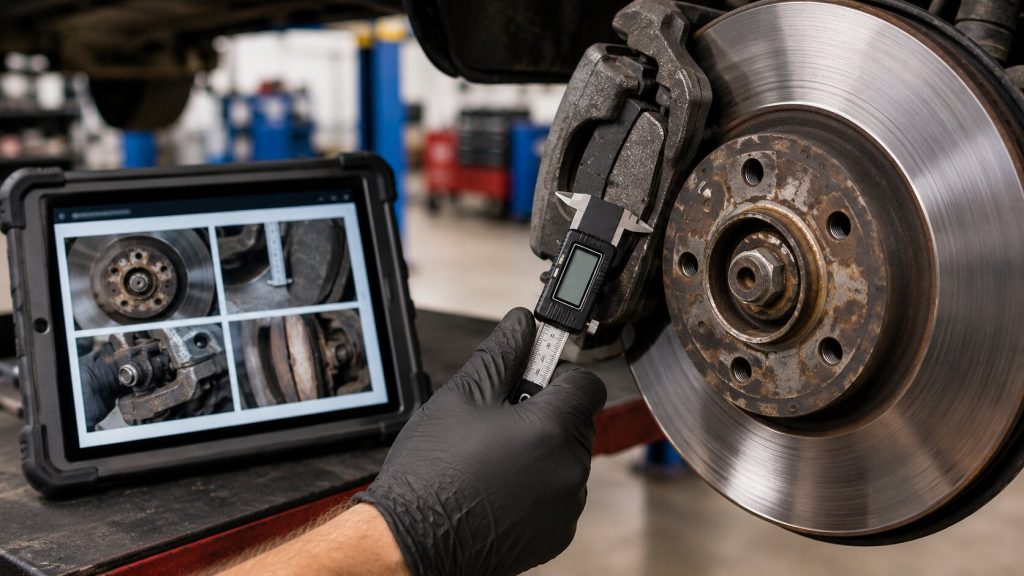
Digital brake inspection reports utilize high-resolution photographic evidence alongside precise millimeter measurements to bridge the gap between technician findings and Utah drivers with objective, visual data to make informed repair decisions, ensuring family safety on mountain roads.
Why Brakes Struggle in Utah Winters
The environment in Utah presents a unique challenge for braking systems. The combination of high-elevation mountain passes and the aggressive use of magnesium chloride on state highways creates a perfect storm for mechanical degradation. Magnesium chloride, the standard de-icing agent used to keep I-15 and canyon roads clear, is highly corrosive. When this atomized mist enters the wheel well, it settles on the caliper slide pins. The lubricant breaks down, turns into a gritty paste, and eventually, the pins seize.
When a slide pin seizes, the caliper can no longer center itself. One pad does all the work, while the other glazes over. Standard visual checks frequently fail to capture the full picture, as they only account for outer pad depth rather than the condition of the hardware inside the caliper. A professional digital process involves pulling the assembly apart to inspect the hardware itself. Documenting the seizing pins, the uneven taper of the pad, and the crust of salt buildup provides clear, objective evidence of why a vehicle might pull to one side or feel sluggish during a morning commute.
Deciphering the Digital Report
The industry standard for braking safety relies on precise measurements. The transition from subjective estimation to objective data is best realized through the use of digital depth gauges. If a report indicates that a brake pad is at 3mm, it should be accompanied by photographic evidence with the gauge clearly showing that measurement.
This process is not about upselling; it is about the coefficient of friction. Once that friction material drops below 3mm, the heat dissipation capacity of the pad plummets. Under normal conditions, the vehicle might seem to stop adequately, but in a panic stop on a slick Utah incline, the difference between a 3mm pad and a 6mm pad is often the difference between a controlled stop and a collision. Digital reports categorize these findings using a clear Red, Yellow, and Green status system. This allows drivers to categorize their immediate safety needs versus future maintenance requirements, putting the decision-making power back into their own hands.
The Anatomy of a Mountain Brake Failure
The Wasatch Range does not forgive mechanical failure. When driving in Utah, the brakes are tasked with converting massive amounts of gravitational potential energy into heat during every descent. If the rotors are already pitted from salt exposure, they lack the necessary surface area to dissipate this intense thermal load.
Pitting is the formation of small, deep holes in the metal surface of the rotor caused by chemical corrosion. These pits act like sandpaper, tearing through brake pad material at an accelerated rate. This is a form of real-world wear that the factory maintenance manual, written for flat-land driving, often fails to predict. While a manufacturer might suggest a brake service interval of 30,000 miles, that figure is largely irrelevant for a vehicle traversing the steep, salt-treated roads of Northern Utah. By capturing images of these pitted surfaces, technicians can show drivers exactly why their pads are wearing down twice as fast as expected.
Why Precision Matters in Automotive Repair
Precision measurement stands in direct contrast to the guesswork that plagued early automotive repair. When a rotor reaches its safety threshold, the digital report links that specific data point to a photograph, ensuring you see the wear rather than just hearing about it. This level of technical documentation ensures that no part is replaced prematurely, but it also guarantees that no dangerous part is left on the vehicle.
The digital report acts as a permanent record of the vehicle’s health. This record acts as a roadmap for your vehicle’s health, illustrating how your driving style interacts with Utah’s terrain. Because I track wear cycles through the seasons, I can let you know exactly when to expect your next service, keeping your vehicle reliable regardless of the weather.
The Value of Visual Evidence
The implementation of digital reporting is perhaps the most significant advancement in consumer-facing automotive diagnostics. It changes the dynamic from a conversation between a knowledgeable authority and a dependent consumer to a collaborative review of data. When the evidence is presented visually, the need for complex, jargon-heavy explanations is reduced. A photograph of a brake pad backing plate that has been pushed out by rust-jacking is universally understood; it requires no technical training to recognize that the component is physically failing.
This transparency is the foundation of building a long-term, trusted relationship between a vehicle owner and their service provider. You no longer have to rely on guesswork; our digital reports provide the proof you need to make informed safety decisions with complete peace of mind.
Don’t leave your family’s safety to guesswork. Get the objective, visual proof you deserve with a digital brake inspection at Steve’s Automotive Specialist. Visit us at 2809 S 2300 E, Salt Lake City, UT 84109.
Frequently Asked Questions
Do you need a digital inspection instead of a standard one?
Yes. Digital inspections are superior because they provide objective, photographic proof of your vehicle’s condition. While a standard inspection relies on a technician’s verbal assessment, a digital report allows you to see the exact millimeter measurements and visual evidence of wear, ensuring you make fully informed safety decisions.
Does road salt affect my vehicle’s braking system?
Yes. Magnesium chloride used on Utah roads causes severe oxidation on brake hardware. This leads to rust-jacking on brake pads and seizing of caliper slide pins. Over time, this salt-induced corrosion forces the calipers to function improperly, resulting in uneven pad wear and significantly reduced stopping power.
Is there a minimum thickness for brake pads to ensure vehicle safety?
Yes. The industry standard for safety is a minimum of 3mm of friction material remaining. Anything below this threshold risks rapid overheating, rotor damage, and increased stopping distances. In challenging environments like Utah, replacement is recommended closer to 4mm to ensure consistent performance on steep mountain grades.
Can mountain driving in Utah cause premature brake wear?
Yes. Frequent driving in mountainous terrain significantly accelerates brake wear compared to flat-land driving. Repeated heavy braking on steep descents generates high thermal loads that degrade friction material faster. When combined with corrosive road treatments, this environment demands more frequent inspections than standard vehicle maintenance intervals typically suggest.
Does rotor pitting negatively impact my overall braking performance?
Yes. Road salt creates chemical corrosion that eats into the metal of your rotors, leaving behind the small, deep craters called pitting. These pits act like sandpaper, wearing down your brake pads prematurely and reducing the contact surface area, which leads to brake fade and inefficient, inconsistent stopping.