
Land Rover air suspension faults in Salt Lake City stem from cracked rubber air bags, corroded valve blocks, and bound height sensors, often triggered by freezing winters and road salt. Driving on leaking air bags burns out the compressor. Diagnostics involve voltage checks, pressure leak-down tests, and soap leak isolation.
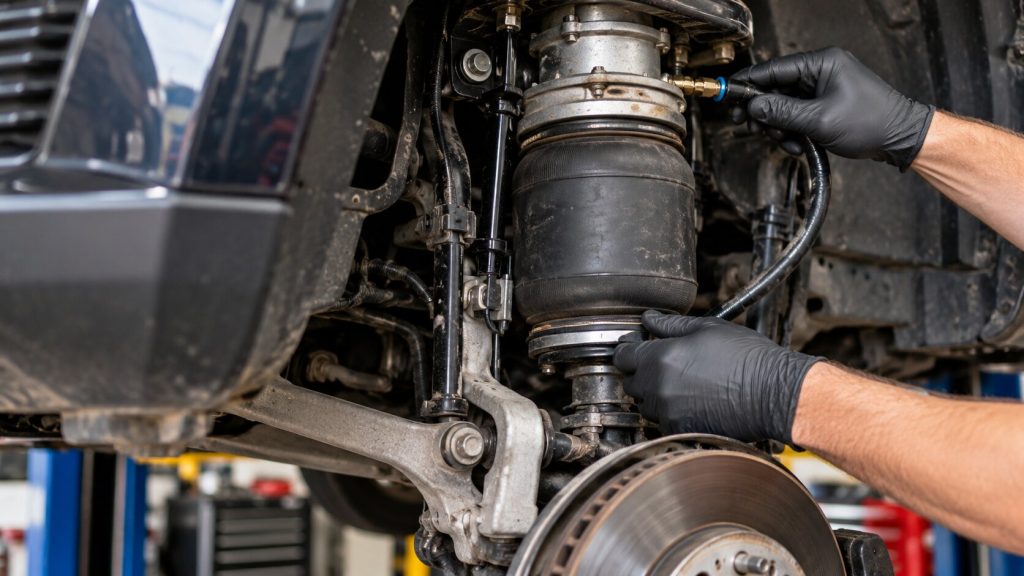
If your Land Rover sags on Parleys Canyon inclines or sits unevenly after cold Salt Lake City nights, leaky air springs, stuck valve blocks, or failing height sensors are usually to blame. When temperature drops cause rubber bladders to harden, tiny dry-rot cracks open up and force your air compressor to work constantly until it overheats. We fix these air suspension issues by pinpointing the exact leak or electrical signal fault before major secondary damage occurs.
Why Your Land Rover Air Suspension Sags and Dropped in Ride Height
Your Land Rover air suspension relies on a closed system of rubber air bladders, high-pressure air lines, a central valve block, and an electric compressor controlled by electronic height sensors. Under normal operation, the control module reads height sensor telemetry at each wheel and signals the valve block to adjust air volume inside each corner air spring. This maintains a level vehicle stance regardless of cargo weight or terrain changes.
When road debris, ozone exposure, and freeze-thaw cycles degrade the flexible rubber air bags, micro-fissures develop along the bottom folding bead. In cold Utah winters, these cracks stiffen and fail to seal, causing air to escape rapidly overnight. The loss of system pressure forces the compressor to run continuously to maintain ride height, which leads to thermal overload, piston ring scoring, and complete compressor failure.
Corrosion around the brass fittings on the valve block also causes internal check valves to seize. When a valve gets stuck open, air pressure cross-flows between the left and right air springs, leaving one side completely dropped while the other sits artificially high. Magnesium chloride road salt along the I-80 corridor can also penetrate the height sensor linkage arms, binding the pivot joints and feeding incorrect voltage signals to the electronic control unit.
Common Signs of Air Suspension Failure in Utah Drivers
- One corner or the entire rear axle sits noticeably lower after parking overnight.
- The onboard compressor runs continuously or makes loud clacking and buzzing sounds from under the vehicle.
- Dashboard messages display warnings like Suspension Fault, Normal Height Only, or Max Speed 30 MPH.
- The ride quality feels excessively harsh, bouncy, or loose when driving over uneven pavement.
- The vehicle takes significantly longer than usual to raise from Access Mode to Off-Road Height.
Diagnostic Process for Land Rover Suspension Leaks
Catching air suspension faults requires systematic testing rather than replacing parts randomly. We follow a precise diagnostic sequence to isolate the root cause quickly and efficiently.
First, we scan the suspension control module using factory-level Land Rover Pathfinder and SDD diagnostic software. This allows us to read specific fault codes, check system pressure limits, and monitor live height sensor voltage sweeps between 0.5V and 4.5V across all four wheel positions.
Next, we perform a manual pressure leak-down test by isolating the air springs from the main valve block and monitoring pressure holding capacity with physical gauges. We spray a high-viscosity soap solution across the air bag folds, brass line unions, and reservoir fittings to reveal escaping air bubbles.
When a Land Rover comes in sagging after an overnight cold soak near Foothill Drive, our soap spray reveals micro-bubbling along the lower rubber roll sleeve of the front air bladder about 80% of the time. If the air bags hold steady at an isolated 10 Bar on our bench test, we immediately check the valve block plungers for internal corrosion. Finally, we verify that the air compressor can supply a full 16.5 to 18.0 Bar of operating pressure without drawing excess electrical current or overheating.
Preventive Care and Repair Strategies for Lasting Performance
Replacing air springs in axle pairs maintains balanced dampening performance and prevents uneven compressor wear. Installing fresh valve blocks along with new air bags ensures clean sealing surfaces and prevents microscopic debris from entering the high-pressure lines. We also inspect and clean height sensor wiring harnesses to prevent road grime from causing signal dropouts.
Regular maintenance checks before extreme winter weather hits Salt Lake City help catch small leaks before they freeze your valve block solid. Clearing road salt from undercarriage components prevents premature galvanic corrosion on aluminum valve housings and air line fittings. Taking proactive steps ensures your Land Rover delivers a smooth, level ride through every season.
Resolving Land Rover Air Suspension Problems
Ignoring a sagging corner or a noisy compressor puts extreme stress on your vehicle’s entire suspension system and risks leaving you stranded. Driving on depleted air springs damages suspension bump stops, control arm bushings, and wheel alignment angles. Independent specialists offer targeted diagnostics that pinpoint exact leak points without unnecessary component replacements or long dealer wait times.
We bring deep technical expertise and specialized diagnostic tools to every Land Rover that comes through our doors. If your vehicle struggles to hold ride height or displays suspension fault warnings, reach out to our team at Steve’s Automotive Specialist, located at 2809 S 2300 E, Salt Lake City, UT 84109, or visit our Salt Lake City repair location to schedule a comprehensive evaluation.
Frequently Asked Questions
Can I drive my Land Rover with a sagging air suspension?
Driving with a collapsed air spring is unsafe because it severely limits suspension travel and degrades steering control. It also forces the air compressor to run continuously, which causes the pump motor to burn out quickly.
Why does my Land Rover sit lower on cold Salt Lake City mornings?
Cold temperatures cause air inside the system to contract and reduce rubber elasticity in aging air bladders. Microscopic cracks in worn air bags expand in sub-freezing weather, letting stored air bleed out overnight.
Do I need to replace the air compressor if my air bag leaks?
No, you do not need to replace the compressor if you repair the leaking air bag before the pump overheats. However, running a vehicle with a constant air leak causes premature piston ring wear and eventual pump failure.
How do I know if the problem is a valve block or an air spring?
A single isolated corner dropping overnight points to a leaking air spring, whereas multiple corners dropping simultaneously or cross-flowing air signals a faulty valve block. Diagnostic pressure tests confirm which component is failing.