
Land Rover Terrain Response faults stem from CAN bus network communication drops caused by weak AGM batteries, corroded wheel-speed sensors, or miscalibrated steering angle modules. Symptoms include locked access height, restricted drive modes, and HDC warnings. Dedicated factory-level JLR diagnostics and voltage testing isolate sensor failures before component replacement.
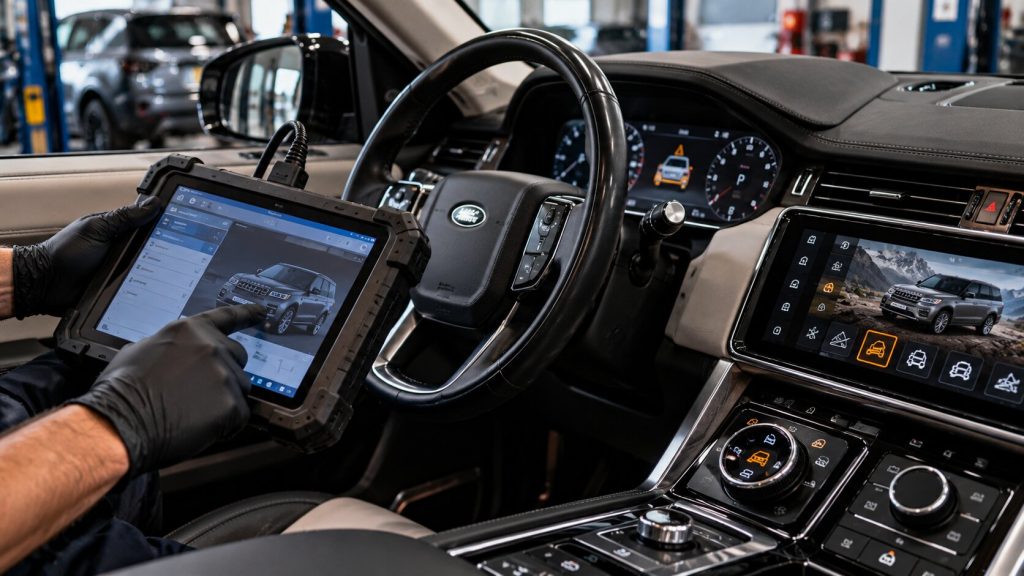
When a Terrain Response fault message appears on your Land Rover dashboard in Utah, it usually stems from a breakdown in sensor communication across your vehicle’s CAN bus network. System failures trigger when wheel-speed sensors, steering angle modules, or transfer case actuators fail to relay accurate real-time data back to the central control unit.
How Land Rover Terrain Response Systems Manage Dynamic Traction
The Terrain Response system coordinates your engine throttle mapping, automatic transmission shift points, transfer case differential locks, and air suspension heights. It relies on a steady stream of digital inputs from individual wheel-speed sensors, dynamic stability sensors, and steering column position modules. Under normal driving conditions around Utah, these modules communicate continuously to balance torque across all four wheels.
- Wheel Speed Sensors: Monitor individual wheel rotation and send live frequency signals over the High-Speed CAN bus.
- Steering Angle Sensor (SAS): Measures driver steering trajectory and reports column angle to ensure proper torque vectoring.
- Brake Control Module (ABS/DSC): Tracks wheel slip and stability thresholds, feeding real-time braking requests back to the network.
- Central ECU / Drivetrain Module: Processes multi-sensor inputs to command transfer case lockup and air suspension height adjustments.
When cold Utah winter temperatures cause AGM battery surface voltage to drop below 11.8V during engine cranking, digital network communication drops out instantly. Heavy road salt spray also corrodes the wiring harness connectors near the chassis rail. A single missing or corrupted signal forces the central module to disable special driving modes like Mud-Ruts or Snow-Gravel as a safety precaution.
Symptoms Associated with Terrain Response Communication Errors
- Suspension Lowering to Access Height: The vehicle drops to its lowest setting and locks out manual ride-height adjustments to protect air springs.
- Transmission Locked in Normal Program: Drive modes automatically revert to standard street settings, disabling selectable off-road options.
- Simultaneous ABS or Traction Control Warning Lights: Multiple yellow indicators illuminate together because the system shares wheel-speed and braking data.
- Loss of Hill Descent Control (HDC): The vehicle displays an “HDC Fault System Not Available” message alongside the main drive mode warning.
Common Causes Behind Instrument Cluster Warnings
| Trigger Source | Root Cause | System Result |
| AGM Auxiliary / Main Battery | Surface voltage drops below 11.8V during cold cranking | Triggers transient U-series CAN bus communication fault codes (e.g., U0102, U0415) upon ignition. |
| Wheel-Speed Sensor | Corroded harness wiring or magnetic reluctor ring degradation | Disables ABS, traction control, and terrain selection options. |
| Steering Angle Module | Loss of zero-point calibration after alignment or power loss | Prevents vectoring calculations needed for Rock Crawl or Sand modes. |
| Electronic Transfer Case Actuator | Internal motor brush wear, binding shift solenoids, or connector corrosion | Locks transfer case in high range and throws persistent code P1889 or U0102. |
Professional Diagnostic Steps for Isolating Control Faults
We begin troubleshooting by connecting dedicated JLR Pathfinder or SDD diagnostic software to scan for active Diagnostic Trouble Codes (DTCs) across every vehicle module. Standard generic OBD-II readers miss Land Rover network-specific communication faults, such as U0102 (Loss of Communication with Transfer Case Control Module) or U0415 (Invalid Data Received from ABS). Our technicians analyze live data streams from each wheel-speed sensor during road testing to catch transient signal drops.
Next, we test electrical supply integrity under load. We perform a voltage drop test across the main power distribution box and ground studs to verify that supply voltage stays stable under starter draw. We physically inspect harness plugs, specifically connector C0378 near the rear wheel arch, checking for green galvanic copper corrosion caused by winter salt spray.
Finally, if the wiring and voltage pass inspection, we check the calibration status. Recalibrating the steering angle zero-point or flashing updated software to the transfer case ECU frequently clears non-hardware faults without needing part replacements.
Shop Note: In nearly 70% of LR4 and Range Rover Sport models coming into our Utah bay with transient U0102 codes, the transfer case motor itself is fine. The real failure is usually harness plug corrosion located behind the wheel liner or a dying AGM battery dropping below 11.8V on cold morning starts.
The Importance of Prompt Diagnostic Attention
Ignoring a Terrain Response fault warning leaves your Land Rover locked in standard street mode, restricting off-road capability when navigating mountain passes or severe Utah winter storms. Driving continuously with an uncalibrated transfer case motor or shorted wiring harness can burn out internal shift solenoids or cause uneven wear across center differential assemblies. Addressing these warnings early prevents expensive mechanical repairs down the road.
Experience Specialized Land Rover Care
If your vehicle is displaying drive mode warnings or suspension fault messages, our team has the factory-level diagnostic software and shop tooling needed to trace the exact root cause. We deliver transparent, precise repairs so you can head back into the mountains with full confidence without dealership wait times.
Visit us at Steve’s Automotive Specialist, located at 2809 S 2300 E, Salt Lake City, UT 84109, or schedule your diagnostic appointment online today in our Salt Lake City location.
Frequently Asked Questions
Can I still drive my Land Rover with a Terrain Response fault?
Yes, you can usually drive the vehicle at moderate speeds on paved roads. However, off-road driving modes will be locked out and air suspension may lock at access height, so you should have it diagnosed promptly.
Will a weak battery trigger a Terrain Response fault message?
Yes, Land Rover modules are sensitive to minor voltage drops during engine cranking. An aging AGM battery dropping below 11.8V frequently causes temporary Terrain Response and HDC fault warnings upon starting.
Does a Terrain Response fault mean my transfer case is broken?
No, most Terrain Response warnings stem from minor electrical issues like corroded wheel-speed sensor wiring, low battery voltage, or steering calibration loss rather than mechanical transfer case failure.
Why does my air suspension drop when the Terrain Response fault appears?
The central control unit lowers the air suspension to standard or access height as a safety measure. This prevents chassis instability when the system loses sensor input required to calculate dynamic traction.