
Localized mechanical stress from UVU’s multi-level parking decks and short-trip oxidation cycles frequently compromises the braking systems of student cars. High-torque braking on 6 percent grades creates thermal gradients that bind caliper sliders, while low-mileage campus commutes prevent moisture evaporation, accelerating galvanic corrosion and causing premature, uneven brake pad wear.
I am pulling the wheels off a sedan that shuttles between Wolverine Crossing and L10. Despite the low mileage, short 1.8-mile campus trips prevent rotors from reaching the 400°F threshold required to gas off moisture, leading to corrosive pad freeze. I found the inboard pad nearly disintegrated while the outboard pad remained intact, a direct result of the topographical stress unique to UVU. This localized environmental fatigue effectively cuts the factory-suggested 30,000-mile service interval down to just 18,000 miles.
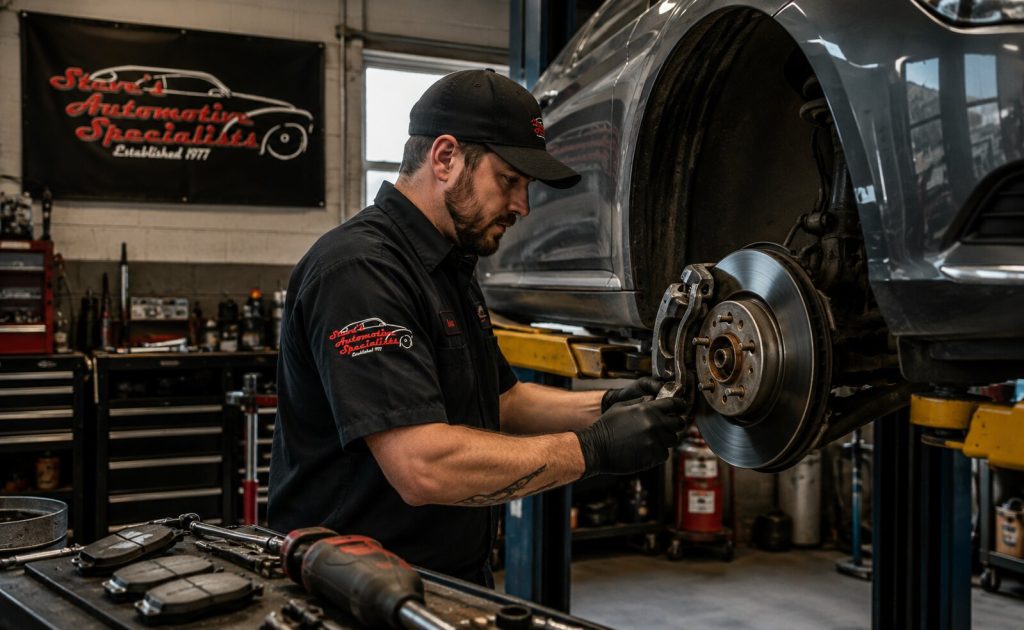
Why UVU student cars develop uneven pad wear on 800 West
The descent from the upper tiers of the UVU parking structures is a masterclass in unbalanced thermal loading. I see it every day in the shop. A student starts their car in the morning—rotors cold—and immediately engages in high-torque, low-speed braking down a 6 percent ramp. I’ve measured the leading edge of a pad reaching 300°F within seconds of leaving a parking spot, while the trailing edge remains cold.
The 300-degree thermal gradient
This extreme 300-degree thermal gradient is the specific moment the mechanical failure begins. The heat expansion is localized and violent. It forces the caliper slide pins to bind. Upon inspection, the slide pins frequently exhibit physical ‘stepping’ or microscopic necking, a direct result of uneven pressure cycles that have exceeded the hardware’s lateral tolerance. As the student turns onto 800 West, that bound pin keeps the pad dragged against the rotor surface. The engine might have the power to overcome the friction, but the pad is slowly being sanded away without the driver ever touching the pedal.
Analyzing caliper binding from Utah Lake humidity
By May, the climate in Orem shifts. Rising temperatures near Utah Lake pull humidity into the valley, creating an electrolyte soup when it mixes with the residual magnesium chloride trapped in the dust shields from winter. I am looking at a caliper bracket now where the slide pin boots have failed. The moisture has entered the bore and initiated a chemical reaction.
Identifying slider pin seizure and galvanic corrosion
The result is a seizure. I use a pry bar to move the piston, and it resists with a gritty, mechanical stubbornness. This isn’t just “old age.” This is localized environmental degradation. The silica-heavy dust from the ongoing Orem Central Station construction acts as an abrasive, finding its way into these seized components and scoring the metal. I often find that the “lifetime” parts promised by big-box retailers simply cannot withstand the chemical reality of a May thaw in Utah County. The salt stays in the crevices long after the snow melts, and the humidity acts as the final catalyst.
How EBD logic accelerates rear brake wear on University Parkway
Most students don’t realize their car’s software is actively wearing out their rear brakes during the “campus crawl.” Modern Electronic Brakeforce Distribution (EBD) logic is designed to prevent “nose-dive” during the stop-and-go fatigue of University Parkway. DME logs confirm an aggressive rear-bias mapping during the low-speed decelerations typical of campus traffic.
Why modern software biases rear pressure during stop-and-go campus traffic
To mitigate pitch, the car’s braking logic shifts the thermal load to the rear, overtasking the smaller calipers during low-speed stops. In these conditions, I frequently find rear pads wearing 30 percent faster than the fronts. It is a total reversal of traditional mechanical expectations. Navigating the 800 West intersection requires high-frequency braking that ‘heat-soaks’ the rear system, exceeding the calipers’ ability to dissipate thermal energy. Without cooling airflow, rear brake fluid reaches copper concentrations over 200 ppm, indicating the fluid has turned acidic and is chemically compromising the system’s internal surfaces.
How we diagnose rotor runout at Steve’s Automotive Specialist
I’ve finished the visual inspection and now I’m setting up the dial indicator. This is the moment of clarity. The student complained of a rhythmic surging in the pedal when slowing down for the I-15 South merge after coming off the higher speeds of the neighboring highways. They thought it was a warped rotor. The reality is more forensic.
Measuring lateral runout with a dial indicator after the E-470/I-15 transition
As I rotate the hub, the needle on my indicator jumps, confirming a lateral runout of 0.005 inches. A 1.7mm taper measured via micrometer provides definitive proof of ‘caliper twist,’ confirming that constant ramp loading has physically compromised the bracket’s alignment. Resolving this requires a complete technical reset, including cleaning hub mating surfaces to a mirror finish and replacing slide pins with high-temp synthetic lubricated units. Eliminating lateral runout prevents caliper ‘walk,’ ensuring full pad-to-rotor contact and stable deceleration during the transition to I-15 speeds.
If you are noticing a soft pedal or uneven wear after your campus commute, reach out to Steve’s Automotive Specialist in 925 N State St, Orem, UT 84057 for a forensic brake analysis.
Frequently Asked Questions
Why do my brakes squeal only when I leave the UVU parking garage?
The high-torque braking on steep garage ramps creates a 300-degree thermal gradient across a cold rotor. The massive temperature differential triggers pad-to-piston harmonics, causing a temporary squeal that dissipates once the rotor and pads reach a uniform operating temperature.
Can Orem’s road salt affect my brakes in the summer?
Yes. Residual winter salt remains trapped in the dust shields and caliper crevices. Seasonal humidity acts as a catalyst for galvanic corrosion, causing pad-to-bracket seizure and compromising the rotor’s thermal dissipation by pitting the internal cooling vanes.
Why are my rear brake pads wearing out before my front pads?
Modern vehicles use Electronic Brakeforce Distribution (EBD) to prevent the car from dipping forward in stop-and-go traffic on University Parkway. The EBD logic shifts the primary braking torque to the rear at low speeds, forcing the smaller calipers to manage a higher duty cycle and causing premature pad depletion.
Do I really need a brake flush if the fluid looks clean?
Yes. In Orem’s short-trip environment, brake fluid absorbs moisture that settles in the calipers. We measure this with copper content tests. High copper levels indicate the fluid has become acidic and is corroding the internal metal components, regardless of the fluid’s color.
What causes the steering wheel to shake when I’m on I-15?
This is typically caused by Disc Thickness Variation (DTV). When brakes bind due to Orem’s ramp loading, they create “hot spots” on the rotor. These spots transform into a hard mineral called Cementite, which doesn’t wear down, causing a pulsation felt through the steering.