
Brake fluid in high-altitude environments like the Wasatch Front absorbs moisture, causing boiling point drops and hydraulic corrosion. When copper exceeds 200ppm, galvanic action destroys ABS modules. Regular flushes maintain chemical stability and prevent these $1,000 plus repairs, ensuring that the vehicle’s hydraulic integrity remains intact.
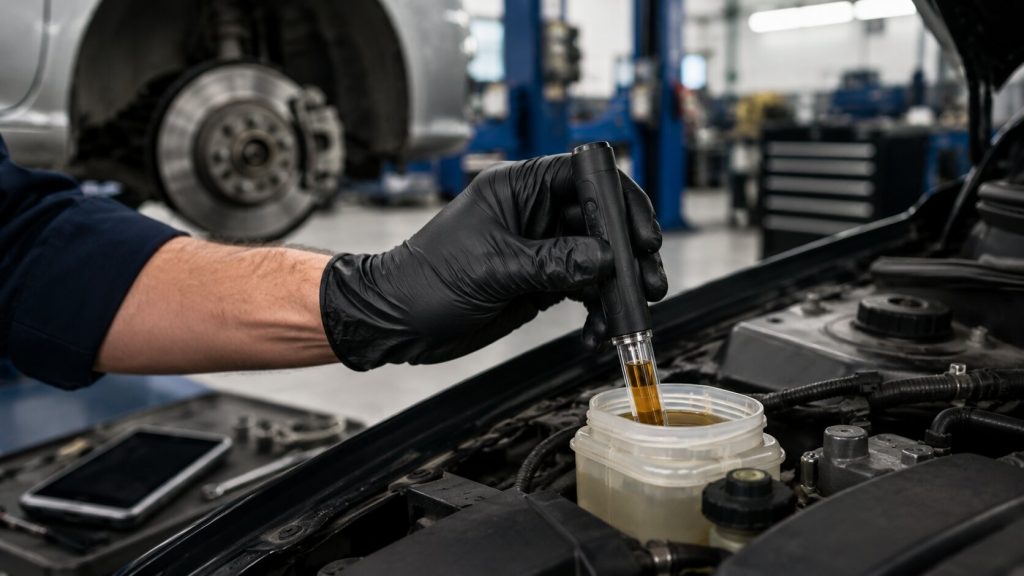
I am using my refractometer to measure moisture levels that owner manuals often overlook. In my experience at the shop, I see Utah’s high altitude accelerate the breakdown of brake fluid into a corrosive electrolyte. I recommend regular flushes to prevent internal rot from destroying your expensive ABS modules and master cylinders.
Why is your ABS Module a Ticking Financial Time Bomb
I am looking at a reservoir right now that most owners would call clean. It is a pale amber, but my refractometer does not lie. It shows a 3% water saturation. In Utah, from the valley floor to the canyons, we deal with a specific chemical treachery. Glycol-based fluid is hygroscopic. It pulls moisture through the microscopic pores of your rubber hoses and the vent in the reservoir cap. Once that water is inside, it does not just sit there. It reacts with the copper brazing in your brake lines.
The 200ppm Copper Threshold and Internal Rot
When I dip a copper test strip into a vehicle that has skipped its two-year service, the purple hue confirms a reading north of 200 parts per million. At this concentration, the brake fluid is no longer just a hydraulic medium; it is an electrolyte. This triggers galvanic corrosion. I have seen the aftermath on a Bosch 9.0 ABS module.
The acidity eats the delicate internal solenoid valves from the inside out. Manufacturers might claim lifetime fluid in the manual to lower the perceived cost of ownership, but the physical reality of electrochemical degradation proves them wrong. A $1,200 module failure is the price of believing a marketing brochure over a chemical reality.
Navigating the I-15 Crawl with Contaminated Fluid
The current traffic patterns near the I-15 and 106th South interchange are a torture test for your hydraulic system. I hear the rhythmic, labored surging of engines idling in the heat. This stop-and-go creep keeps your brake pads millimeters away from the rotors, generating immense heat that has nowhere to go. This thermal energy transfers directly into the caliper pistons and the fluid sitting behind them.
How Temperature Swings Accelerate Fluid Hydration
Our local weather features rapid shifts from a mountain frost to 70°F valley sun. This causes the air in your brake system to breathe. As it cools at night in places like Sandy or Orem, it draws in Utah’s spring air. As it heats up on your commute toward downtown Salt Lake, that moisture lowers your fluid’s boiling point. I’ve had drivers come in describing a pedal that suddenly goes to the floor during a heavy traffic day on State Street. That is vapor lock.
The 3% moisture content flashes into steam at a significantly lower boiling point due to Utah’s atmospheric pressure. You cannot compress a liquid, but you can compress a gas. When you hit the pedal and it feels like stepping on a marshmallow, you are feeling the atmosphere inside your brake lines.
Comparing a $150 Flush to a $2,500 Hydraulic Overhaul
A professional flush, where I run fresh fluid through the lines until the copper levels drop to zero and the moisture is purged, costs about $150. If you ignore it, you aren’t just risking a soft pedal; you are inviting black sludge into your safety systems. This sludge is a byproduct of moisture reacting with internal rubber seals. It settles in the lowest points of the system—usually the ABS pump and the calipers.
Why the Bosch ABS Pump Fails When Sludge Enters the Return Ports
The return ports in a modern ABS pump are smaller than a needle tip. I have dissected these pumps and found them packed with a gritty, black silt that feels like fine sandpaper. Once those ports clog, the pump cannot pulse. This is why you get a hard pedal that won’t move. You are now looking at a master cylinder, an ABS unit, and potentially four calipers. Add in the labor to bleed the system using an ISTA-D diagnostic tool and the bill easily clears $2,500.
Diagnosing Hydraulic Rot in High-Altitude Braking Systems
Pulling a vacuum on the bleeder screw reveals a gritty, dark discharge instead of the smooth flow of clear fluid I expect to see. I can hear the gritty crunch of a bleeder valve seized by magnesium chloride from Utah’s winter road treatments. When it finally cracks open, the fluid that exits is the color of used coffee.
Diagnosis relies on data, not guesswork. I use a refractometer to measure the exact refractive index of the fluid, which pinpoints the precise water percentage. Looking at the PicoScope waveforms of the ABS solenoids, a jagged line on the scope indicates the internal valves are dragging from heavy sludge accumulation. The degraded fluid has essentially turned into a slow-acting poison for the vehicle’s most critical safety system.
If you notice a spongy pedal or dark fluid in your reservoir, contact Steve’s Automotive Specialist at 925 North State St., Orem, UT 84057 to flush out the moisture and protect your ABS module before a costly breakdown occurs.
Frequently Asked Questions
Is it necessary to change my brake fluid every two years in Utah?
Yes, you should replace your brake fluid every two years regardless of mileage. In our local environment, the high elevation and rapid temperature shifts accelerate moisture absorption. Waiting longer allows copper levels to rise, which eventually triggers expensive internal corrosion within your ABS hydraulic unit.
Can I just top off the brake fluid instead of flushing it?
No, simply topping off fluid does not eliminate the moisture or copper buildup within the hydraulic lines. The remaining acidic fluid stays trapped inside the calipers and ABS valves, where it relentlessly corrodes internal rubber seals and metal hardware, eventually leading to a complete and costly system failure.
Are a soft pedal and dark fluid signs that my fluid has failed?
Yes, a soft or spongy brake pedal is the most common indicator of high moisture content. You might also notice a dark, tea-like color in the reservoir instead of a clear or light yellow tint. By the time the ABS light illuminates, internal damage is often already done.
Is a routine brake fluid flush an expensive service?
No, a professional flush is actually an affordable preventative measure. The high cost only occurs when the service is ignored, leading to the failure of the ABS module or master cylinder. These components often cost over $1,000 for the parts alone, plus complex programming and labor.
Can traffic on I-15 cause brake failure?
Yes, the prolonged stop-and-go idling in construction zones causes significant heat-soak. Without airflow to cool the braking system, the heat transfers into the fluid. Thermal energy from heavy braking will cause contaminated fluid to boil, creating a vapor lock that results in an immediate and total loss of pedal firmness.