
Intense Salt Lake City summer heat and high-altitude UV rays cause cabin temperatures to exceed 145°F, breaking down the adhesive beneath your Audi RS leather dashboard. This leads to severe shrinkage and seam failure. Ordinary conditioners cannot fix this structural damage, requiring professional re-tensioning to properly stretch and secure the interior hide.
Unshielded Nappa leather dashboards on 2018–2024 Audi RS5 and RS7 models parked in open lots around Salt Lake City are baking in the intense summer heat. The high-altitude sun and extreme cabin temperatures are rapidly destroying the leather’s topcoat, causing permanent dry-rot and splitting seams.
Understanding the Chemistry of Audi Interior Decay
Audi RS dashboards use special water-based glue to attach leather to the frame. In Utah’s extreme summer heat, temperatures inside the car soar past 145°F. This intense heat triggers a destructive chain reaction:
- Plasticizer Evaporation: The softening chemicals inside the leather turn into vapor and escape.
- Adhesive Shearing: The glue holding the materials together loses its grip and weakens.
- Structural Contraction: The dried-out leather pulls tightly over the defrost vents and instrument clusters.
- Material Failure: The final result is permanent shrinkage, warped bezels, and split seams.
Why Store-Bought Conditioners Fail in the Desert
Most owners try to fix stiff leather with over-the-counter conditioners. In our climate, this usually backfires. When factory leather loses its moisture balance and goes rigid, the surface pores close up.
Over-the-counter products just leave a greasy residue behind, which quickly gathers dust and debris.’ Worse, these oils often settle into the contrasting polyester stitching found on RS models. Once trapped, the oil accelerates the degradation of the thread fibers. If your dashboard looks shiny or feels tight, stop applying these products immediately.
How to Detect Early Signs of Audi Dashboard Heat Damage
Catching leather thermal fatigue early requires a methodical inspection of tension zones before visible cracking destroys the core hide. I use three specific diagnostic steps to evaluate the damage:
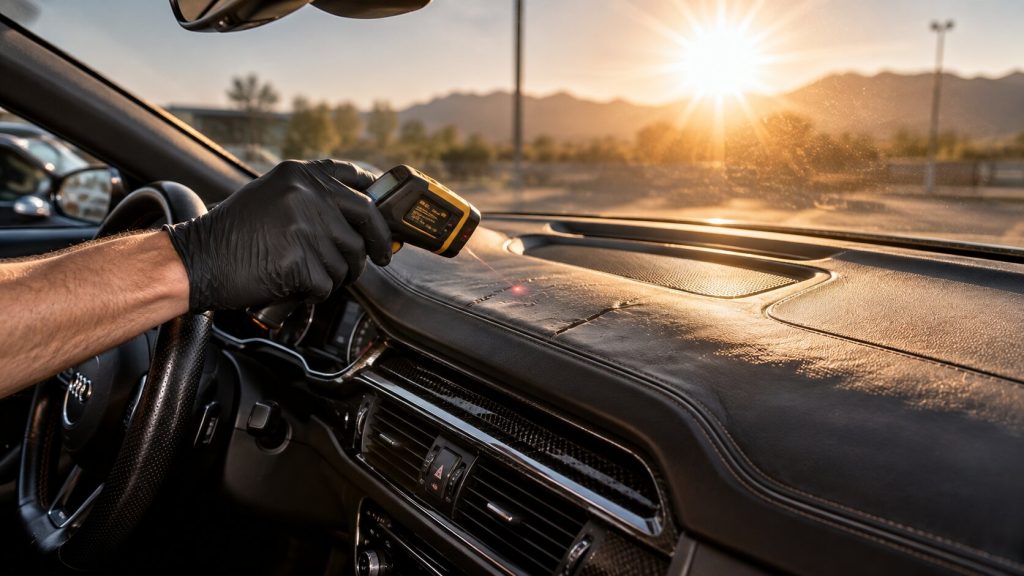
- Infrared Thermal Scan: An infrared pyrometer locates localized heat pockets near the windshield interface. Significant temperature differentials indicate the internal support structure is already failing.
- 10x Illuminated Loupe Inspection: The perimeter stitching is examined for micro-fraying. Fuzzy or brittle threads are a primary indicator that the underlying adhesive bond has failed.
- Airbag Cover Pressure Test: Firm pressure applied to the passenger airbag cover reveals its condition. A healthy dash feels firm and uniform, while early-stage delamination feels hollow, springy, or separated from the substrate.
| Diagnostic Method | What You Are Looking For | Severity Level |
| Infrared Scan | Heat pockets near the windshield interface | Warning |
| 10x Loupe | Micro-fraying or brittle contrast stitching | Moderate |
| Pressure Test | Hollow/springy feel on airbag cover | Critical |
Essential UV Protection Strategies for Utah Summers
You cannot stop the sun, but you can manage the cabin environment. Follow this maintenance protocol to extend the life of your Audi’s interior:
- Install Ceramic Windshield Tint: Apply a clear, crystalline ceramic film to the front windshield. This blocks 99 percent of UV rays without reducing nighttime visibility.
- Use Custom-Fit Heat Shields: Avoid generic cardboard shades. A custom-fitted shield ensures total coverage of the dashboard edges, preventing localized hot spots.
- Switch to Water-Based Sealants: Use pH-balanced, water-based leather cleaners and UV-inhibitor sealants every three months. These are designed to penetrate the fibers rather than coating the surface.
The High Cost of Ignoring Audi RS Dashboard Shrinkage
Waiting until your RS dash completely separates from the frame transforms a simple preventative job into a major financial headache. Once the leather shrinks beyond a certain point, the material loses its memory. Even if you hydrate the leather later, it will not shrink back to its original shape.
At this stage, the only solution is a full dashboard replacement. For an Audi RS model, this requires:
- Removing the entire instrument panel.
- Disconnecting complex, sensitive electronics.
- Replacing expensive carbon fiber trim pieces that are easily damaged during removal.
This is a five-figure repair. If caught during the initial adhesive shearing phase, I can often perform re-tensioning. By using professional-grade rehydration equipment, I can carefully reset the leather’s shape and apply a protective UV shield.
Why Independent Expertise Matters for Audi RS Models
Dealerships often treat interior damage as a replace-only service, handing you a five-figure estimate and a massive backlog wait. They lack the interest or specialized patience required to perform precision restoration work on high-end German trim. When you bring your RS to my shop, you get a practitioner who understands the exact clip sequences, delicate fiber-optic harness routings, and composite substrate tolerances unique to the B9 and C8 chassis.
Preserving your interior protects your vehicle’s resale value and stops minor thermal degradation from turning into an expensive structural nightmare. If your dash is starting to feel rigid, or if you notice the leather pulling tight around the defrost vents, do not wait for the seams to split.
Stop by Steve’s Automotive Specialists at 2809 S 2300 E, Salt Lake City, UT 84109, or call my desk directly. Let’s get an infrared gauge on that dash, arrest the adhesive shearing, and save your RS interior before it requires a full-scale replacement.
Frequently Asked Questions
Can standard leather conditioners stop Utah UV dashboard cracking?
No. Once the underlying adhesive breaks down from extreme heat, store-bought surface conditioners cannot restore the structural integrity of the shrinking hide. These products often sit on the surface, attracting dust and failing to reach the deeper layers where the damage occurs.
Does parking in the shade at a mall fully prevent interior heat-soaking?
No. Ambient high-altitude UV radiation and reflected heat from the surrounding asphalt still penetrate the side glass. Even out of direct sunlight, trapped heat still damages delicate stitching and leather.
Are Audi RS carbon fiber trim pieces affected by this same heat cycle?
Yes. Extreme cabin heat causes the epoxy resin matrix on factory carbon trim to yellow, micro-crack, or lift away from its aluminum backing. This makes proper tinting and sunshades crucial for protecting the entire dash area.
Can a shrunk Audi dashboard be saved without replacing the entire unit?
Yes. If caught early during the initial adhesive shearing phase, professional re-tensioning and the application of specialized thermal-blocking sealants can stabilize the material. Early intervention is the only way to avoid a full dashboard replacement.