
Incomplete service records hide serious Land Rover maintenance gaps. In Utah’s harsh climate, deferred care accelerates air suspension, cooling, and driveline failure. Scanning electronic diagnostic history and inspecting fluid conditions reconstructs true service history, establishing a fresh maintenance baseline to prevent costly, cascading mechanical repairs.
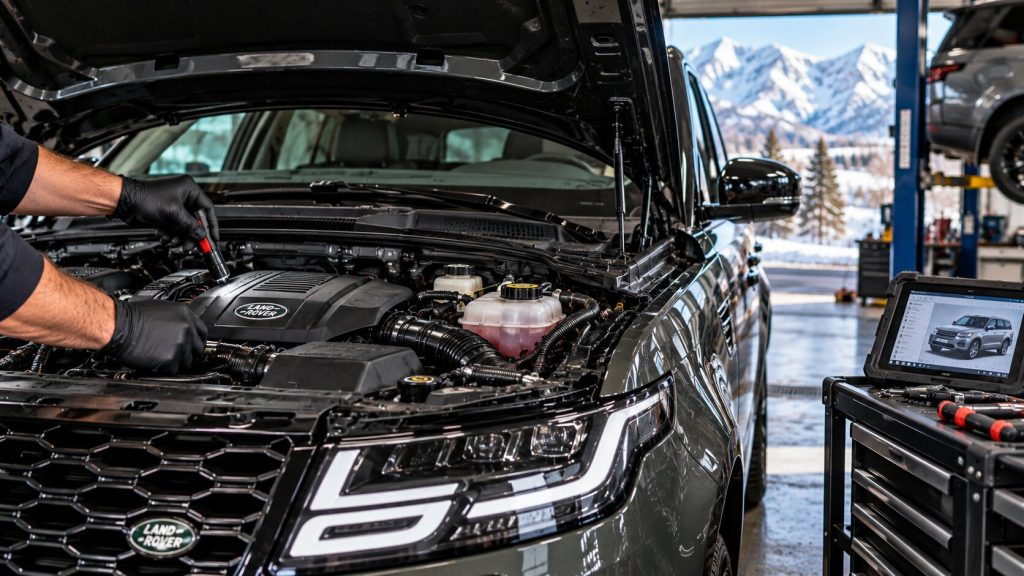
Missing service records on a Utah Land Rover usually conceal weeping cooling crossover pipes, shearing driveline fluids, and overworked air suspension compressors. In Utah’s climate, severe seasonal temperature swings and steep high-altitude mountain climbs quickly accelerate wear on these complex systems. Uncovering hidden maintenance gaps requires a detailed diagnostic inspection process to reconstruct your vehicle’s true service history and protect your vehicle’s value.
Key Land Rover Maintenance Indicators and Regional Stress Factors
- Suspicious Service Gaps: Frequently point to delayed fluid flushes in transmission, transfer case, and differential systems, accelerated by Wasatch winter stop-and-go driving.
- Uneven Ride Height: Indicates air suspension degradation in air struts, compressors, or valve blocks caused by road salt corrosion and freeze cycles.
- Minor Coolant Odors: Signal plastic fitting brittleness around thermostat housings and crossover pipes under high-altitude engine thermal loads.
- Soft Brake Pedal: Reflects aging brake fluid and wear on caliper seals or hydraulic lines from intense mountain pass downhill braking heat.
Why Incomplete Records Create Hidden Mechanical Risks
Land Rovers rely on precise maintenance schedules to keep complex mechanical and electronic systems working together smoothly. When a previous owner skips fluid changes or delays routine inspections, small issues begin to compound quietly behind the scenes. Engine oil breakdown can lead to internal sludge buildup, while neglected transmission fluid degrades shift quality over time.
Without complete service records, you cannot rely solely on the vehicle’s current odometer reading to guess component health. A vehicle driven short distances in Utah winter traffic experiences much harsher thermal cycles than one driven on open highways. Uncovering these hidden gaps means looking past surface appearances and evaluating physical component conditions directly.
Reconstructing Land Rover Service History Without Paperwork
Evaluating an existing or recently purchased Land Rover starts with a methodical review of all available physical and digital clues. We look for oil change stickers, stamped service booklets, and digital records logged by independent shops or dealerships. When paperwork stops, physical inspection data bridges the gap to reveal how the vehicle was actually treated.
Shop-Floor Finding: When we hook a newly purchased Land Rover up to JLR Pathfinder or SDD diagnostic software after a run down Parleys Canyon, we frequently find stored fault codes (like C1A20-64 for slow compressor pressure build) hidden in internal modules, even when the dashboard shows no warning light.
Checking fluid conditions gives immediate insight into past maintenance habits. Transmissions, differentials, and transfer cases each hold fluids that change color, clarity, and smell as they break down under heat and stress. Fluid sampling helps reveal whether major driveline components were serviced regularly or left running on factory fill for years.
Land Rover Systems Most Vulnerable to Deferred Maintenance
An air suspension system represents one of the most common areas where deferred service creates costly repair needs. Microscopic leaks in air springs force the compressor pump to run constantly to maintain vehicle height, leading to thermal overload, relay failure, and valve block damage. Catching a weeping air strut early prevents complete system shutdown while driving up Parleys Canyon.
Cooling systems on modern Land Rover engines (such as the 5.0L V8 and 3.0L V6) use composite plastic cooling crossover pipes that become brittle with age and heat exposure. Postponing coolant flushes allows protective additives to deplete, accelerating internal corrosion and plastic degradation. Inspecting seam lines, hose connections, and cooling manifolds catches hairline fractures before sudden coolant loss causes severe engine overheating.
Our 5-Step Land Rover Diagnostic Inspection Protocol
To reconstruct a pre-owned Land Rover’s true service history and catch hidden vulnerabilities before they lead to unexpected breakdowns, we follow a rigorous 5-step diagnostic protocol:
- Initial Physical Inspection: Perform a thorough visual check of external components, engine bay seals, fluid levels, drive belts, and chassis wear points for obvious leaks or deterioration.
- Scan Diagnostic Modules: Connect factory JLR Pathfinder or SDD software to pull stored fault codes, freeze-frame historical data, thermal exposure logs, and mileage stamps from every electronic module.
- Sample Vital Fluids: Extract fluid samples from the engine, transmission, front/rear differentials, and transfer case to analyze oxidation levels, viscosity loss, and metallic wear particles.
- Inspect High-Stress Components: Mechanically evaluate air suspension struts, compressor pressure rates, composite plastic cooling manifolds, rubber coolant hoses, and brake line integrity.
- Build a Baseline Care Plan: Compile our physical and digital findings into a prioritized roadmap designed to reset all deferred maintenance items and restore complete vehicle reliability.
Creating a Fresh Baseline Maintenance Plan for Your Vehicle
Once potential maintenance gaps are identified, the next step is establishing a fresh baseline for future care. Instead of guessing when services were last performed, resetting key maintenance items restores total confidence in your vehicle. Prioritizing essential safety and reliability items ensures your Land Rover remains dependable in all driving conditions.
- Flush all vital fluids, including engine oil, transmission fluid, transfer case fluid, front/rear differential fluids, and brake fluid, to establish a known baseline.
- Replace brittle cooling crossover pipes, thermostat housings, engine air filters, cabin air filters, and spark plugs.
- Inspect drive belts, tensioners, and rubber coolant hoses for signs of cracking, stiffness, or fluid contamination.
- Test the battery and charging system under load to prevent unexpected electronic glitches caused by low voltage.
Protecting Your Land Rover With Specialized Independent Care
Addressing deferred maintenance promptly prevents minor component wear from cascading into catastrophic repair bills down the road. Waiting for dashboard warnings or mechanical noises usually means damage has already spread to surrounding parts. Independent specialists offer the dedicated testing procedures and focused expertise required to keep these sophisticated vehicles running at their peak.
Driving in Utah presents unique challenges for any Land Rover, from winter road salt to mountain pass climbs. At Steve’s Automotive Specialist, our technicians combine hands-on physical checks with deep digital scans to identify deferred maintenance and map out a clear care strategy for your vehicle. Book your Land Rover diagnostic inspection today, or stop by 2809 S 2300 E, Salt Lake City, UT 84109.
Frequently Asked Questions
How can I check a Land Rover service history without paper records?
You can reconstruct service history by scanning the vehicle’s internal control modules (like the Central Junction Box and Powertrain Control Module) using JLR Pathfinder or SDD software. These modules log historical freeze-frame data, thermal cycles, and mileage stamps even after dashboard warning lights are cleared.
What are the first services to perform on a used Land Rover?
The primary baseline services are flushing the front/rear differentials and transfer case, replacing brittle plastic cooling crossover pipes, and performing an engine oil service. Driveline fluids shear rapidly under severe winter driving and require fresh synthetic fluid to protect gears and bearings.
Can deferred air suspension maintenance cause other vehicle problems?
Yes. Running a leaking air suspension forces the compressor pump to run continuously until it overheats and fails completely. The extra electrical draw can also stress the battery, alternator, and suspension control relays over time.
Why is cooling system maintenance so critical on Land Rovers?
Modern Land Rover engines run at high operating temperatures that cause composite plastic cooling pipes to degrade and fracture over time. Fresh coolant prevents internal corrosion, maintains protective additives, and reduces thermal shock on fragile plastic fittings.