
Land Rover network communication faults occur when control modules lose contact across CAN bus lines due to harness corrosion or thermal stress. Common symptoms include cascading dashboard warnings and intermittent no-starts. Advanced oscilloscope testing isolates damaged wiring and faulty modules early, preventing severe electrical damage and costly harness replacements.
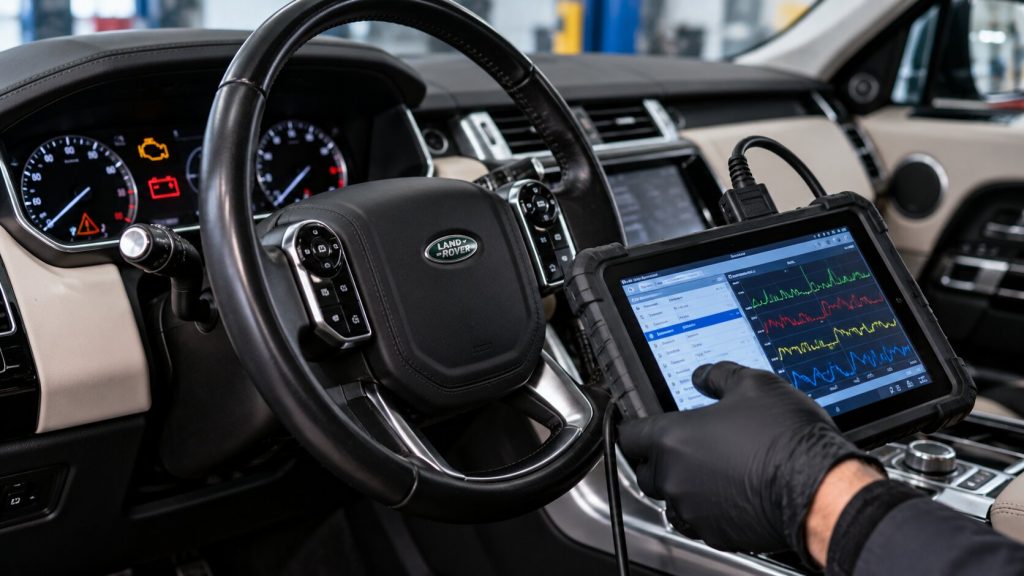
When a Land Rover’s dashboard triggers a simultaneous cascade of warning lights, individual control modules have lost communication across the internal High-Speed (HS-CAN) or Medium-Speed (MS-CAN) bus lines. Moisture intrusion from Utah winter snowmelt, salt spray along I-15, and engine bay heat-soaking routinely corrode sensitive harness connections, forcing dropouts between the ECM, BCM, and ABS units.
Understanding How Your Land Rover Control Modules Communicate
Dozens of control units share critical real-time operational data across twisted-pair copper wiring using standardized High-Speed CAN (500 kbps), Medium-Speed CAN (125 kbps), and Local Interconnect Network protocols. When you step on the accelerator or turn the steering wheel, control units calculate sensor inputs, verify system health, and cross-reference values across the network. If a single module drops offline or transmits corrupted signals due to pin degradation, neighboring units cannot verify safety parameters and trigger a network-wide fault code.
Primary Symptoms of Internal Network Communication Failure
- Instrument Cluster Cascades: Sudden appearance of multiple warning lights for ABS, traction control, air suspension, and transmission performance simultaneously.
- Intermittent Engine No-Start: The starter motor fails to engage or turns over without firing because the immobilizer cannot verify security codes from the Engine Control Module.
- Limp Mode Activation: The vehicle restricts gear shifting and reduces total engine power output to protect internal mechanical components from unverified sensor data.
- Loss of Comfort Features: Climate controls, power windows, infotainment screens, or ambient lighting stop responding due to secondary MS-CAN communication drops.
Common Root Causes Behind Land Rover CAN Bus Disruptions
- System-Wide Warning Cascades: High-speed CAN bus twisted pair failures caused by Utah road salt and winter moisture ingress, especially during deep snow slush or heavy highway driving.
- Intermittent No-Start Conditions: Gateway or central junction box thermal stress triggered when cabin heat-soaking occurs during intense Utah summer heatwaves.
- Air Suspension Locked in Access Height: Body control network disruptions caused by water ingress from clogged sunroof drain tubes pooling around floor harness splices.
High-Stress Physical Factors That Force CAN Networks Past Their Limits
Under normal operating conditions, a Land Rover HS-CAN bus transmits differential voltage signals where CAN-High rests at 2.5V and spikes to 3.5V during data transmission, while CAN-Low drops from 2.5V down to 1.5V. Physical degradation occurs when environmental moisture creeps into harness connectors or exposed splices, initiating galvanic corrosion on copper pins. As microscopic oxides build up, pin resistance climbs past strict operational tolerances, altering the crucial 1.0V differential required for clean frame reception.
Continuous thermal cycling from idling in summer traffic expands and contracts plastic connector housings, causing micro-fractures in fragile terminal crimps. When the twisted-pair structure of the network harness unravels or grounds against chassis metal, signal reflections occur, flooding the bus with corrupted data frames. This distortion forces transceivers into passive bus-off states, isolating affected systems to prevent total bus lockups.
Shop-Floor Diagnostic Observation: We routinely pull Land Rover harnesses where the CAN-High line shows 2.5V static on a multimeter, but probing with a PicoScope reveals 1.2V signal reflections caused by green copper corrosion inside the passenger floor sill splice. If pin resistance across the splice exceeds 0.5 ohms, transceiver framing errors drop the BCM off the bus immediately.
How Advanced Oscilloscope Diagnostic Workflows Trace Signal Degradation
Isolating a network breakdown requires systematic diagnostic procedures using specialized equipment rather than simple scan tool code reading.
- Scan Tool Network Topology Check: We connect dealer-level TOPIx Pathfinder diagnostic software to map every active module on the HS-CAN and MS-CAN networks, pinpointing silent or bus-off modules.
- Breakout Box Voltage Measurements: We install a breakout box at the OBD-II port to measure static resistance across pin 6 and pin 14, verifying whether the network’s 60-ohm parallel termination resistance is intact (two 120-ohm resistors in parallel).
- Dual-Trace Oscilloscope Signal Capture: We attach high-speed oscilloscope probes to CAN-High and CAN-Low lines to observe physical wave patterns, checking for clean square waves, correct signal amplitude, and absent noise spikes.
- Individual Module Isolation: If corrupted signals appear, we systematically disconnect modules along the network trunk while monitoring live waveform output until clean communication restores.
Professional Maintenance Prevents Costly Cascading Module Damage
Unresolved short circuits or high resistance can back-feed voltage spikes directly through signal wires, damaging delicate transceiver chips inside healthy control units. Over time, leaving corrosion unaddressed causes wiring harnesses to green-corrode internally, requiring extensive dashboard disassembly or complete harness replacement instead of targeted connector pin repairs. Catching network anomalies early at our shop stops minor signal drops before they escalate into complete electrical system overhauls.
For expert Land Rover diagnostic care and precision network repair, schedule an appointment directly with our team at Steve’s Automotive Specialists, located at 2809 S 2300 E, Salt Lake City, UT 84109.
Frequently Asked Questions
Can a weak car battery cause Land Rover module communication codes?
Yes, low voltage during engine cranking can disrupt control module boot sequences and cause temporary CAN bus communication errors. However, if warning lights persist after the battery is fully charged and load-tested, the underlying cause is typically physical wiring degradation, harness corrosion, or a failing transceiver.
How do technicians know if a module is faulty or if the wiring is bad?
Technicians use a digital storage oscilloscope to analyze the raw signal voltage and waveform shapes traveling through the network wires. If the waveform retains its proper 1.0V differential square shape up to a specific control unit’s connector, the wiring is functional and the module’s internal transceiver is the failure point.
Is it safe to drive my Land Rover with active CAN bus communication codes?
No, driving with active CAN bus communication faults is unsafe because critical safety features like ABS, stability control, and air-bag deployment rely on uninterrupted network signals. Furthermore, network instability can trigger limp mode without warning, restricting gear selection and engine power while driving in traffic.
What causes sunroof drain leaks to damage Land Rover network wiring?
Clogged sunroof drain tubes back up and overflow into the A-pillars, allowing water to track directly down into the footwell wire channels. This moisture pools around the factory twisted-pair CAN bus splices, initiating rapid galvanic corrosion that destroys signal integrity across the body network.