
Cheap brake pads fail on steep mountain descents like Parley’s Canyon because their low-grade resin binders melt under high thermal stress, causing severe glazing and complete loss of stopping power. Upgrading to high-carbon, manufacturer-spec components ensures proper heat dissipation, protecting your vehicle and keeping you safe on steep grades.
Why Cheap Audi Brakes Hate Parleys Canyon
Every winter on the drive down Interstate 80 tells the same story. Someone in a sleek Audi Q5 crests the top of Parleys Canyon, points their nose toward Salt Lake City, and trusts a set of budget brake pads to handle the next several miles of relentless downhill gravity.
It is a terrifying gamble. By the time they hit the lower grades, those bargain-bin pads are completely cooked, leaving them with smoking rotors, a soft pedal, and a very close call with the car ahead of them. Cheap pads fail here because:
- Their low-grade resin binders melt rapidly under sustained thermal stress.
- Severe glazing develops on the friction surface, causing an immediate loss of stopping power.
Upgrading to high-carbon, manufacturer-spec components changes the math entirely by shedding that heat before it ruins the morning commute.
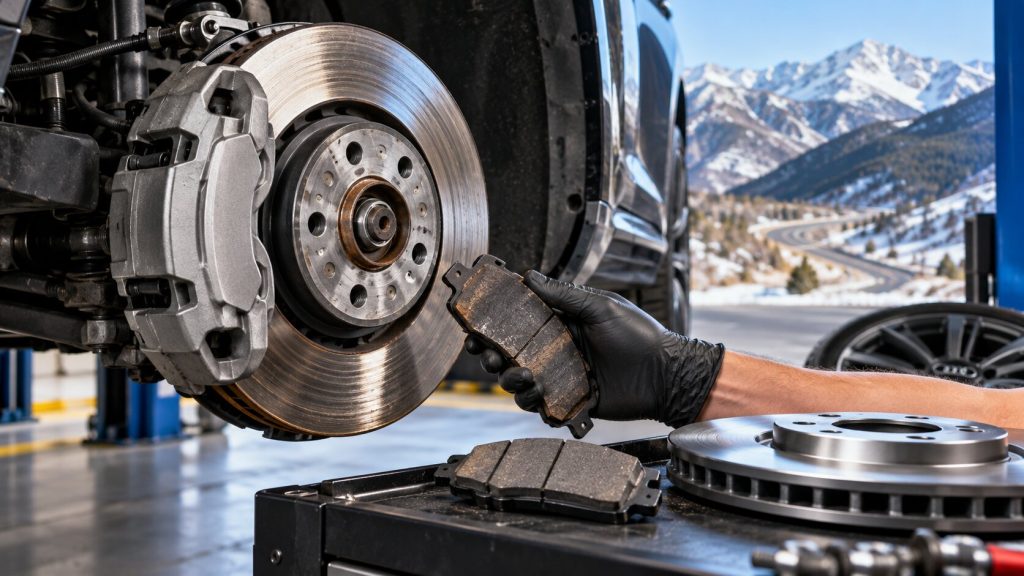
Shop Verdict: When I pull the wheels off an Audi coming down from Parleys Canyon with a spongy pedal, I routinely find hardened, glazed pad surfaces and micro-fractures running through the backing plates—clear evidence that low-grade resin binders outgassed and boiled away under sustained thermal stress.
The Difference Between Cheap and Good Brakes
Looking at friction materials in a controlled testing environment reveals a staggering difference between cheap budget pads and high-carbon Audi-spec components. Side-by-side thermal imaging and dynamometer stress tests show exactly how these materials handle severe heat.
- Budget pads: Typically use a low-cost mix held together by cheap phenolic resins that trap heat directly on the friction surface instead of dissipating it through the backing plate.
- High-carbon metallurgy: Increases thermal conductivity, allowing the rotor and pad to absorb and shed extreme heat cycles without warping when descending steep grades.
How Mountain Driving Destroys Cheap Brakes
Under normal driving around town, budget friction material holds together just fine. But the moment a car drops down a 6% grade, physics changes the rules completely and kinetic energy turns into massive thermal energy.
Cheap pads use low-grade resin binders that simply cannot handle temperatures climbing past 400℉. Those binders liquefy and turn into a slick glaze. Worse yet, they outgas rapidly, creating a microscopic barrier of hot air right between the pad and the rotor.
At that exact moment, braking power vanishes—leaving a shiny metal slide, while the material suffers thermal shock as micro-fractures spread through the backing plate.
How Professional Inspections Catch Brake Failure Early
Guessing is never an option when it comes to stopping power. Fixing this right takes actual measurement, not just a quick visual glance through the alloy wheels.
- Rotor thickness check: I grab a digital micrometer to measure variation across eight different points. If it varies by even a fraction of a millimeter, that rotor gets tossed.
- Friction depth inspection: Pad material depth is checked carefully, keeping in mind that factory specs mean nothing once wear drops below three millimeters.
- Heat-soaking scan: Technicians look for blue heat-soaking marks on the rotor face, as those dark circles signal that the metallurgy has already degraded from extreme thermal stress.
Ditch the Corporate Backlog and Upgrade Your Stop
Waiting to fix failing brakes is a fast track to destroying calipers, warping steering knuckles, and risking an accident on the morning commute. Dealership service centers love to hand out massive repair bills and make drivers wait weeks for generic replacement parts that will just fail the next time they hit the mountains.
Don’t gamble your morning commute on generic parts that can’t handle the drop. Get the right high-carbon metallurgy and precision fitment for our local canyon grades. Stop by the bay or schedule your appointment today at Steve’s Automotive Specialist, located at 2809 S 2300 E, Salt Lake City, UT.
Frequently Asked Questions
Do cheap brake pads fade so quickly on steep mountain descents?
Yes. Low-grade resin binders liquefy under continuous friction. Budget pads rely on cheap resins that melt past 400°F, generating a pocket of superheated gas that lifts the pad off the rotor surface.
What is the minimum rotor thickness allowed for an Audi braking system?
Audi engineering standards dictate a strict maximum limit of one millimeter of total wear. Anything past this causes the iron to thin out, trap heat, and crack under pressure.
How does road salt used in Salt Lake City winters affect brake performance?
Winter de-icing chemicals cause galvanic corrosion where the steel rotor meets the aluminum wheel hub, leading to rust jacking that pushes the rotor out of alignment and causes violent steering wheel shaking during braking.
Are high-carbon rotors worth the investment over standard steel replacements?
Unlike standard blanks that warp and develop hot spots under heavy loads, high-carbon iron absorbs thermal shock much more effectively, delivering a pedal feel that stays firm and predictable mile after mile.