
Audi wheel bearings can fail prematurely from Salt Lake City winter salt and potholes without making standard humming noises. Advanced vibration analysis detects microscopic bearing raceway pitting early by measuring high-frequency floorboard resonance during highway driving, preventing severe secondary suspension damage before it starts.
The Mystery of the Shaking Audi on the Interstate
You’re cruising down I-15 or I-80, listening to your favorite podcast, when a strange, high-frequency buzz starts creeping up through your floorboards. It’s not quite a loud roar yet, but it’s enough to make your teeth itch.
If you drive an Audi around here, our brutal winter freeze-thaw cycles and aggressive road salt have probably teamed up to chew on your wheel bearings. Most drivers wait until the car sounds like a landing commercial jet before doing anything. I’d much rather catch it way earlier using tools that actually listen to what your suspension is whispering.
Why Old Mechanic Tricks Miss the Real Problem
Back in the day, mechanics used to lift your car up, grab the tire at twelve and six o’clock, and shake it hard. If it wiggled, you needed a new bearing. If it stayed tight, you were good to go.
That trick completely misses modern bearing failures. Today’s Audi engineering uses precision-machined steel components that can develop microscopic pitting on the raceway long before any physical play shows up in the hub. You can wiggle that wheel all afternoon and feel zero loose play while the ball bearings inside are slowly turning into metal glitter.
How I Use Special Tools to Find Trouble Early
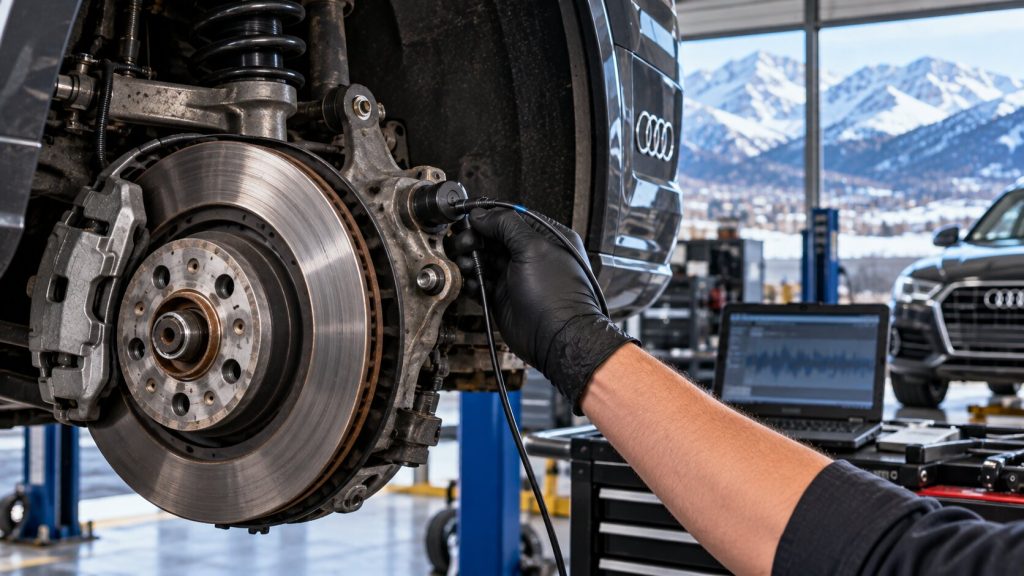
Instead of guessing based on noise or a loose wheel, I hook up high-end triaxial accelerometers directly to the steering knuckle. Think of this tool as a stethoscope that listens to the microscopic vibrations shaking through the metal at 70 miles per hour.
When a rolling element strikes a tiny pit on the outer race, it creates a very specific frequency signature. I run FFT spectrum analysis to isolate that exact frequency. If the data shows the bearing passing frequency is out of spec, I know the part is failing weeks before it ever starts making that classic grumpy humming sound.
How Winter Weather Damages Your Car
Salt Lake City throws a massive amount of environmental abuse at your suspension system every single day. Magnesium chloride brine and coarse winter rock salt don’t just stay on the asphalt—they find their way past aging wheel bearing seals.
Once inside, these chemicals mix with moisture and spark rapid galvanic corrosion across the steel races. When you smash into a massive pothole left behind by a hard winter, the impact forces the rolling balls straight into that corroded raceway. That creates tiny micro-dents that kick off a chain reaction of progressive metal fatigue.
If your Audi’s floorboard hums at 72 MPH but the wheel stays tight on a lift, don’t trust the old manual shake test. Hook up an accelerometer to the knuckle: if the FFT spectrum spikes right at the outer-race pass frequency, the bearing is actively shedding micro-metal into the grease—swap it before it eats your ABS sensor.
Signs Your Wheel Bearings Are Starting to Fail
Your Audi usually tries to warn you long before a complete mechanical breakdown strands you on the shoulder. Keep an ear and foot out for these subtle indicators during your daily commute:
- High-speed floorboard buzz: A subtle, persistent vibration felt through the pedals specifically between 65 and 80 miles per hour.
- Faint low-speed clicks: A quiet metallic clicking when turning tightly inside parking structures or navigating sharp neighborhood corners.
- Spongy brake pedal feel: A slight, unexpected pedal travel caused by the hub wobbling under micro-loads and pushing the pads slightly away from the rotor.
- Intermittent steering shimmy: A minor steering wheel wobble that comes and goes depending on pavement smoothness and highway expansion joints.
Don’t Let a Bad Bearing Melt Your Knuckle
Waiting until a wheel bearing completely locks up is a fast track to destroying your steering knuckle, cooking your ABS sensors, and welding the race directly to the spindle. Dealerships love seeing that happen because it turns a standard hub swap into a massive parts-replacement bill.
I’d much rather catch it the second the FFT data goes sideways, keeping your morning run down I-15 safe and your wallet intact. Stop ignoring that high-speed floorboard hum and swing by Steve’s Automotive Specialist at 2809 S 2300 E, Salt Lake City, UT so I can throw an accelerometer on the knuckle and look at the real data before things get expensive.
Frequently Asked Questions
Can an Audi wheel bearing fail without making a loud humming noise?
Yes. An Audi wheel bearing can fail completely without making a loud humming noise due to internal raceway pitting occurring before physical play develops.
Why do Salt Lake City winter road conditions ruin wheel bearings?
It’s a nasty combination of chemistry and physics. Magnesium chloride brine slips past worn-out rubber seals, eats away at the metal with galvanic corrosion, and then freeze-thaw potholes deal the final crushing blow to the weakened steel races.
How does vibration analysis detect bearing wear better than manual checks?
Manual hand shaking on a lift only catches a bearing when it’s already completely destroyed and wobbling. Accelerometers measure the actual sound frequencies and shock waves happening inside the metal while the car is rolling down the highway under a full load.
What happens if I ignore early-stage wheel bearing vibration in my Audi?
If you let it go too long, the bearing can literally seize up at speed. At best, you’ll melt your ABS sensors and chew up the steering knuckle; at worst, you’re looking at a dangerous roadside failure.