
Utah mountain driving dictates whether brake rotors can be safely machined or require full replacement. Standard resurfacing reduces the thermal capacity of the cast iron disc. Under severe braking stress, thinner rotors lack the material mass to dissipate heat, leading to premature brake fade, permanent warping, and structural failure.
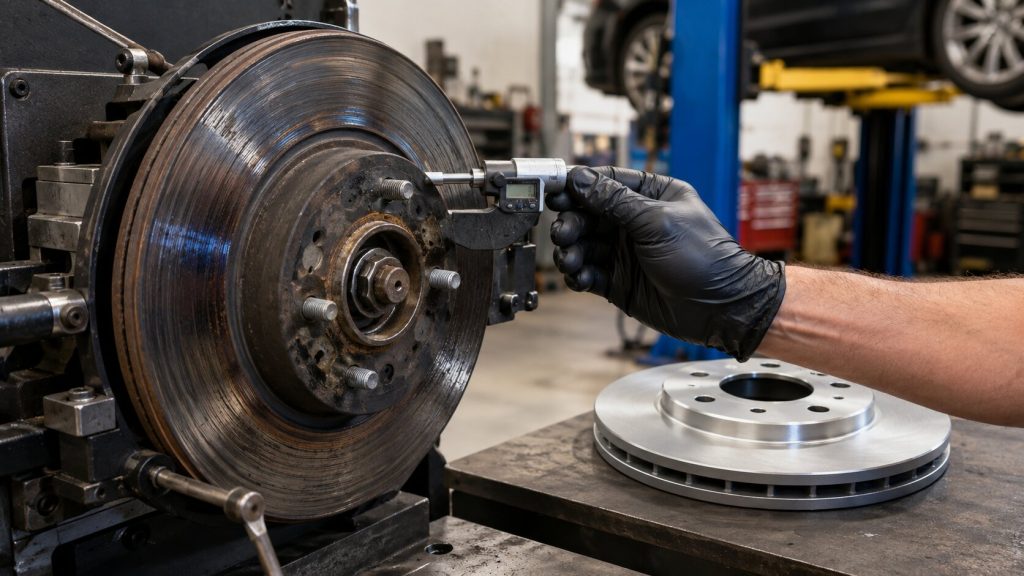
I’ve got a worn brake assembly mounted on the lathe right now to evaluate its remaining structural life. My diagnostic tools reveal that machining down a thin rotor face directly sacrifices the crucial thermal mass needed to survive severe Wasatch Front elevation drops. I balance the cost of lathe labor against the price of new iron to show you exactly where a thinned rotor loses its ability to handle mountain heat.
Why Your Steering Wheel Shake Descending Parleys Canyon
I just pulled a midsize SUV onto the shop bay floor after its heavy downhill commute from Park City. The driver reported a severe vibration through the floorboards and steering column whenever the brakes were applied. While a quick look shows immediate heat checking along the rotor’s circumference, fixing this permanently requires a deeper mechanical evaluation of the structural runout right at the wheel hub assembly.
The 0.002-inch Runout Limit and Brake Shudder
Locking a magnetic dial indicator onto the steering knuckle tells the real story that just descended Interstate 80. As I rotate the wheel hub by hand, the indicator needle sweeps past 0.005 inches of lateral runout. Modern braking systems tolerate a maximum variation of only 0.002 inches before the brake pads begin to ride unevenly over the high spots of the iron disc. This micro-deviation creates intense high-frequency vibrations that translate into a violent steering wheel shudder under heavy mountain application.
Resurfacing vs. Replacement Cost Economics
I must evaluate the financial trade-offs between utilizing an on-car brake lathe and installing brand new cast iron assemblies. Making the right call means looking past the quick shop labor estimate so we can focus on whether the rotor has enough metal left to survive mountain driving. Many vehicle owners ask for a surface cut because it lowers the immediate out-of-pocket parts expense.
When Saving Half the Cost Compromises Mountain Safety
The specialized labor required to set up a precision brake lathe and run a slow finish cut often equals half the cost of brand-new parts. While automotive repair databases show short-term financial savings on paper for machining, these calculations fail to account for the severe topography of the Wasatch Front. Shaving down the cast iron mass lowers the maximum operating limit of the brake assembly, making it a false economy when the thin rotor warps again within months. Sourcing fresh replacement units provides uncompromised cooling architecture and full structural thickness.
How Utah’s Canyon Descents Destroy Thin Machined Rotors
Sustained grade descents apply incredible physical stress to friction surfaces, transforming velocity into extreme thermal loads. When iron discs lose significant structural volume through machining, their ability to store and reject this energy drops exponentially. The resulting heat saturation alters the base metal, leading to structural failures that become obvious during early summer conditions.
Thermal Mass and the Dangers of Cementite Hot Spots
Descending Little Cottonwood Canyon subjects vehicles to sustained kinetic-to-thermal conversion where rotors frequently exceed 600°F. Previously machined rotors lack the material volume to absorb this extreme energy, leading to structural overheating that alters the iron on a molecular level.
This thermal overload creates hard, brittle areas known as cementite that cause permanent pedal pulsation because the brake pads cannot bite into the altered metal uniformly. Furthermore, hitting cold snowmelt puddles or a car wash causes sudden thermal shock, instantly cracking these thinned components.
Precision Diagnostics and Professional Replacement
Structural evidence on the shop floor clearly reveals the braking system’s mechanical condition. Following a thorough wipe-down of the rotor face, final caliper and hub checks established an objective safety baseline. A digital micrometer confirmed a measurement of 22.3 millimeters, which is well below the factory discard specification, while heavy rust scales indicated that the cooling channels are blocked.
Trying to resurface these rotors would leave them dangerously thin for I-15 traffic, so putting on new ones is the only safe call. I finished up by torquing the lug nuts to 90 foot-pounds in a strict star pattern, which guarantees everything is seated perfectly and ready for the road.
Visit Steve’s Automotive Specialist at 2809 S 2300 E, Salt Lake City, UT 84109, to ensure your brakes are mountain-ready before your next canyon trip.
Frequently Asked Questions
Is machining initially cheaper than replacing your brake rotors?
Yes. Machining is initially cheaper than replacement because you avoid the upfront cost of new parts. If you are constantly driving up in the canyons, shaved-down rotors will warp almost immediately from the heat, meaning you will end up buying new ones soon anyway and paying twice for the same job.
Can you always resurface brake rotors for any vehicle?
No. You cannot always resurface brake rotors safely. If a rotor face shows deep scoring exceeding 0.015 inches, or if machining it flat drops the total thickness within 0.050 inches of the factory discard limit, the disc must be replaced.
Does a technician need a micrometer to know if rotors are too thin?
Yes. Spotting a thin rotor means grabbing a micrometer and checking around the face of the disc to see if the wear is uneven. If the measurement falls within 0.050 inches of the factory discard specification stamped on the hub, the unit cannot be machined.
Will driving on machined rotors that are too thin cause brake fade?
Yes. Taking a car out with over-machined rotors means your brakes will overheat almost instantly because there is simply not enough metal left to absorb the friction. This thermal overload leads to sudden brake fade and a soft, spongy pedal as brake fluid approaches its boiling point during canyon descents.
Do Utah’s steep canyon descents cause machined rotors to warp faster?
Yes. Riding your brakes all the way down a steep Utah canyon can push temperatures past 600 degrees, which twists thin iron out of shape in a hurry. Because machining removes crucial iron mass, the thinned metal cannot dissipate this intense thermal energy quickly enough, causing the disc to distort under heavy load.