
When brake pads drop below 3mm, the friction material no longer insulates the caliper from kinetic heat. Thermal energy transfers into the rotor and hydraulic fluid, causing glazing and seal degradation. In Utah, this transition triggers metal-to-metal contact, structurally compromising rotors and forcing expensive caliper replacements due to piston over-extension.
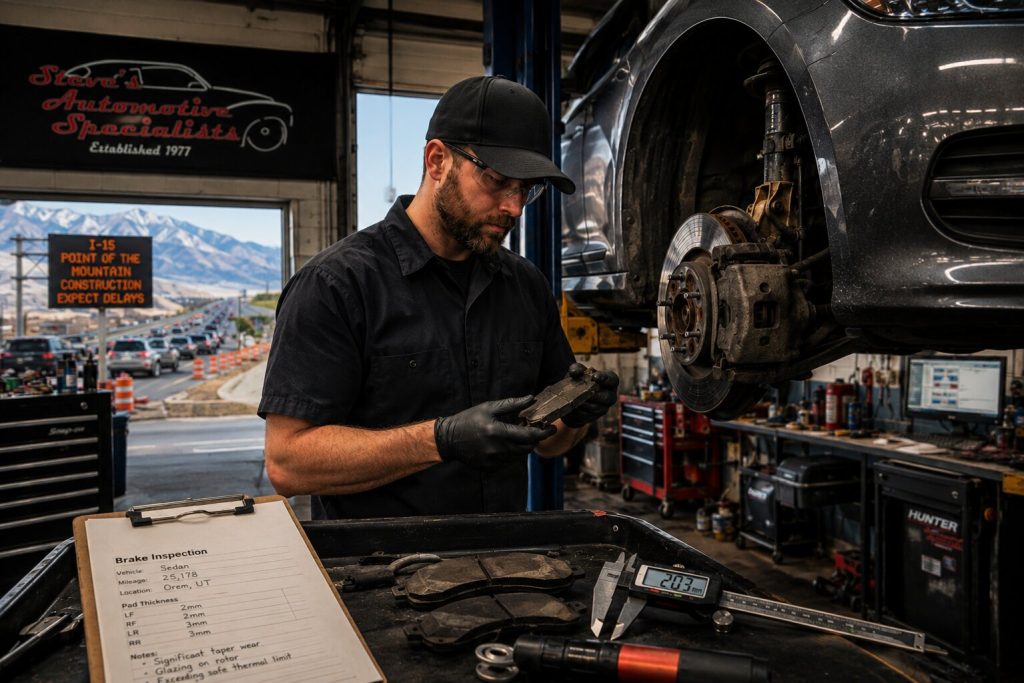
I am looking at a sedan on the lift right now that just came in from a morning commute through the I-15 “Point of the Mountain” construction. As I pull the wheel, the acrid scent of overheated resin hits first. It is the smell of a brake system that has been pushed past its thermal limit. In Orem and Sandy, the owner’s manual claim of a 50,000-mile service interval is a fantasy. On the Wasatch Front, pads pull off the hub at 25,000 miles with significant taper wear and glazing—a direct result of the 6% grades and University Mall stop-and-go.
Why does a 15-minute descent from Draper destroy thin pads?
Descending from the steep residential inclines of Suncrest requires sustained brake application that generates localized rotor temperatures exceeding 600°F. When pads are worn thin, they lack the thermal mass to absorb this kinetic energy, causing the heat to soak directly into the caliper pistons and hydraulic lines. This accelerated thermal transfer often leads to brake fluid aeration and a dangerous increase in stopping distances during a May afternoon commute.
The 3mm “Point of No Return” for thermal insulation
When friction material drops below the 3mm threshold, the pad loses its capacity to act as a heat shield. Instead of being dissipated, this extreme energy soaks directly through the steel backing plate and into the caliper pistons. This degrades the internal EPDM rubber seals and causes brake fluid aeration, creating hydraulic leaks that often go unnoticed until the brake pedal unexpectedly sinks to the floor.
The forensic breakdown of rotor scarring
The combination of Great Salt Lake aerosols and spring road grit creates an abrasive slurry that rapidly erodes the integrity of exposed iron rotors. Once the soft friction material is gone, the hardened steel backing plate begins to machine deep, irreparable grooves into the rotor surface. This structural scarring compromises the parallelism of the braking system, resulting in the violent steering wheel shudder often felt during high-speed stops on I-15.
Why Sandy’s road salt turns “simple swaps” into caliper replacements
Utah’s environment combines Great Salt Lake aerosols with heavy road brine to create a gritty paste that traps mineral dust between the pad and rotor, acting like a lathe that carves the metal before the wear indicator even shrieks. Ignoring this sound turns a simple 130 dollar pad swap into a 900 dollar restoration because the hardened steel backing plate grinds directly against the cast iron rotor once the friction material is exhausted.
Grinding metal-on-metal stretches your stopping distance by forty percent on rain-slicked May roads because steel backing plates simply cannot bite into iron. This extreme friction causes the rotor to “glass over” with cementite hard spots, a molecular change that makes the metal brittle and prone to shattering.
The Hydraulic Cost of Piston Over-extension
Worn-out pads push the caliper piston to the edge, where road grime can easily bypass the stretched dust boot and score the internal seals. This over-extension shifts the hydraulic balance of the system, requiring significantly more fluid volume to move the pads and causing the master cylinder to work harder. Under sustained load at a stoplight, worn seals allow fluid to sneak past the piston, turning a seemingly firm pedal into a soft, sinking safety hazard.
How neglected pads compromise the ABS logic and master cylinder seals
The extra distance the piston must travel creates a 12mm lag in the pedal, delaying the engagement of the ABS module when you need it most. This mechanical strain is exacerbated at Utah’s altitude, where a refractometer often reveals 4% moisture content in the fluid, significantly lowering the boiling point of DOT 3 oil. During heavy braking near Utah Lake detours, this contaminated fluid can actually boil inside the lines, creating compressible gas pockets that result in a spongy pedal and a total loss of stopping power.
Forensic Results from the Service Bay at Steve’s Automotive Specialist
My first step is pulling out the micrometer to check if the rotor is thick enough to handle the thermal loads of a Wasatch descent. In this case, the measurements prove that the rotor has been thinned beyond its structural limit by the backing plate of the exhausted pad. The final forensic proof is the seized caliper slide pin, which has locked the assembly into a permanent tilt and destroyed the internal piston bore.
Measuring run-out and parallelism on the Wasatch Front
My digital micrometer confirms the diagnostic verdict, showing a rotor thickness of 19.4mm against a factory minimum of 22mm, with the steel backing plate having physically machined away the internal cooling vanes. This neglect, combined with road salt that seized the lower caliper slide pin, forced the inner pad to wear at a 15-degree angle and generated the heat-soak that fused the piston to its bore. I have verified that a new caliper is mandatory to resolve the steering jitter and pressure imbalance before I final-torque the bracket bolts to 80Nm.
High moisture content in your DOT 3 fluid will boil during a summer descent from Suncrest, leaving you with zero pedal pressure. Reach out to the team at Steve’s Automotive Specialist in 925 N State St, Orem, UT 84057 for a refractometer fluid test and a pad thickness audit to ensure your thermal barrier is still intact before the May heat hits the Wasatch Front.
Frequently Asked Questions
How much does it cost to replace brake pads in Utah?
Expect a $700+ jump in repair costs if you wait for the grinding sound. A routine pad swap quickly escalates in Sandy as road brine seizes the lower slide pins, forcing a full hardware extraction. Once that happens, the piston over-extends and fuses to the bore, requiring a mandatory caliper replacement.
Why do my brakes squeak more in May?
May’s heavy spring runoff reacts with leftover road brine to build a crust of surface rust that ruins your initial brake bite. However, if the squeaking is persistent, it likely indicates the mechanical wear indicator is contacting the rotor, signaling that your pads are dangerously thin.
Can high altitude affect my car’s braking performance?
Yes, higher elevations like Orem and Sandy affect the boiling point of brake fluid. Under heavy use, such as descending canyon roads, old fluid with high moisture content can boil, leading to a spongy pedal and a dangerous loss of stopping power.
How often should I have my brakes checked in Sandy?
Given the aggressive grades and stop-and-go traffic on the Wasatch Front, I recommend a visual inspection every 6 months or 7,500 miles. Between the steep canyon grades and the road brine, Utah vehicles almost never make it to the “standard” mileage marks before the pads are spent.
What are the signs that my rotors are already damaged?
Feeling a vibration in the wheel while slowing down is a classic sign that your rotors are heat-cracked and no longer true. This usually happens when thin pads fail to insulate the rotors from extreme friction temperatures during heavy stops.