
Land Rover driveline noise usually signals worn differential gears, damaged wheel bearings, or transfer case failure. Differential noise changes with throttle load, while bearing hum shifts during turns. Road testing and fluid checks isolate the exact cause, allowing timely repairs that prevent catastrophic gear failure and costly repairs across Utah roads.
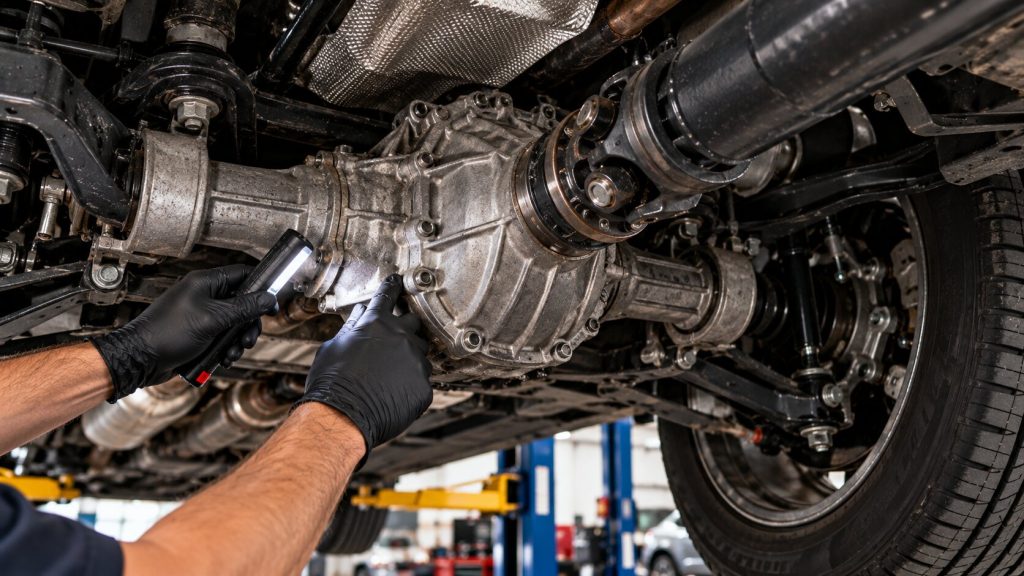
Land Rover models driven across Utah highways and off-road trails frequently develop load-dependent differential whine, harsh bearing growls, and subtle driveline vibrations. Separating a failing ring-and-pinion gear set from a worn wheel bearing, transfer case assembly, or uneven tire tread requires precise diagnostic road testing. We evaluate these complex drivelines to catch mechanical wear early and keep your vehicle operating smoothly.
Identifying Land Rover Driveline Noise and Vibration Patterns
Driveline noise in a Land Rover rarely appears without a specific mechanical cause. Differential noise typically manifests as a high-pitched whine that alters tone depending on whether you are accelerating, coasting, or maintaining a steady speed. Bearing failure produces a lower, rhythmic growl or rumble, much like a heavy skateboard wheel on rough asphalt, that builds progressively as vehicle speed increases.
Vibrations usually point to rotating components like driveshafts, universal joints, or imbalanced wheel assemblies. A vibration felt primarily through the floorboard or seat frame under heavy acceleration suggests driveline angle misalignment or worn prop-shaft center bearings. Recognizing these subtle differences helps us isolate the exact component under stress before widespread failure occurs.
How Road Testing Pinpoints Differential and Bearing Issues
Isolating a differential fault from adjacent driveline components requires a systematic road test under varied driving conditions. We attach electronic multi-channel chassis ears (sensitive microphone clamps) to the differential housing and wheel knuckles, monitoring sound frequencies while pulling steep incline grades up Parleys Canyon or coasting on I-80.
- Load Testing: Pitching the noise between acceleration and deceleration isolates ring-and-pinion gear tooth wear from steady-state bearing damage.
- Lateral Weight Transfer: Swerving gently in a safe area loads left and right wheel bearings, shifting sound levels to confirm wheel hub issues.
- Neutral Coasting: Disengaging drive power while coasting at highway speed helps separate engine-dependent noise from rotating driveline friction.
- Speed-Matched Monitoring: Tracking whether vibration frequency matches wheel speed or driveshaft rotation speed isolates the precise rotating assembly.
Analyzing Fluid Condition and Internal Component Wear
Differential fluid acts as a direct diagnostic record of internal gear and bearing health. Factory-recommended lubricants like Castrol SAF-XO / 75W-90 synthetic break down under prolonged thermal stress, dropping viscosity below critical film strength, meaning the oil gets too thin to keep metal parts from touching.
When fluid leaks out or breaks down, microscopic metal particles shave off internal components and circulate through the casing. Pulling the magnetic drain plug on an LR4 or Range Rover Sport rear differential often reveals fine steel silt and dark, scorched fluid, confirming pinion bearing micro-pitting or gear tooth backlash out of spec. Installing fresh, high-grade lubricant and re-setting ring-and-pinion backlash (the microscopic gap between gear teeth) within factory tolerances prevents gear pitting and protects expensive differential housing assemblies.
Differentiating Transfer Case and Wheel Bearing Failures
Sound travels easily through a Land Rover’s heavy unibody frame, making a bad transfer case or wheel bearing frequently mimic differential failure. A failing wheel bearing typically creates a loud, low-frequency hum that changes pitch when negotiating mountain passes and sharp turns. Transfer case issues usually present as a high-frequency vibration or chain slap sound under heavy engine load.
Tire condition also plays a massive role in our driveline diagnostics on all-wheel-drive platforms. Uneven tire wear, mismatched tread depths exceeding 2/32 inches between tires, or improper inflation pressures create synthetic driveline wind-up, a mechanical strain where tires try to rotate at slightly different speeds. This mechanical binding mimics gear whine and puts unnecessary stress on the central transfer case differential lock mechanisms.
Expert Mechanical Repairs for Land Rover Drivelines in Utah
Ignoring driveline noise leads to severe mechanical damage, fluid starvation, and catastrophic gear lockups on the road. Replacing worn bearings and re-shimming ring-and-pinion gear sets early restores quiet operation and protects your vehicle’s drivetrain performance.
We provide complete Land Rover diagnostic, maintenance, and driveline repair services tailored to local mountain-grade driving demands.
Schedule your Land Rover driveline inspection today at Steve’s Automotive Specialist located at 2809 S 2300 E, Salt Lake City, UT 84109.
Frequently Asked Questions
How do I tell if my noise is a wheel bearing or a differential?
Wheel bearing noise changes volume or pitch when you turn the steering wheel side to side, whereas differential noise responds strictly to accelerator pedal position. Pitch changes under load point to ring-and-pinion or pinion bearing wear.
Can driving with a noisy differential cause further damage?
Yes, running a vehicle with differential noise causes metal particles to circulate through the housing, damaging surrounding bearings and gear teeth. Left uncorrected, the assembly can overheat, seize, or destroy the main differential housing.
Why does my Land Rover vibrate only during acceleration?
Driveshaft universal joint wear, failing constant velocity (CV) joints, or worn differential mounting bushings cause vibration under heavy acceleration. Torque loads force worn joints out of center alignment under power.
How often should Land Rover differential fluid be replaced?
Land Rover differential fluid should be replaced every 30,000 to 60,000 miles depending on driving conditions. Vehicles driven regularly through steep Utah mountain passes or wet off-road trails require 30,000-mile fluid changes to prevent lubricant breakdown.