
Land Rover highway steering vibration usually stems from wheel imbalance, tread cupping, bent rims, or worn lower control arm hydro-bushings. Systematically inspecting rotational assemblies, wheel runout, and steering linkage isolates chassis oscillations from driveline harmonics. Timely diagnostic evaluation prevents premature suspension wear and restores smooth, confident high-speed driving.
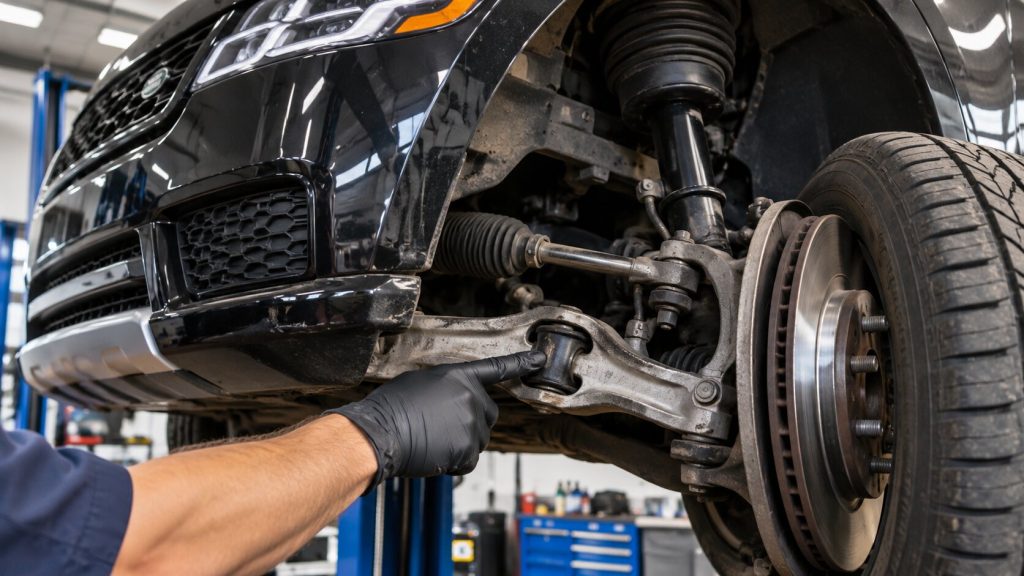
When driving between 55 and 75 mph down I-15 or I-80 across Utah, minor mechanical variations in your Land Rover escalate into noticeable feedback through the steering column. Identifying the exact root cause requires systematically evaluating wheels, tires, bearings, and chassis mounts to isolate rotation-dependent forces from driveline harmonics. When we pull LR4 or Range Rover Sport control arms off after harsh Utah winter driving, fluid leakage from the lower control arm rear hydro-bushing is overwhelmingly the secondary catalyst that amplifies minor tire imbalance into heavy steering shake.
Why Highway Speeds Trigger Steering Vibration
At elevated road speeds, any rotational imbalance or geometry defect in your Land Rover dynamic assembly produces a repeating frequency. Front wheels and tires complete roughly 700 to 800 revolutions per minute at 65 mph, meaning even a quarter-ounce balance weight loss creates a noticeable vertical or lateral oscillation.
Suspension components like control arm bushings and ball joints normally damp out baseline road harshness. However, when these rubber hydro-bushings soften or develop micro-tears from road salt and extreme Utah seasonal temperature swings, they stop dampening minor force variations. Instead, the worn suspension allows over 0.040 inches of dynamic fore-and-aft hub deflection under road load, transmitting vibration directly through the steering rack into your hands.
Differentiating chassis vibration from engine or transmission issues comes down to engine load versus vehicle speed. If the steering vibration persists when you slip the transmission into neutral while coasting at 65 mph down a Utah highway incline, the issue lies directly in the rolling chassis, wheel assemblies, or front steering linkage rather than the engine mounts or torque converter.
Evaluating Wheel Balance and Tire Condition
The most frequent source of highway-speed shaking is uneven weight distribution across the tire and wheel assembly. Lost adhesive balance weights, heavy mud accumulation on the inner rim barrel, or bent wheel lips from winter pothole impacts across Utah roadways immediately disrupt smooth high-speed rotation. Road-force balancing equipment measures this assembly deflection under load, where values exceeding 15 lbs of force cause severe steering feedback.
Check your tire tread condition, as it plays an equally critical role in front-end stability. Irregular tread wear, such as cupping or feathering caused by improper toe alignment, creates a rhythmic thump that mimics an out-of-balance wheel. Furthermore, internal tire belt separation can cause severe high-speed wobble while looking completely normal during a static visual check.
- Static and Dynamic Unbalance: Heavy spots on the inner or outer wheel lip create vertical hopping or lateral shimmy.
- Tread Cupping: Alternating high and low spots across the tread blocks generate both noise and steering feedback.
- Radial Runout: A tire or wheel that is not perfectly round hops vertically with every full rotation.
- Separated Belts: Internal steel belt shifted positions create a localized bubble or structural tread squirm.
Inspecting Wheel Runout and Hub Assembly Integrity
Even a perfectly balanced tire cannot compensate for a bent wheel or an eccentric hub interface. Wheel runout measures the degree to which a wheel deviates from a perfect circle (radial runout) or wobbles side-to-side (lateral runout) as it spins on the hub spindle, with tolerances requiring dial-indicator readings under 0.002 inches.
Land Rover alloy wheels feature precise hub-centric mounting faces. If rust build-up or debris sits between the brake rotor hat and the wheel mounting pad, the wheel sits at a slight angle relative to the hub axle. This tiny alignment defect amplifies significantly at highway speeds, causing noticeable vibration despite correct wheel balance numbers.
Wheel bearings also demand careful inspection when troubleshooting front-end movement. A failing wheel bearing often produces a low hum or growl that changes tone during lane changes, but excessive internal clearance within the bearing raceway can also allow the entire brake rotor and wheel assembly to flutter at speed.
Checking Front Suspension Bushings and Steering Linkage
Many Land Rover vehicles utilize complex multi-link front suspension setups designed to manage heavy curb weights both on and off road. Hydro-bushings (fluid-filled rubber mounts) are commonly used on lower control arms to isolate road shock, but these bushings gradually leak or tear over time.
When hydro-bushings lose their hydraulic fluid, the lower control arm gains excess fore-and-aft play under braking and cruising conditions. This play allows the front wheel hub to oscillate forward and backward at high speeds, transforming normal tire rolling forces into violent steering wheel shake.
Tie rod ends and steering rack mounts must also maintain tight tolerances to keep the front tires tracks parallel. Loose inner or outer tie rod joints allow the front wheels to flutter slightly side-to-side, particularly when hitting highway expansion joints or uneven pavement grooves across Utah.
Reviewing Driveline Components and Engine Mounts
While steering wheel vibration usually points to front wheel or suspension issues, driveline defects can transmit similar feedback through the floorboards and steering wheel. Front driveshaft double-cardan joints, CV axles, and transfer case output flanges develop play that mimics tire imbalance.
Worn engine or transmission mounts allow powertrain torque fluctuations to transfer into the vehicle chassis. If a rubber powertrain mount collapses, engine vibrations transfer directly into the unibody frame, making the steering column vibrate even when the vehicle is sitting still or traveling at low city speeds.
Inspecting front axle inner CV joints is particularly important if the vibration occurs strictly during hard acceleration at highway speeds. Worn inner CV tripods carve pits into their outer housings, forcing the front driveshafts to bind and shake the front end under heavy engine load.
Experience Precision Land Rover Service in Salt Lake City
Addressing persistent steering vibration requires specialized testing equipment, precise torque specifications, and experienced hands. Our team uses advanced road-force balancing and systematic chassis inspection protocols to pinpoint the exact source of front-end instability in your Land Rover.
Ignoring high-speed steering shake accelerates wear on control arm bushings, tie rod ends, and front tires, turning a simple balance correction into an extensive suspension repair. We focus on transparent diagnostics and lasting repairs so you can enjoy smooth, confident highway driving across Utah.
Schedule your comprehensive chassis and wheel evaluation today with our local experts located at 2809 S 2300 E, Salt Lake City, UT 84109. Visit my team at Steve’s Automotive Specialist to get your vehicle driving smoothly again.
Frequently Asked Questions
Can a bad wheel alignment cause steering wheel vibration at high speeds?
No. A bad wheel alignment causes vehicle drift or uneven tread wear rather than a direct vibration. However, severe mis-alignment causes irregular tread cupping over time, which ultimately generates high-speed steering vibration.
How do I know if my vibration is caused by tires or suspension?
Tire-related vibration usually starts at a specific speed, such as 60 mph, and remains constant at that speed regardless of engine acceleration. Suspension-related vibration often worsens during braking, cornering, or going over highway expansion joints.
Why does my Land Rover shake only when applying the brakes at high speeds?
Brake rotor thickness variation or uneven pad deposit buildup causes shaking during braking rather than pure wheel balance issues. As the brake pads clamp onto uneven rotor surfaces, the hydraulic feedback pushes back through the steering rack.
Will balancing my front tires solve all steering wheel vibrations?
No. Wheel balancing solves rotational weight imbalances but cannot fix bent rim lips, torn hydro-bushings, or radial belt separation. A thorough visual and mechanical inspection of the entire front suspension is necessary to confirm all components are within specification.