
Daily school runs across Orem and Lindon prevent brake hardware from achieving the heat necessary to purge moisture. This results in glazed pads rather than consistent friction. Frequent low-speed stops cause pad transfer failure, while the descent from the Lindon Bench creates significant thermal loads that warp rotor geometry.
I am pulling a 2022 SUV into the bay. The owner reports a faint squeal during the morning drop-off at Lindon Elementary. On the highway, brakes benefit from cooling airflow and consistent pressure that “beds” the pads. In Utah County school zones, the cycle is different. Frequent, light applications at 20 mph generate localized surface heat without the clamping force necessary to scrub the rotors clean.
Why does the descent from the Lindon Bench accelerate rotor glazing?
The sustained grade from the foothills down to State Street forces drivers to maintain constant light pressure on the pedal. This creates a low-heat environment that glazes the pads without reaching the temperatures needed for a full cleaning cycle. Over several weeks of school runs, this results in the pad material hardening into a smooth, non-gritty surface. I am seeing this chemical transformation daily on vehicles that navigate the Lindon elevation shifts.
The 400-degree thermal threshold
I am measuring the rotor surface with an infrared pyrometer. As parents descend from the Lindon foothills toward State Street, they ride the brakes to maintain speed. This creates a sustained 400-degree thermal environment. Unlike a single hard stop that allows for a cooling period, this prolonged heat-soak glazes the pad material. The resin in the brake pad liquefies and smears across the rotor face. I see the result on this vehicle: a mirror-like finish on the discs that reduces the coefficient of friction. The pads are not worn down by volume; they are chemically altered by the grade.
Can short trips to Orem schools cause brake fluid failure?
Most school commutes in Orem cover less than three miles, which is insufficient to generate the engine bay heat required to dry out the braking system. This allows ambient moisture to penetrate the master cylinder reservoir and settle into the lowest points of the hydraulic lines. Without the thermal purge of a longer drive, the fluid becomes saturated and loses its ability to resist boiling. My testing equipment confirms that these local routes are the primary cause of internal hydraulic degradation.
Managing hygroscopic saturation in the Utah Valley
I am dipping a refractometer into the master cylinder. The fluid shows 4% moisture content. Brake fluid is hygroscopic, meaning it absorbs water from the Utah Valley air. Under normal driving, the calipers get hot enough to evaporate incidental moisture. A 2.1-mile trip from a driveway near 800 North to the school gates ends before the fluid reaches the necessary 212°F. This moisture settles in the lines, lowering the boiling point and causing internal corrosion in the ABS actuator. The “Maintenance Required” light on the dash is dark because it cannot “see” the chemical degradation of the hydraulic fluid.
Is the 800 North commute damaging your vehicle’s suspension?
The high concentration of speed tables and traffic-calming measures on 800 North subjects the vehicle’s struts to thousands of additional cycles per month. These rapid compression events occur while the vehicle is heavily loaded with passengers, pushing hydraulic fluid past the internal valving at high velocities. This generates internal friction and heat within the strut body that a standard highway commute would never produce. I am currently documenting an increase in premature seal failures specifically along these high-traffic school corridors.
Speed table rebound and MacPherson strut fatigue
I have the vehicle on the lift to inspect the front struts. Orem uses specific speed table geometries for traffic calming in school zones. When a vehicle loaded with three passengers hits these at 15 mph, the MacPherson struts undergo a rapid compression and rebound cycle. I am looking for “wet” strut bodies, indicating the seals have failed from the internal pressure spikes. May 2026 roadwork on 2000 West diverts heavy traffic into residential zones, quintupling suspension oscillation cycles per mile.
What did the safety inspection reveal at Steve’s Automotive Specialist?
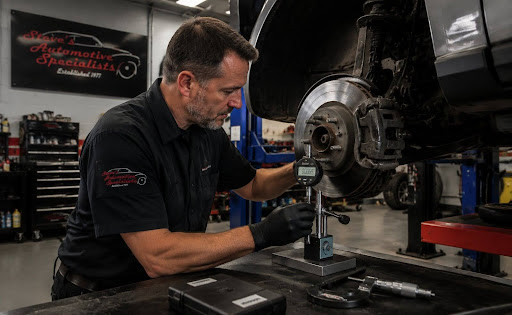
I’m clocking 0.005 inches of lateral runout at the hub with a dial indicator. Even with 6mm of pad life remaining, that oscillation creates a high-frequency kickback that prevents the friction material from ever finding a flat seat against the rotor. I use precision instruments to identify warping and taper that a quick visual check would miss entirely. By checking the hardware against factory tolerances, I can see exactly how the Orem environment has forced the metal to move. I’m pull-testing the caliper slides and checking the piston boots for heat-cracking. If these pins aren’t moving freely, your new pads will glaze over before the first bell rings in September.
Measuring lateral runout and pad taper
I am mounting a dial indicator to the hub to check lateral runout. The needle jumps 0.005 inches. This is the “Smoking Gun.” The uneven heat-soak from stop-and-go school traffic has physically warped the rotor. I also measure the pads with a micrometer; the inner pad is 2mm thinner than the outer. This pad taper proves the caliper slide pins are sticking due to the salt and spring runoff from the Lindon Bench.
Your dash display shows 40% brake life remaining based on an algorithm, but my micrometer shows the inner pad is tapered down to the backing plate due to a seized lower slide pin. If you notice a pulse in the pedal while driving through Orem, reach out so I can get it on the rack for a forensic look at the hardware at Steve’s Automotive Specialist in 925 North State St. Orem, UT.
People Also Ask
Do school zones wear out brakes faster?
Yes. Frequent low-speed braking prevents pads from reaching the “bedding” temperature required for a clean friction transfer. Orem and Lindon commutes cause pad glazing and rotor crystallization, reducing stopping power despite having sufficient pad thickness.
Why does my brake pedal vibrate in school traffic?
This is usually caused by lateral runout or “warped” rotors. In Utah County, the combination of descending the Lindon Bench and frequent stopping in Orem school zones creates uneven heat-soak. This thermal stress distorts the rotor surface, leading to a pulsating sensation.
How often should I check my brakes in Utah County?
A safety inspection is vital every 6 months or 6,000 miles. Orem’s environmental factors, including spring runoff and short-trip moisture accumulation, can degrade brake fluid and seize caliper pins long before the vehicle’s onboard computer triggers a maintenance reminder.
Can Orem speed bumps damage my suspension?
Yes. Repeatedly crossing speed tables and traffic-calming measures at 800 North with a fully loaded vehicle accelerates strut seal failure. Fluid leaks and degraded rebound control destabilize the vehicle during sudden emergency braking.