
Severe thermal degradation causes sudden commercial vehicle brake failure on sustained Utah mountain descents. High altitude reduces air density, dropping rotor cooling efficiency by 15%, while repeated deceleration along the I-15 corridor pushes temperatures past 1,200°F. Predictive fleet maintenance tracking telemetry thresholds prevents unexpected fleet downtime.
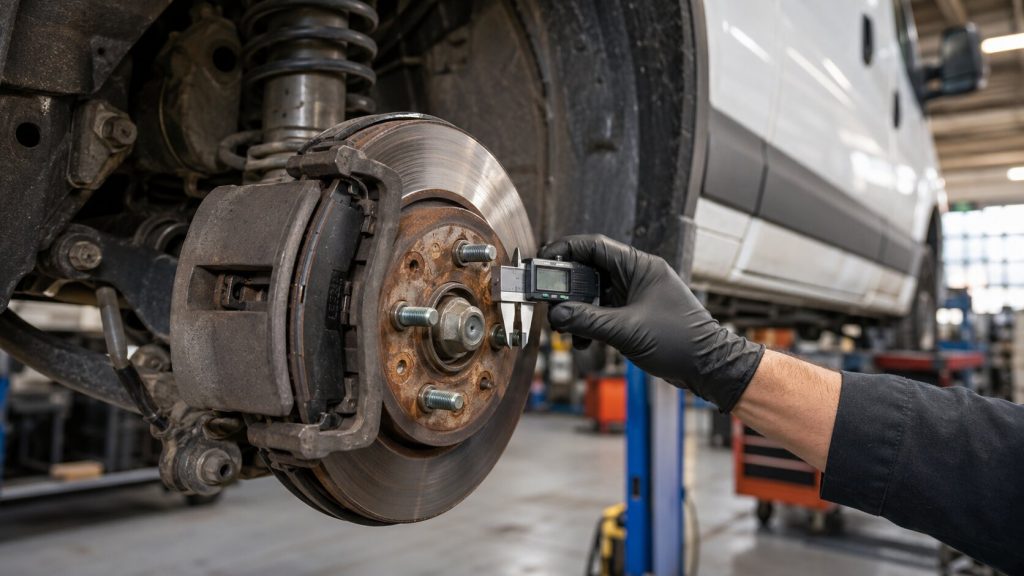
I am pulling a loaded Ford Transit onto my lift after an East Bench delivery run, immediately smelling the acrid aroma of scorched brake resin. While factory manuals specify generic 15,000-mile inspections, my digital micrometer proves this standard schedule fails completely against steep Utah topography. Descending a 7% grade like Parleys Canyon under full load pushes rotor temperatures past 1,200°F, causing standard ceramic pads to gas out and trigger severe brake fade.
Why Final-mile Delivery Vehicles Suffer Brake Fade on I-15
The kinetic energy conversion required to slow a transit van from seventy miles per hour to a dead stop in stop-and-go highway traffic is immense. The problem worsens along the Point of the Mountain corridor through Lehi and Draper, where ongoing highway construction bottlenecks create sudden, high-velocity deceleration events. When a driver repeatedly hits those thresholds in the midday heat, where ambient temperatures climb past 95°F and asphalt temperatures hit 140°F, the braking system has zero opportunity for thermal recovery. The heat-soak moves directly into the sliding caliper assemblies and quickly degrades internal seals.
The 1,200°F Thermal Threshold
During my inspection of this front brake system, I connected our diagnostic interface to the vehicle J1939 CAN-bus network to pull the onboard telematics log. The fleet monitoring logic inside the electronic stability control module keeps a precise tally of severe braking events. The telemetry log showed that this vehicle cut speed hard enough to cross the 0.3G threshold 47 times in a single shift. Standard floating single-piston calipers rely on a thin layer of silicone-based slide-pin grease to maintain alignment. Under sustained 1,200°F spikes, that grease undergoes a complete polymer chain breakdown, runs out of the rubber guide boots, and leaves the steel slide pins exposed to dry friction.
Is it Mechanical Wear or Salt Lake Valley Heat-soak
The physical degradation of the hydraulic components is only half the battle. We also have to contend with environmental contamination that mimics mechanical component wear. Once the pins bind, the caliper cannot float freely, forcing the inner brake pad to stay hard against the rotor face even after the driver releases the pedal. This continuous friction creates an uninterrupted thermal cycle that glazes the pad surface, transforming the compliant friction material into a glassy, smooth ceramic layer with an incredibly low coefficient of friction.
Identifying Slide-pin Polymer Breakdown Along the Point of the Mountain Corridor
As I remove the caliper guide bolts, which are torqued to a factory specification of 26 ft-lbs, I check the resistance across the electronic pad-wear sensor wiring loop. The multimeter indicates a high resistance fault despite 5 mm of usable pad material remaining, proving that local road contamination ruined the circuit.
During winter, the road salt and atomized magnesium chloride sprayed onto I-15 accumulate inside the caliper piston boot and around the anti-rattle clips. When summer cloudbursts or high-pressure pressure washers blast the chassis, they wake up those trapped chemicals and kickstart active galvanic corrosion. This rust jack pinches the brake pads tightly within the caliper bracket slots, causing them to drag continuously and bake the rubber dust seals until they become brittle and crack.
How High-altitude Descents Destabilize Standard Friction Formulations
The lower atmospheric pressure found at our higher elevations across Utah directly alters how commercial brake systems shed heat. At an elevation of over 4,000 ft in the valley, and up to 8,000 ft along the mountain delivery routes, the air density is significantly lower than at sea level. Because the air is less dense, the convective cooling efficiency of ventilated rotors drops by more than 15%. The cooling vanes cast into the center of the rotors cannot move enough air mass to drop the rotor temperature before the next braking cycle begins.
Why Encapsulated Engines Struggle at 5,800ft
Modern delivery vans make this cooling problem worse because their smooth underbody panels and sealed engine bays lock heat right inside the wheel wells. Too many fleet managers try to save a buck by buying cheap ceramic pads meant for commuter cars driving on flat roads. When subjected to long, heavy descents down from Park City, these generic pads fail due to rapid thermal saturation. I install advanced fleet-grade semi-metallic or metallocene-bonded carbon matrices on all class 2 through 5 commercial vehicles to combat this elevation factor.
Precision Diagnostics Stopping Failures Before They Happen
By combining real-time computer diagnostics with precise physical measurements, we pinpoint critical brake issues before a driver loses stopping power on the highway. My diagnostics often reveal a smoking gun, usually excessive moisture, that leads to a dangerous loss of pedal pressure on mountain descents. These factors turn standard brakes into a liability for any vehicle navigating this terrain. I treat every service interval as a chance to catch these failures early by performing the detailed digital fluid and mechanical inspections that most shops overlook.
Contact Steve’s Automotive Specialist at 925 N State St, Orem, UT 84057 today to schedule a predictive fleet brake diagnostic audit and secure your fleet’s safety.
Frequently Asked Questions
Are national fleet mileage guidelines sufficient for Wasatch Front delivery routes?
No. Standard intervals ignore the accelerated thermal wear caused by our steep mountain descents and constant stop-and-go highway construction. To ensure safety and prevent costly roadside failures, commercial vehicles operating in this unique terrain require comprehensive, proactive brake inspections at least every 6,000 miles.
Does moisture cause spongy brake pedals on mountain descents?
Yes. A spongy pedal is a clear sign that moisture-contaminated fluid has boiled into compressible vapor. If you ride the brakes down a steep pass with degraded fluid, the intense heat will boil the liquid, potentially leaving you with zero pedal pressure and a dangerous, non-responsive braking system.
Do standard ceramic pads fail early on Utah delivery routes?
Yes. Ceramic pads struggle to dissipate the intense thermal energy generated by heavy, loaded delivery vehicles on steep mountain grades. This leads to internal resin breakdown, severe surface glazing, and deep cracking, which ultimately results in a catastrophic loss of braking friction exactly when you need it most.
Can winter road salt cause summer brake failures?
Yes. Residual magnesium chloride and salt trapped inside calipers trigger rapid galvanic corrosion once summer humidity hits. This chemical buildup binds the slide pins and forces the brake pads to drag continuously, leading to accelerated component wear and premature mechanical failure long after the winter season ends.
Are uneven wear and a hot metallic smell signs of grease breakdown?
Yes. Burned-out slide-pin grease typically manifests as wedge-shaped, uneven pad wear across the friction surface. Expect the vehicle to pull to one side during braking, paired with that unmistakable, acrid metallic stench that lingers long after you’ve finished a run through the valley.