
Electronic brake wear sensors function by monitoring circuit continuity or specific electrical resistance values within the brake pad assembly. When brake pads wear to the critical point, the sensor signals the control module via a circuit change, which subsequently requires a professional software reset to clear the resulting dashboard warning.
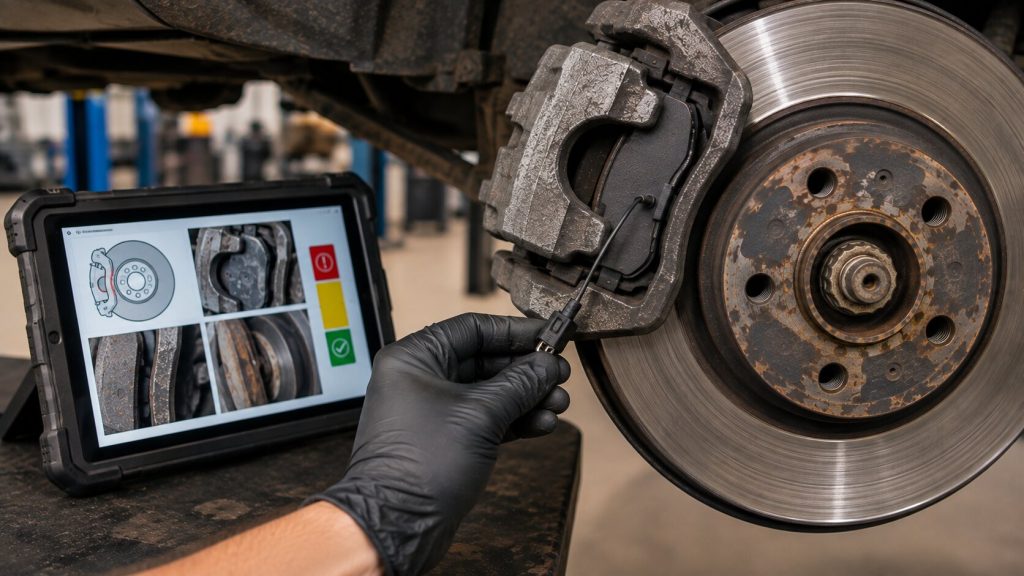
How Your Vehicle Monitors Brake Thickness In Real-Time
I spend my mornings in this shop looking at the difference between what the manual claims and what the asphalt actually does to a car. Most drivers think their brake light is a simple switch, like a light bulb in a hallway. It is not. We are dealing with two distinct types of tech. Older or budget-focused systems use a single-stage sensor. It is essentially a wire loop embedded in the pad. When the pad wears down far enough, the rotor grinds the wire, the circuit opens, and the dash lights up. It is binary. It is on or off.
Then there is the modern two-stage sensor. These use integrated resistors to communicate a range of data to the Engine Control Module. As the pad wears, the internal resistance changes incrementally, allowing the vehicle to estimate the remaining mileage before a service is required. It is an active calculation rather than a reactive trigger.
Identifying False Positives Versus Actual Pad Depletion
Utah winters are not kind to these delicate circuits. Every time a car comes in from a canyon run down Big Cottonwood, I am looking for the tell-tale signs of salt-induced ghost codes. Road salt from our highways creates a conductive slurry that migrates into the harness connectors.
When that salty mist settles into the pin housing, it creates high-resistance paths that trick the computer. The vehicle sees a change in resistance and assumes the pad is worn, even if the friction material is thick. I have seen countless low pad warnings where the pads were brand new. The issue was never the sensor; it was the microscopic oxidation on the pins inside the connector. I feel the grittiness of that corrosion when I pull the harness apart. It is a sharp, jagged resistance that you can feel in your fingertips, contrasting with the smooth, firm click of a healthy, clean connection.
The Mandatory Post-Service Digital Reset
The most common point of frustration for the weekend mechanic is the persistent warning light after they have physically installed new pads and sensors. You can install the best hardware on the market, but the dashboard will remain lit like a Christmas tree.
The vehicle’s computer stores a hard fault in its non-volatile memory. It does not matter that the circuit is now complete; the module has marked the system as failed. You have to force the software to re-interrogate the sensor. I use my scan tool to clear the error state and initiate the brake wear reset procedure. Without this digital handshake, the car refuses to acknowledge the new hardware. This is a gatekeeper for the home mechanic, requiring a diagnostic computer to bypass.
Why The Mechanical Squealer Is Not Enough
Some owners argue that the physical metallic squealer tab—the one that makes that high-pitched screech against the rotor. They think the electronic system is just an unnecessary layer of complexity. From a physics standpoint, they are wrong. The mechanical tab is a primitive emergency measure that only alerts you when metal is literally touching metal. At that point, you have already compromised your rotor surface.
In a high-torque, stop-and-go environment like the commute toward Salt Lake City, your brake temps skyrocket. If you rely solely on a squealer, you are waiting for an audible alarm in a cabin insulated by sound-deadening glass and a high-end stereo. The electronic sensor, by contrast, gives you a precise digital buffer. It tells the car, and by extension the driver, that you have roughly 15 to 20 percent of your pad life remaining. That is the difference between a simple pad swap and a full rotor-and-caliper overhaul due to deep scoring.
Precision Diagnostics for Accurate Brake Repairs
When a vehicle comes into the shop, the process goes beyond simple part swapping. Utilizing a multimeter to check the raw resistance at the sensor plug remains the only way to find the smoking gun.
Diagnostic verdicts generally rely on specific observations from the scan tool. A severed wire displays infinite resistance, indicating an open circuit, while a corrosion-compromised connector shows a jittery, fluctuating resistance value that shifts when the harness is manipulated. This fluctuation serves as definitive proof. If the scan tool displays a steady value matching factory specifications, the sensor is confirmed to be functioning perfectly, indicating that the fault lies elsewhere in the communication bus.
Ready to stop the guesswork and get your braking system back in peak condition? Schedule your professional brake service today at Steve’s Automotive Specialist, located at 2809 S 2300 E, Salt Lake City, UT 84109.
Frequently Asked Questions
Can the brake pad wear light be ignored?
No. The light serves as a critical final line of defense. Ignoring this warning essentially gambles with the integrity of your rotors, leading to severe damage and costly repairs that far outweigh the cost of a simple pad replacement.
Does the brake light stay on after replacing the pads?
Yes. The light remains active because the vehicle’s control module stores the fault in its permanent memory. Even with new sensors installed, a software reset using a professional diagnostic tool is required to clear the error code and recalibrate the brake wear monitoring system.
Do all cars use the same type of brake sensor?
No. Vehicle manufacturers use varying sensor technologies, ranging from simple single-stage wire loops to sophisticated multi-stage resistive sensors. While older models often rely on basic continuity circuits, modern luxury and performance vehicles utilize complex sensors that communicate detailed data to the onboard computer to estimate remaining brake life.
Can road salt cause a false brake warning?
Yes. Road salt and moisture frequently trigger false warnings by corroding the electrical connectors attached to the brake sensors. This corrosion introduces high resistance into the circuit, which the vehicle’s computer misinterprets as a worn-out sensor or thin brake pads, resulting in a dashboard alert despite healthy pads.
Is it necessary to replace the sensor every time brake pads are changed?
Yes. Sensors should be replaced during every brake overhaul. Because these components are designed for single-use and become embrittled by intense heat, attempting to salvage them during a service almost always leads to wire fatigue or damaged harness connectors.