
Predictive braking software uses telematics, line pressure, and thermal history to project pad life. By monitoring live deceleration, wheel speed variances, and Electronic Stability Control cycles, the central gateway pinpoints pad degradation and caliper drag weeks before traditional mechanical scrapers ever start making noise on the shop floor.
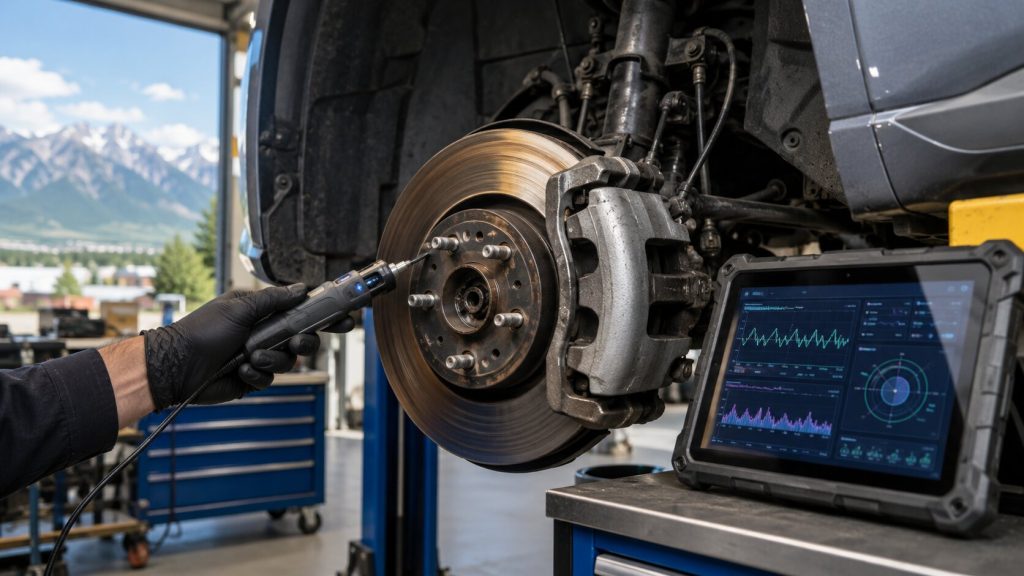
I use advanced shop diagnostics to pull real-time brake line pressure and thermal data before a vehicle ever makes an audible sound. I analyze live Electronic Stability Control telemetry to catch subtle friction losses on the communication bus by tracking your daily Utah driving patterns and wheel speed deviations. This live data highlights degrading pads and misaligned rotors well ahead of any traditional mechanical dashboard warning.
Why Your Commute Down Parleys Canyon Accelerate Virtual Wear Alerts
I am standing in the service bay pulling live telemetry from a luxury SUV that commutes daily down Parleys Canyon on Interstate 80. While factory manuals estimate a 30000-mile brake pad life, dropping thousands of feet of elevation into the Salt Lake Valley completely invalidates those assumptions. Modern telemetry platforms replace physical mechanical wear indicators with virtual wear algorithms embedded in the central gateway. The central gateway builds a live simulation of actual pad breakdown by reading real-time driving data straight from the network bus.
Reading the Thermal Spikes in Your Brake Control Module
Every time a driver descends Parleys Canyon, the Electronic Stability Control module translates logging duration, clamping force, and deceleration rates into calculated thermal energy. Sustained mountain braking quickly exceeds 600°F, causing pad outgassing and micro-cracking that triggers a predictive fault long before a dashboard light illuminates. When the algorithm notices it takes an extra 3 Bar of brake line pressure to hit the baseline stopping rate over 500 cycles, it automatically flags an accelerated wear pattern. This software-driven tracking catches friction material degradation well before traditional hardware fails.
Is it a Worn Pad or Salt-bitten Caliper Pins From Winter
I pull the front wheel off the hub assembly and immediately inspect the caliper slide pins. Even in mid-July, the hardware is fighting residual winter road salt and magnesium chloride from Interstate 15 that has dried into a gritty paste inside the rubber guide boots. When these slide pins seize, the caliper cannot release cleanly, forcing the inboard brake pad to remain pressed against the spinning rotor surface. This creates a silent, continuous friction drag that the driver cannot hear or feel, yet the vehicle constantly fights the mechanical resistance.
How Rolling Resistance Metrics Expose Binding Hardware
While an ordinary technician might look at 6 millimeters of pad material and think everything is fine, I hook into the gateway to check live rolling resistance data. The predictive algorithm monitors how the vehicle coasts, cross-referencing wheel speed down to a fraction of a single revolution per minute. When the Electronic Stability Control module detects a wheel decelerating faster during an off-throttle cycle with zero hydraulic line pressure, it flags a dragging caliper. This allows the software to isolate mechanical binding purely by checking the parasitic drag of lingering winter road residue.
Managing Extreme Asphalt Heat Along the Wasatch Front
The ambient temperature outside is hovering at 102°F, but radiant surface heat along the Point of the Mountain corridor on Interstate 15 easily surpasses 130°F. This extreme heat leaves the brakes completely heat-soaked before they even clamp down on the steel rotors. A heavy stop-and-go commute from Draper into downtown Salt Lake City under these conditions creates severe thermal stress because the metal cannot shed heat effectively into the thin mountain air. When high-speed deceleration occurs over these blistering baseline temperatures, the friction material experiences severe structural shear stress.
Predicting Rotor Distortion Before Pedal Pulsation Begins
When a blistering hot rotor encounters rapid cooling from a localized summer cloudburst or an immediate undercarriage car wash, the cast iron undergoes severe thermal shock. This rapid contraction causes micro-structural changes leading to lateral runout, commonly known as rotor warping. Long before the driver ever feels the pedal vibrate, the predictive system catches the issue by monitoring high-frequency wheel speed fluctuations during light braking. When the rotor develops even a 0.02-millimeter thickness variation, the brake pads ride over that tiny metal hill, creating microscopic hydraulic line pressure fluctuations that the sensor array catches as an active geometric failure.
Verifying Diagnostic Data and Caliper Performance
A digital dial indicator is mounted against the inner face of the rotor to confirm the scan tool’s findings. The factory software architecture utilizes specific data channels to report advanced vehicle health analytics.
Caliper bracket bolts are locked down to the exact factory specification of 110 Nm using a torque wrench. Definitive proof is found on the diagnostic scanner pressure release curves, where a healthy system should drop to exactly 0.0 Bar within 150 milliseconds of releasing the pedal. Diagnostic data from this Utah commuter vehicle reveals a residual pressure of 0.8 Bar persisting for over 3 seconds post-release.
The electronic control module has logged this specific latency for two weeks, continuously adjusting its pad life calculation downward. This smoking gun data confirms that extreme heat-soak combined with winter road salt buildup has triggered the early virtual service alert weeks before the mechanical wear indicator ever touches the rotor face.
To keep your vehicle stopping accurately on severe mountain grades, contact Steve’s Automotive Specialist at 2809 S 2300 E, Salt Lake City, UT 84109 for an advanced system analysis.
Frequently Asked Questions
Can predictive braking software tell me exactly when my pads will fail?
Yes. The predictive software evaluates your specific driving habits and regional route history to forecast a highly accurate service window. By analyzing line pressure and thermal patterns over time, the system projects remaining pad life weeks before physical wear components make contact with the rotor.
Do extreme summer temperatures affect brake sensor accuracy?
No. Extreme summer heat never degrades sensor accuracy because the control module continuously adjusts for ambient temperatures. The software injects radiant asphalt heat values directly into its virtual wear models to accurately track real-world pad breakdown.
Can road salt cause a brake warning light to turn on?
Yes. Road salt can cause a predictive system warning by corroding electrical harness connections or seizing mechanical caliper slides. When slide pins bind, the system detects continuous parasitic drag and logs a virtual wear fault due to accelerated thermal accumulation on that specific wheel.
Is a predictive brake alert the same as a traditional dashboard warning light?
No. A predictive brake alert triggers inside the vehicle communication gateway well before a traditional dashboard light illuminates. The algorithm identifies abnormal wear patterns, sensor variances, and fluid pressure lags early, allowing technicians to resolve mechanical binding before the friction material is completely gone.
Should driving habits be changed down Utah canyons to save brakes?
Yes. Utilizing your engine transmission downshifts to control your speed down steep canyon grades reduces continuous brake application. Minimizing duty cycle frequency curtails transient thermal excursions and associated friction material outgassing, thereby preventing the predictive diagnostics from migrating to an accelerated wear trajectory.