
Advanced Driver Assistance Systems depend on the seamless integration of digital perception and mechanical execution. While software identifies road hazards, the physical brake system must translate that command into immediate force. Precise sensor calibration and hydraulic integrity are essential to ensure your vehicle executes critical emergency maneuvers without dangerous latency.
The Dependency of ADAS on Mechanical Brake Health
I have spent enough time under vehicles to know that software is only as good as the hardware executing the command. When a collision avoidance system signals an emergency stop, it expects the hydraulic system to reach peak clamping force in a specific number of milliseconds. If your brake fluid is old or contaminated with moisture, it becomes compressible and introduces a subtle, dangerous latency. While a human might intuitively compensate for a soft pedal during routine driving, the computer expects an immediate and linear pressure rise. When the fluid cannot deliver that instant spike, the vehicle overshoots the target, rendering the sophisticated sensor array less effective.
Why Sensor Calibration Matters After Minor Glass Repairs
Many drivers assume that lane assist systems are plug and play, but they are not. Even a shift of one degree in a front facing camera after a simple windshield replacement changes how the car calculates stopping distance and lane boundaries. These sensors are incredibly sensitive to alignment, and any deviation causes the computer to receive distorted data that leads to ghost braking.
When the camera is not perfectly calibrated, the system loses its spatial awareness. This results in either an oversensitive system that triggers without cause or a delayed response when the system should be engaging to prevent a genuine collision. Professional calibration is a precise physical adjustment that keeps the vehicle within the manufacturer safety tolerances.
How High Altitude and Heat Affect Brake Fluid Response
Utah driving is exceptionally hard on hardware due to our combination of steep canyon grades and extreme summer heat. Most manufacturers suggest long intervals for brake fluid maintenance, but that advice ignores the reality of boiling fluid during a prolonged descent down canyons like Parleys. Extreme heat reduces fluid viscosity, which slows the reaction time of ABS solenoid valves and undermines the reliability of your safety system. When the fluid breaks down, it creates microscopic gas bubbles that compromise the hydraulic pressure necessary for modern electronic braking. I often see vehicles in this region that require much more frequent service because the heat cycles we experience degrade the chemical composition of the fluid far faster than the service manual anticipates.
The Difference Between Manual Specs and Real World Conditions
Standard service manuals establish a broad baseline, but they fall short of compensating for the severe atmospheric pressures and thermal loads typical of our high-altitude desert terrain. Relying solely on factory intervals often leaves a critical gap in your vehicle’s defensive capabilities.
My experience on the shop floor reveals that the moisture content in brake fluid rises significantly faster in our climate compared to the standardized conditions used by automakers for their testing. Ignoring this reality is a gamble with the very safety features you rely on during your daily commute along the I-15 corridor.
Identifying the Jitter in Your Electronic Braking System
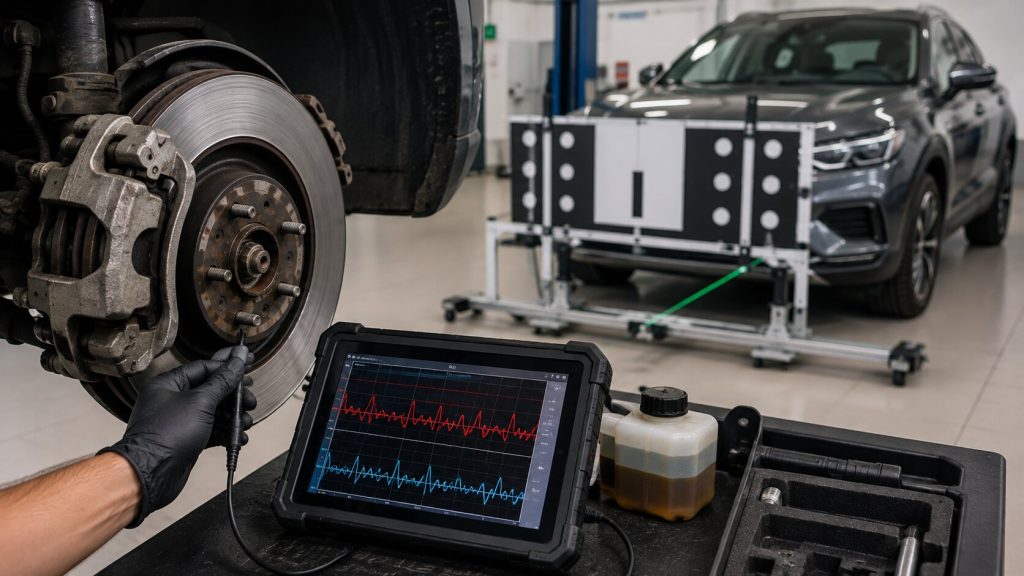
I am currently hooking up a diagnostic scanner to a client vehicle that displayed a warning light after a hard stop. By comparing ECU command requests against actual hydraulic pressure readings, I can spot performance gaps. A healthy system tracks with precision, while a failing system reveals itself through the clear jitter captured on the diagnostic scanner.
This jitter is a telltale sign that the wheel speed sensor is sending fragmented data or that the hydraulic modulator is struggling to clear air from the lines. When the mechanical braking response fails to mirror the computer’s projected pressure curve, the resulting gap signifies a disconnect between digital intent and mechanical reality.
Why Variance in Pressure is a Major Safety Concern
When I see a variance of even 5 bars during an emergency test, I know the safety system is compromised. The computer initiates brake pulsing, yet the mechanical feedback fails to mirror the anticipated pressure curve. This is the smoking gun that proves why an ADAS feature might fail to trigger exactly when you need it most.
Even with fully functional sensors, a system is compromised if the hydraulics cannot uphold the pressure required for emergency braking. My expertise lies in aligning electronic requests with actual rotor performance, pinpointing the mechanical instabilities that persist even after full software optimization.
Maintaining Precision in Your Advanced Safety Systems
Modern safety features are fundamentally dependent on the physical condition of your braking components and the precision of your sensors. If your brake pads are thin or the hydraulic system is contaminated, the computer cannot apply the necessary stopping force to keep you safe. I don’t separate the software from the hardware; if the hydraulics are sluggish, the computer is just guessing.
Bring your vehicle to Steve’s Automotive Specialists at 2809 S 2300 E, Salt Lake City, UT 84109 for the professional calibration and maintenance required to keep your systems synced. With a thorough understanding of the stresses Utah’s terrain places on your hardware, we provide the specialized care needed to keep your vehicle performing reliably.
Frequently Asked Questions
Does a windshield replacement affect my ADAS safety features?
Yes. Replacing a windshield directly impacts the calibration of your forward facing cameras. Because these sensors are mounted to the glass, even slight movement or the use of non OEM glass can distort the optical path, leading to incorrect distance calculations and potential failure of your automatic emergency braking.
Do you need to flush your brake fluid more often in Utah?
Yes. The combination of high altitude and steep mountain driving significantly increases the thermal load on your brake system. Extreme heat cycles accelerate brake fluid degradation and moisture absorption, resulting in a spongy pedal feel and sluggish response from your essential safety systems.
Can a minor bumper bump disable my lane assist?
Yes. Even a minor impact can shift the alignment of radar sensors hidden behind your bumper. Modern ADAS relies on these sensors to detect road markings and surrounding vehicles with millimeter precision. If the hardware is slightly out of alignment, the system may provide false warnings or fail entirely.
Does mechanical wear affect my car computer?
Yes. Modern safety features are fundamentally dependent on the physical condition of your braking components. If your brake pads are thin or the hydraulic system is compromised by air or old fluid, the computer cannot apply the necessary stopping force to keep you safe during an emergency.